



Note : Another interpretation of the J-port is to cut the secondary port beyond the o-ring groove, just short of the water-jacket.

| Generation | Series | Year |
| 1st generation | Series 1-3 | 1979 - 1985 |
| 2nd generation | Series 4-5 | 1986 - 1992 |
| 3rd generation | Series 6 | 1993 + |
| Engine | |
Description | Approx. HP |
| 13B 6Port | |
The size of standard intake ports varied somewhat depending on markets and time. The port seen here is quite a large standard port. | 130-160hp |
| 13B Extend Port | |
Also known as Street Port, Mild Port. This porting design enlarges the port marginally giving more top end power with slightly less bottom end (much like a mild cam in a conventional motor). Original carb and exhaust can be retained (with only a slight loss in power), and the vehicle will be very drivable in every day traffic. | 160-180hp |
| 13B Bridge Port |
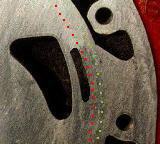
| Bridgeporting is possibly the most popular form of porting. Substantial power gains can be made at relatively low cost, whilst maintaining engine lastability. In order to obtain the maximum potential of the engine the standard carb must be replaced with a high performance carb, and the exhaust with a high flow item. This porting style increase the inlet and exhaust port overlap greatly , causing the distinctive brapping idle. More mid-range to top-end power will be developed by a bridgeport, depending on primary and secondary port sizes. Note : the dotted green line in the picture denotes the appoximate position of the water o-ring on the plate, and the red dotted line denotes the edge of the rotor housing when positioned on the plate. | 200-250hp |
| 13B JPort |
| J-Porting is a little ambiguous in it's definition, so I'll try to give the
most logical definition, that I've heard.
A J-Port is a Bridgeport that has had the secondary port widened beyond the
edge of the rotor housing (see red dots on picture). This requires
the edge of the rotor housing to be cut just short of the water o-ring groove
to assist gas flow. Note : Another interpretation of the J-port is to cut the secondary port beyond the o-ring groove, just short of the water-jacket. |
240-280hp |
| 13B Monster Port |
| A Monster Port is the most radical of the porting designs. It is similar to the Bridge and J Ports, but due to the size of the secondary port, a large amount of the rotor housing must be cut into the water jacket, and filled to prevent water leakage. A gap must be cut in the water o-ring and sealed off. The purpose of the motor was to dodge rules preventing peripheral ports in competition racing. Engine life is greatly reduced to about 6 months (usually water leaking into the motor). | 280+hp |
| 13B Peripheral Port |
| A Peripheral Port involves blocking the side intake ports with devcon (or similar) and cutting a large port (similar to the existing exhaust port) in the rotor housing. Although this engine will last better thant the Monster Port, torque at low engine RPM in virtually non-existant and idle speed is 2000+RPM. | 300+hp |