
 1992: Ford-Cosworth Debut Engine  Newman/Haas XB |
Ford Ford Motor Company(USA) Factory: England, UK First Champ Car Engine: XB(1992) First Champ Car Win: 1992 World Championships: 2 1999 Engine: XD 1999 Teams: Newman/Haas, Patrick, Payton/Coyne, Rahal As seperate manufacturers, Ford and Cosworth has been part of 17 World Championship titles. Ford and Cosworth formed a partnership in European racing in 1959. However, it wasn't until 1992 did the Ford-Cosworth name appear in the World Championship. The new partnership was immediately successful, winning in its first year and nearly taking the title. The manufacturer did take the championship the next year with Nigel Mansell piloting a Lola T93/00. Ford-Cosworth's quick success proved short lived. Both Honda and Mercedes-Benz have surpassed the blue oval marque by estimation, but only just. At the end of the 1998 season, Ford bought out the racing division of Cosworth Engineering after Volkswagen took over the rest of Cosworth in a deal to obtain the Rolls-Royce name. For 1999, Ford will continue to use the XD engine. Ford Official Ford website |
 1994: Honda Debut Engine  Rahal/Hogan Racing Honda V8 |
Honda Honda Motor Company(Nippon) Factory: California, USA and Honshu, Nippon First Champ Car Engine: Honda V8(1994) First Champ Car Win: 1992 World Championships: 3 1999 Engine: HRS 1999 Teams: FCR, CGR, Green, Walker Honda had a rough time in its maiden season. It's engines were highly uncompetitive, contributing to Rahal/Hogan not qualifying for the Indianapolis race. Honda made a quick turnaround though, winning its first race the next year. By its third year, it became the best engine in the series, duly taking its first World Championship. Honda Performance Developement, located in Santa Clarita, USA, is in charge of the company's World Championship program. With its championship title of 1996, it marked the first time since 1976 when a USA built engine won the World Championship. In addition to HPD's work, Honda R&D Tochigi Center in Shimotakanezawa, Nippon also participates in the design and manufacturing of the new HRS engine for 1999. Honda Racing Official Honda Racing website Honda Official Honda website(USA) Honda Motor Sports Official Honda Racing website(Nippon) Twin Ring Motegi Official Twin Ring Motegi website(Nippon) |
 1994: Mercedes-Benz Debut Engine  Team Penske 500I |
Mercedes-Benz Daimler-Chrysler Aktiengesellschaft(Deutschland) Factory: England, UK First Champ Car Engine: 500I(1994) First Champ Car Win: 1994 World Championships: 1* 1999 Engine: IC108E 1999 Teams: Bettenhausen, Forsythe, Hogan, PacWest, Penske Mercedes and Benz began its involvement during the pre-championship years with private teams running their cars. In 1923, an official factory Mercedes team entered the Indianapolis race, and there would be a 71 year wait for a return to the World Championship by the Mercedes name. In 1926, Mercedes and Benz would merge, and in 1994, a merger with the Ilmor engine manufacturer would bring them back. Although Mercedes-Benz merged with Ilmor, political reasons kept the manufacturer from entering the World Championship in 1994, at first. Because Ilmor's engine for 1994 was based on the Ilmor built Chevrolet engines, it was politically unfeasable for a Chevrolet derived engine to be called a Mercedes. Therefore, the 1994 engines would be called the Ilmor D engines. However, using the USAC rules for the Indianapolis race, Ilmor was able to produce an Indianapolis only special engine. Because this was not derived from the Chevrolet engines, it could be badged as a Mercedes. Not only did this engine qualify on pole easily, but it also dominated the race. Unfortunately for the manufacturer, despite strong engines made since 1995, no Mercedes-Benz cars have won a World Championship. For 1999, Mercedes-Benz will continue to use the IC108E debuted in 1998. Mercedes-Benz Official Mercedes-Benz website Mercedes-Benz Official Mercedes-Benz website(USA) *- Although Al Unser Jr. won the 1994 World Championship, only 1 win was contributed by Mercedes-Benz. The other wins were credited to Ilmor. |
 1996: Toyota Debut Engine  All American Racers RV8A |
Toyota Toyota(Nippon) Factory: California, USA and Honshu, Nippon First Champ Car Engine: RV8A(1996) First Champ Car Win: - World Championships: 0 1999 Engine: RV8D 1999 Teams: AAR, Arciero-Wells, Della Penna, Gordon Being Nippon's largest automobile manufacturer, it comes as a surprise that its World Championship engine is still uncompetitive, especially compared to its chief rival, Honda. However, Toyota falls way behind Honda in terms of experience in formula car racing. While Toyota has made big improvements since its first engine in 1996, it is still a distant fourth among the four engine manufacturers. California based Toyota Racing Development USA is in charge of the company's World Championship effort. As pressure mounts, TRD Nippon is also increasing its participation. The new RV8D has improved power and reliability than for 1999, and a new RV8E will debut sometime in the middle of the year. Besides the RV8D Championship Car engine, the manufacturer also makes the spec 4AGE engine for CART's Formula Atlantic Championship. Toyota Official Toyota website Toyota Motor Sports Official Toyota Racing website(Nippon) |
  |
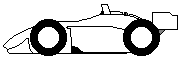
Owner: Dan Gurney Chief Designer: David Bruns Factory: Santa Ana, California, USA First Champ Car: 1966 First Champ Car Win: 1966 World Championships: 2 1999 Chassis: Eagle 997 1999 Team: All American Racers The Eagle is the chassis name of AAR built cars. With a storied history including 2 World Championships, the Eagle name first appeared in Formula One. After competing mainly in sports car racing for 10 years, the Eagle returned to the World Championship in 1996. 1996's Eagle Mk V proved dissapointing, forcing the AAR team to use Reynards in 1997. A new Eagle chassis, the 977, was completed in mid 1997, but it was also dissapointing, and was never even tested. AAR surprised everyone with the introduction of the Eagle 987 at round 13 of the 1998 World Championship. The radical new Eagle proved competitive immediately, setting faster times than the other Toyota powered Reynards. The 987 utilizes a 1998 Reynard gearbox. For 1999, an updated car has been produced, dubbed the 997. |
  |
Lola Cars International
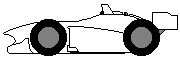
Owner: Martin Birrane Vice President: Keith Wiggins Chief Designer: Ben Bowlby Factory: Huntingdon, England, UK First Champ Car: T80(1965) First Champ Car Win: 1966 World Championships: 6 1998 Chassis: Lola B99/00 1998 Teams: Hogan, Payton/Coyne Lola Cars was one of the world's larget and most successfull race car producers. The company enjoyed enormous success since CART was formed, winning 6 World Championships. That all changed with the 1997 season with the highly unsuccessful T97/00. It was later during the 97 season that Lola found the problem, a miscalibration of the wind tunnel used during the design process. But it was too late for Lola to save its customer base. A struggle over control of the company resulted in Ireland's Martin Birrane taking over. Keith Wiggins(formerly with Pacific) and Frank Dernie(formerly with Arrows) has come to the team in hopes of rejuvinating the company. For 1999, the Lola's numbering system has changed to B--/-- rather than the traditional T--/--. Besides the B99/00, the constructor also makes the T97/20 for CART's Indy Lights Championship. |
  |
Penske Cars
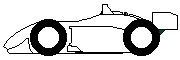
Owner: Roger Penske Chief Designer: John Travis Factory: Poole, England, UK First Champ Car: ? First Champ Car Win: 1978 World Championships: 8 1999 Chassis: PC27B 1999 Team: Team Penske Penske is the only team currently using its own chassis. The Penske Car record in the World Championship has seen its ups and downs. The constructor hit the low in the late eighties, forcing Team Penske to use March cars. Still, it has survived through difficult times and its Championship record is the best amonst the current competitors. The new PC27B car is an updated version of the 1998 car. Although the PC27 occasionally showed great potential, it often encountered reliability and handling problems. |
  |
Reynard Racing Cars
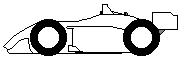
Owner: Adrian Reynard Chief Designers: Barry Ward Factory: Bicester, England, UK First Champ Car: 94I(1994) First Champ Car Win: 1994 World Championships: 4 1999 Chassis: 99I 1999 Teams: Arciero-Wells, FCR, Forsythe, CGR, Green, PacWest, Rahal, Walker 1998 Chassis: 98I 1999 Teams using 98I: Bettenhausen, Gordon, Patrick, Payton/Coyne 1997 Chassis: 97I 1999 Teams using 97I: Patrick Entering the World Championship in 1994 with Chip Ganassi Racing as its "factory team," the constructor incredibly won in its debut race. That outstanding form was followed quickly with its first World Championship the following year. Since its arrival, Reynard has beaten Lola to take a vitual monopoly with the customers. The newest 99I is another car based on its debut 94I. Due to concerns over its participation in Formula One starting in 1999, several teams have left Reynard. Reynard Racing Cars Official Reynard website |
  |
Swift Engineering
Owner: Hiro Matsushita Chief Designer: Mark Handford Factory: San Clemente, California, USA First Champ Car: 007.i(1997) First Champ Car Win: 1997 World Championships: 0 1999 Chassis: 010.c 1999 Teams: Newman/Haas, Patrick, Della Penna The newest constructor to enter the World Championship, this constructor is owned by driver Hiro Matsushita, who acquired it from designer David Bruns. With the resources of Newman/Haas behind them, the initial car won in its debut race. Prior to 1998's Nazareth Grand Prix, David Bruns, chief designer of the 007c and 009.c left the company for All American Racers. Disagreement over management with the company president, Alex Cross, seemingly caused the break up. This made Mark Handford the new chief designer for Swift. Besides the 010.c Championship Car, the constructor also manufactures the 008.a for CART's Formula Atlantic Championship. |
This "Equipment" page first created on April 28, 1998.
Version 2 created on April 30, 1999.
Last modified on April 30, 1999.