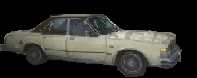
"She may not look like much kid, but she's got it where it counts." � � � � � � � � � � � � � � � � � � � � � � �- Han Solo, Star Wars
Where does one find a derby car?
Well, I for one, am not made of money. A lot of folks do a lot of different things to obtain derby cars. Some have contacts with junk yards, others comb the country side searching for derelicts sitting in someone's barn. What have done in the past is buy an old clunker as an everyday driver and drive it around until it is no longer road legal. Then it becomes a derby car. Most of my cars were obtained this way. As I have a little more finacial swing this method of getting cars is not really viable anymore. Besides, if I brought home one more trashcan everyday driver my wife would kill me. I know of at least one junk yard that sells derby cars for $100 during the season. I also have made it a habit of combing through the local Want-Ad for parts cars that may be drivable. The only problem with that is when someone has a parts car, particularly an older one, they think they are sitting on a gold mine and are asking for a lot of coin for their wreck. That leads to yet another issue for someone in the New England area looking for a car to wreck. Unlike the midwest, the northeast (particularly MA, RI) just doesn't have great quantities of old cars lying around. The trick, is to just keep an eye out during your daily travels. You just may see a car sitting in a lot, or in someones yard. Just leave a note on it with your number. And if worse comes to terrible, just hit up your local junk yard. They're bound to have something running for cheap. As a rule, I won't pay more than $200 for a derby ride and up until now I haven't even had to go that high. There are cheap rides out there, it's just a matter of looking hard enough. I Have a Suitable Ride, Now What Do I Do? There are over 750 derbies held in the U.S. and there are over 750 different sets of rules to build your car to. It's EXTREMELY important that you obtain a set of rules for the race you are building your vehicle for and study them. What is legal at Derby A may not pass inspection at Derby B. The one thing that most derby promoters stress above all is saftey. Derbys aren't much fun if folks are getting killed. I, by definintion, am still a small fry when it comes to derbying. Some of the guys I know race all year long. They drag cars across the country to compete in every race in their region. Me, I mainly stick to one set of races for now. Up until this year, I have had no trailer of my own so I had to pay someone to haul my car to the derby and that get's real expensive and annoying. I drive in the Brockton-Middleboro Fair , sponsored by JM Productions , which is kind of cool, because they hold derbies and other off the wall automotive events for almost a whole week. The rules there are for very stock cars. It keeps it cheap for the newbies. What Kind of Cars Are Allowed? By Rule, any American made 2 or 4-door hardtop weighing between 2800lbs and 4800lbs (manufactured weight) is allowed. All station wagons and sedans over 4800lbs are lumped into their own category better known as the "Heavy Weights". If you have a big car they may be over the weight limit or a station wagon then you have to find out what the officials are doing about the heavies for that season, as it changes. Brockton has started running compact heats as well. Any vehicle under 2800lbs, with the exception of AWD, 4WD, and Pontiac Fiero's. Those little cars are a blast to watch. Ok, you have a car and now you want to build it by the Brockton Fair's rules... Pre-Building Stuff The first thing I do is I give the car a good tune up. Change/or clean the plugs and wires, change the oil, you know 'stuff'. I try to get the engine running as smooth as I can. Once the car is running relatively ok, I then turn the idle up a couple notches. This assures that it won't stall due to a low idle setting. (this happens more often than you think.) Strip That Car!! By rule you must strip all of the following off the car: soft chrome Trim Inner door panels hood ornements Side mirrors wheel covers lights Freon all glass the rear seat (both cushions) headliner visors rugs With a good wrecking bar, removing most of the above is a cinch. Use a sharp razor knife to cut the rug away. The rear seat can be somewhat of a pain to remove. On most cars, the top cushion is welded to the body. The bottom cushion should come out fairly easy by pulling the back up first. I use a wrecking bar to wedge it between the top cushion and the body and pull it away from the body. A torch or Sawz-All should be more than adequate to cut through the mounts that hold the rear cushion on. Don't throw the cusions away just yet though, we'll need them later on. The glass is the trickiest thing to remove and there are several proven methods to do so. The side windows are easy to remove. Most are held on by a series of screws. Once the door panels have been removed, these are easy to get at. The windshield can be tough, but you don't have to worry about shattering it. In my opinion, the hardest window to remove is the rear window. It isn't made from the shatter-proof glass that the windshield is made of, so you have to use caution. The Windshield and The Rear Window There are several methods to removing the windshield and rear window. I've used all of them. Kick it it out. It's a mess, yet effective. Wear heavy boots if you do this. Sawz-All it out. When you've cut the windshield out you can then take a sharp paint scraper and scrape out the remaining glass and sealant. Park the car facing the sun so that it gets the adhesive sludge nice and soft and work a peice of cable or wire (The hood latch cable is wonderful for this) through the edge of the glass, through the adhesive and have a buddy get on the other side of the windsield and each of you grab an end and saw back and forth through the adhesive. This is the cleanest way of doing things. Beware though, That cable will get hot and break so have some backups available. Electrical The rules state that the battery MUST stay under the hood and forward of the firewall, but that you can relocate it. You can modify the ignition in any way you see fit providing that the actual ignition switch (the thing you turn in 'normal' cars) must be within 16 inches of the steering wheel. Me, I hate car electronics. A lot of guys will take a good factory ignition setup and trash it in favor of their own. To each is own, I say. The only reason that I would mess with the ignition is if I had a car without a key (which happened this year ironically). Besides minor things like moving any overly exposed ignition relays and such, I generally stick with the stock ignition if I can. As I mentioned before, I had no key to my 1999 car so I had to get creative. I still wanted to avoid having to rewire the whole ignition, so what I did was I cracked the column open with my rusty, trusty wrecking bar and tore the ignition out. Then, over dinner, I modified it to accept a different key (Read "Modify" as I busted the lock cylinder sufficiently to accept ANY key I used) and wired and taped it back onto the column. Worked like a charm. I learned my lesson the hard way when it came to battery placement. It is true that if you leave your battery in the stock posistion that it will be the first thing they hit. There are a lot of different therories as what protects a battery best. Some encase the battery in a steel battery box, while others use a wooden one. I for one, think that a steel battery box is asking to short your battery out. A wood one is a lot better, as wood does nothing to short a terminal out. Unfortunately, when the rules tell you to keep the battery forward the fire wall, that kind of limitates what kind of box you use. You can still use a box, but I find that it severly reduces the amount of space under the hood and represents (especially in the case of a metal box) a large, unmoving target. I have a different off the wall, oddball theory that has worked for me for years. I think the battery should have enough protection from flying debris and hard impacts, but I think it should have the ability to roll with the punch as well. If you have your battery in a box and someone slams your side hard enough to hit the box, then the box, which is securely mounted, tries to resist the blow, which obviously it won't because a car is a bit bigger and stronger. But with my idea, the car creates a dent that touches the battery area, the battery should be able to move with the blow rather than resist it. What I do is I remove the AC unit, but I keep the fiberglass case that houses it. The fiberglass case usually needs modification in order to fit the battery. This is easily done with a hammer. You give the bottom of the case a wooden bottom and you secure the battery in place with up to 4-6 tarp straps or bungees (tarp straps are better). I then take some leather sheets and put them around the battery and then cram as much stuffing (i.e. cushing foam) as I can fit. This may seem like an backwards way of doing it, but it has worked for me for 4 years. You really should take the time to remove any and all excess wiring from the car. Also, the fuses that aren't needed to start the car should be removed as well. Any one of those loose wires can short the the electrical and leave you feeling real pissed. Also... very important. Remove the wire harness from near the gas tank. You don't want anything that creates a spark own there. Body Work The rules regarding what can be done to the body are pretty strict up here. I know that in other parts of the country one can take your everyday old junk car and convert it into a sherman tank. Not so at Brockton. The bodies, for the most part, remain stock. Here are the main body areas and what you can and cannot do to them. Frame NO WELDING. You cannot modify the frame in anyway. Bumpers There is no rule saying that you have to use the stock bumper, so I suppose you can use a different one. I've never done it. You can attach your bumper to the frame in any way that does not reinforce any other part of the car. The Doors All doors must be chained or wired shut. Only the drivers door may be welded and even then they can only be like 1/4 inch welds. You can reinforce the drivers door in any manner that does not reinforce any other part of the car. I use a wire/duct tape combination that's pretty rock solid. Trunk and Hood The trunk must be wired or chained down in at least one spot and no more than 2. There is a minumum of three wraps of wire if you choose wire, but if you are using a thinner guage wire then they'll let more slide. If chain is used, the maximum size chain can be 1/4 inch links and there must be 1 link worth of slack. You cannot use all-thread anywhere. A hole must be cut into the hood, about 8 inches from the center of the carb and no more than a foot across. Quarter Panels You cannot cut any metal from the quarter panels or wheel wells. You can beat the snot out of the fender with a sledge hammer. Also, if the car has been derbied, you can cut some metal away from the QP's, but I would suggest that you don't go nuts with the air shears. Other You can crease the trunk, the roof, and anything else really as long as you don't obviously reinforce anything. You can have a rollcage. Fuel The rules concerning fuel are controversal and have been the subject of some hot debates. My thoughts are that if the rules require the stock tank stay then that's what I'll do to drive. If they tell me to remove the tank, then the tank is gone. That's right folks, the stock gas tank must remain in place and be used. It sounds dangerous, I know, but I've really put a lot of thought into it and I believe that it is not. The rules require a sheet-metal screw to be placed into the side of the tank, no more than 3 inches from the lowest portion of the tank. The purpose of the screw is twofold. First, it lets the officials moniter how much fuel is being carried (There is a 3 gallon limit) and secondly, it prevents the tank from pressurizing itself. You see, when you turn your engine over, the first thing that happens is your fuel system pressurizes the tank. What makes a gas tank dangerous is pressurized gas fumes. They explode. That's the big fear that everyone has; that they'll explode as soon as the tank takes a hit. But, you poke a hole in the tank and the fumes aren't allowed to come under pressue. Let me give you an example. I'll use an example that ALL derby folks know: Beer. You take a fresh, unopened beer and you punch a hole in it and what happens? Prescious beer splatters everwhere explosively. Now take that same fresh beer and open it, then punch a hole into it. Can you guess what happens next? Beer just dribbles out of the hole. The gas tank does the same thing. In five years I have never seen anyone get hurt from fire or even seen a serious fire from using the fuel tank. Also, you must chain the tank up through the truck floor and you may place a protective cover over the tank no more than 3/16 of an inch thick. This covering may be made of rubber, plastic, or metal. Exhaust It's pretty cut an dry here. The exhaust must extend at least to the drivers seat, so no exhaust stacks. You really should cut the exhaust before the axle as I have seen it way too many times where the exhaust gets pinched and kills the engine or you get stuck your own exhaust pipe. It's easy to do. All you need is a Sawz-All and a steady grip. Tires Any 12-14 ply car tire on the stock sized rim is ok. In other words you can't throw 16 inch rims on a car that normally came with 15 inch ones. You cannot run a tire within a tire, but you can run tubes. Neither tube nor tire may be filled with anything but air. Wheel weights on your drive tires must be removed and they don't allow recaps on the drive tires. Air pressure can at 35 psi maximum. Suspension Stock is key. The car must go down about 6 (I think) inches under the weight of one man. Cars with frozen suspensions will be tossed. Mopars with the adjustable torision may extend the adjustment halfway. Transmission Again, it's pretty cut and dry here. You cannot modify the stock gear gear shifting setup. You can strengthen the tranny linkage in any way you see fit, but the gear shifter has to remain in place, be it on the the floor or on the column. Also, your differential has to remain stock, so no welding up your spider gears. However, if the stock differential was posi then you're all set. The tranny cooler lines can be modified or looped into themselves. Any transmission coolers must be under the hood. Cooling The radiator must remain in it's stock posistion. All the antifreeze must be replaced with water. Now the rules don't make mention of having to flush the cooling system, so I just empty the radiatior and fill that with water. So there is still a bit of coolant in the engine block to mix with the water. I usually leave the radiator cap screwed to it's first posistion so that the coolant doesn't come under as much pressure. Safety You must have an over the shoulder seat belt. The stock type is fine. You can bolt one through the roof if need be. You can also put a 5-point harness in if you wish. Remember I told you to save the seat cushion? You take that cushion and cut it up and wire it around where you'll sit, particularly on the door frame, the two posts closest to you, and maybe the steering wheel. You'll be glad that you did. I didn't once and I couldn't walk right for a week. End Thoughts It sounds like a bit of work, but you'll find that a couple friends plus yourself can get this done easily in about a weekend for a quickie job, but it will take longer if you want the car to last. Building the car is truly half the fun. The whole family can be involved in the building of a car. A lot of the veteran drivers from other parts of the country will probably notice that the rules are fairly strict compared to where they drive. Just keep in mind all the other cars were built in a similar fashion, so usually it ends up coming down to who's the better driver.
There are over 750 derbies held in the U.S. and there are over 750 different sets of rules to build your car to. It's EXTREMELY important that you obtain a set of rules for the race you are building your vehicle for and study them. What is legal at Derby A may not pass inspection at Derby B. The one thing that most derby promoters stress above all is saftey. Derbys aren't much fun if folks are getting killed.
I, by definintion, am still a small fry when it comes to derbying. Some of the guys I know race all year long. They drag cars across the country to compete in every race in their region. Me, I mainly stick to one set of races for now. Up until this year, I have had no trailer of my own so I had to pay someone to haul my car to the derby and that get's real expensive and annoying. I drive in the Brockton-Middleboro Fair , sponsored by JM Productions , which is kind of cool, because they hold derbies and other off the wall automotive events for almost a whole week. The rules there are for very stock cars. It keeps it cheap for the newbies.
What Kind of Cars Are Allowed?
By Rule, any American made 2 or 4-door hardtop weighing between 2800lbs and 4800lbs (manufactured weight) is allowed. All station wagons and sedans over 4800lbs are lumped into their own category better known as the "Heavy Weights". If you have a big car they may be over the weight limit or a station wagon then you have to find out what the officials are doing about the heavies for that season, as it changes. Brockton has started running compact heats as well. Any vehicle under 2800lbs, with the exception of AWD, 4WD, and Pontiac Fiero's. Those little cars are a blast to watch.
Ok, you have a car and now you want to build it by the Brockton Fair's rules...
Pre-Building Stuff
The first thing I do is I give the car a good tune up. Change/or clean the plugs and wires, change the oil, you know 'stuff'. I try to get the engine running as smooth as I can. Once the car is running relatively ok, I then turn the idle up a couple notches. This assures that it won't stall due to a low idle setting. (this happens more often than you think.)
By rule you must strip all of the following off the car:
soft chrome
Trim
Inner door panels
hood ornements
Side mirrors
wheel covers
lights
Freon
all glass
the rear seat (both cushions)
headliner
visors
rugs
With a good wrecking bar, removing most of the above is a cinch. Use a sharp razor knife to cut the rug away. The rear seat can be somewhat of a pain to remove. On most cars, the top cushion is welded to the body. The bottom cushion should come out fairly easy by pulling the back up first. I use a wrecking bar to wedge it between the top cushion and the body and pull it away from the body. A torch or Sawz-All should be more than adequate to cut through the mounts that hold the rear cushion on. Don't throw the cusions away just yet though, we'll need them later on.
The glass is the trickiest thing to remove and there are several proven methods to do so. The side windows are easy to remove. Most are held on by a series of screws. Once the door panels have been removed, these are easy to get at. The windshield can be tough, but you don't have to worry about shattering it. In my opinion, the hardest window to remove is the rear window. It isn't made from the shatter-proof glass that the windshield is made of, so you have to use caution.
The Windshield and The Rear Window
There are several methods to removing the windshield and rear window. I've used all of them.
Kick it it out. It's a mess, yet effective. Wear heavy boots if you do this.
Sawz-All it out. When you've cut the windshield out you can then take a sharp paint scraper and scrape out the remaining glass and sealant.
Park the car facing the sun so that it gets the adhesive sludge nice and soft and work a peice of cable or wire (The hood latch cable is wonderful for this) through the edge of the glass, through the adhesive and have a buddy get on the other side of the windsield and each of you grab an end and saw back and forth through the adhesive. This is the cleanest way of doing things. Beware though, That cable will get hot and break so have some backups available.
The rules state that the battery MUST stay under the hood and forward of the firewall, but that you can relocate it. You can modify the ignition in any way you see fit providing that the actual ignition switch (the thing you turn in 'normal' cars) must be within 16 inches of the steering wheel. Me, I hate car electronics. A lot of guys will take a good factory ignition setup and trash it in favor of their own. To each is own, I say. The only reason that I would mess with the ignition is if I had a car without a key (which happened this year ironically). Besides minor things like moving any overly exposed ignition relays and such, I generally stick with the stock ignition if I can. As I mentioned before, I had no key to my 1999 car so I had to get creative. I still wanted to avoid having to rewire the whole ignition, so what I did was I cracked the column open with my rusty, trusty wrecking bar and tore the ignition out. Then, over dinner, I modified it to accept a different key (Read "Modify" as I busted the lock cylinder sufficiently to accept ANY key I used) and wired and taped it back onto the column. Worked like a charm.
I learned my lesson the hard way when it came to battery placement. It is true that if you leave your battery in the stock posistion that it will be the first thing they hit. There are a lot of different therories as what protects a battery best. Some encase the battery in a steel battery box, while others use a wooden one. I for one, think that a steel battery box is asking to short your battery out. A wood one is a lot better, as wood does nothing to short a terminal out. Unfortunately, when the rules tell you to keep the battery forward the fire wall, that kind of limitates what kind of box you use. You can still use a box, but I find that it severly reduces the amount of space under the hood and represents (especially in the case of a metal box) a large, unmoving target. I have a different off the wall, oddball theory that has worked for me for years. I think the battery should have enough protection from flying debris and hard impacts, but I think it should have the ability to roll with the punch as well. If you have your battery in a box and someone slams your side hard enough to hit the box, then the box, which is securely mounted, tries to resist the blow, which obviously it won't because a car is a bit bigger and stronger. But with my idea, the car creates a dent that touches the battery area, the battery should be able to move with the blow rather than resist it. What I do is I remove the AC unit, but I keep the fiberglass case that houses it. The fiberglass case usually needs modification in order to fit the battery. This is easily done with a hammer. You give the bottom of the case a wooden bottom and you secure the battery in place with up to 4-6 tarp straps or bungees (tarp straps are better). I then take some leather sheets and put them around the battery and then cram as much stuffing (i.e. cushing foam) as I can fit. This may seem like an backwards way of doing it, but it has worked for me for 4 years.
You really should take the time to remove any and all excess wiring from the car. Also, the fuses that aren't needed to start the car should be removed as well. Any one of those loose wires can short the the electrical and leave you feeling real pissed. Also... very important. Remove the wire harness from near the gas tank. You don't want anything that creates a spark own there.
Body Work
The rules regarding what can be done to the body are pretty strict up here. I know that in other parts of the country one can take your everyday old junk car and convert it into a sherman tank. Not so at Brockton. The bodies, for the most part, remain stock. Here are the main body areas and what you can and cannot do to them.
Frame
NO WELDING. You cannot modify the frame in anyway.
Bumpers
There is no rule saying that you have to use the stock bumper, so I suppose you can use a different one. I've never done it. You can attach your bumper to the frame in any way that does not reinforce any other part of the car.
The Doors
All doors must be chained or wired shut. Only the drivers door may be welded and even then they can only be like 1/4 inch welds. You can reinforce the drivers door in any manner that does not reinforce any other part of the car. I use a wire/duct tape combination that's pretty rock solid.
Trunk and Hood
The trunk must be wired or chained down in at least one spot and no more than 2. There is a minumum of three wraps of wire if you choose wire, but if you are using a thinner guage wire then they'll let more slide. If chain is used, the maximum size chain can be 1/4 inch links and there must be 1 link worth of slack. You cannot use all-thread anywhere. A hole must be cut into the hood, about 8 inches from the center of the carb and no more than a foot across.
Quarter Panels
You cannot cut any metal from the quarter panels or wheel wells. You can beat the snot out of the fender with a sledge hammer. Also, if the car has been derbied, you can cut some metal away from the QP's, but I would suggest that you don't go nuts with the air shears.
Other
You can crease the trunk, the roof, and anything else really as long as you don't obviously reinforce anything. You can have a rollcage.
Fuel
The rules concerning fuel are controversal and have been the subject of some hot debates. My thoughts are that if the rules require the stock tank stay then that's what I'll do to drive. If they tell me to remove the tank, then the tank is gone. That's right folks, the stock gas tank must remain in place and be used. It sounds dangerous, I know, but I've really put a lot of thought into it and I believe that it is not. The rules require a sheet-metal screw to be placed into the side of the tank, no more than 3 inches from the lowest portion of the tank. The purpose of the screw is twofold. First, it lets the officials moniter how much fuel is being carried (There is a 3 gallon limit) and secondly, it prevents the tank from pressurizing itself.
You see, when you turn your engine over, the first thing that happens is your fuel system pressurizes the tank. What makes a gas tank dangerous is pressurized gas fumes. They explode. That's the big fear that everyone has; that they'll explode as soon as the tank takes a hit. But, you poke a hole in the tank and the fumes aren't allowed to come under pressue. Let me give you an example. I'll use an example that ALL derby folks know: Beer. You take a fresh, unopened beer and you punch a hole in it and what happens? Prescious beer splatters everwhere explosively. Now take that same fresh beer and open it, then punch a hole into it. Can you guess what happens next? Beer just dribbles out of the hole. The gas tank does the same thing. In five years I have never seen anyone get hurt from fire or even seen a serious fire from using the fuel tank.
Also, you must chain the tank up through the truck floor and you may place a protective cover over the tank no more than 3/16 of an inch thick. This covering may be made of rubber, plastic, or metal.
Exhaust
It's pretty cut an dry here. The exhaust must extend at least to the drivers seat, so no exhaust stacks. You really should cut the exhaust before the axle as I have seen it way too many times where the exhaust gets pinched and kills the engine or you get stuck your own exhaust pipe. It's easy to do. All you need is a Sawz-All and a steady grip.
Any 12-14 ply car tire on the stock sized rim is ok. In other words you can't throw 16 inch rims on a car that normally came with 15 inch ones. You cannot run a tire within a tire, but you can run tubes. Neither tube nor tire may be filled with anything but air. Wheel weights on your drive tires must be removed and they don't allow recaps on the drive tires. Air pressure can at 35 psi maximum.
Suspension
Stock is key. The car must go down about 6 (I think) inches under the weight of one man. Cars with frozen suspensions will be tossed. Mopars with the adjustable torision may extend the adjustment halfway.
Transmission
Again, it's pretty cut and dry here. You cannot modify the stock gear gear shifting setup. You can strengthen the tranny linkage in any way you see fit, but the gear shifter has to remain in place, be it on the the floor or on the column. Also, your differential has to remain stock, so no welding up your spider gears. However, if the stock differential was posi then you're all set. The tranny cooler lines can be modified or looped into themselves. Any transmission coolers must be under the hood.
Cooling
The radiator must remain in it's stock posistion. All the antifreeze must be replaced with water. Now the rules don't make mention of having to flush the cooling system, so I just empty the radiatior and fill that with water. So there is still a bit of coolant in the engine block to mix with the water. I usually leave the radiator cap screwed to it's first posistion so that the coolant doesn't come under as much pressure.
Safety
You must have an over the shoulder seat belt. The stock type is fine. You can bolt one through the roof if need be. You can also put a 5-point harness in if you wish. Remember I told you to save the seat cushion? You take that cushion and cut it up and wire it around where you'll sit, particularly on the door frame, the two posts closest to you, and maybe the steering wheel. You'll be glad that you did. I didn't once and I couldn't walk right for a week.
End Thoughts
It sounds like a bit of work, but you'll find that a couple friends plus yourself can get this done easily in about a weekend for a quickie job, but it will take longer if you want the car to last. Building the car is truly half the fun. The whole family can be involved in the building of a car. A lot of the veteran drivers from other parts of the country will probably notice that the rules are fairly strict compared to where they drive. Just keep in mind all the other cars were built in a similar fashion, so usually it ends up coming down to who's the better driver.