Reader's Survey responses,
complied and analysed
The Professional Writing group three (3), only wrote the survey form focusing on primary school teachers throughout the Western Region of Sydney.
This was submitted to the principals of the schools with a request that staff be asked to complete the survey form concerning gifted children and their education. Predominately teaching staff and the auxiliary or support staff within their school.
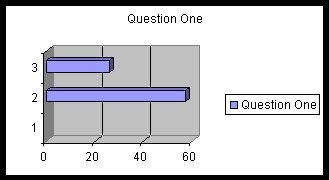
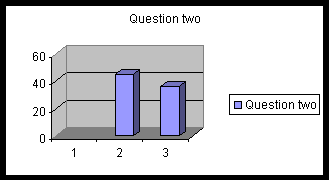
The number of respondents to the survey was calculated at question one, YES (57) fifty seven and NO (26) twenty six this giving a total of (83) people completed a part or all of the survey forms delivered to the schools. Then in the survey (45) forty five people indicated that they have worked with gifted children. This being just over half of all the respondents. See appendix "D" The Qualifications of the teachers who completed the surveys at William Dean PS, Dean Park. Hassell Grove PS, Hassell Grove and then Plumpton PS at Plumpton.
The decision making process for the questions to be used was a collaborative decision and our first draft became the final questionnaire or survey form. The survey had two scale type questions, these being questions four and five. In Paul Anderson book Technical Writing: A reader's centered approach, he does suggest only one of this style of questions. After reviewing the University of Western Sydney's subject surveys which is one hundred percent (100%) scale questions the group agreed to use two of this type of questions. (Anderson, P 1995 p. 164-165)
Researchers perspective of these scales can be broken up to quantify the responses receive allowing the answer to be examined.
Very low 1 . 2 . 3 low
Improving 4 . 5 . 6 better
Better plus 7 . 8 . 9 . 10 excellent.
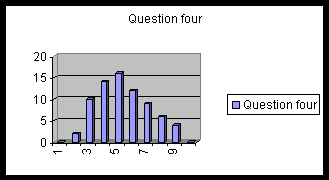
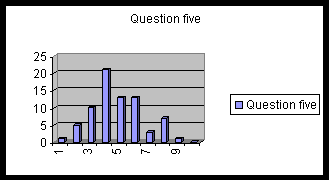
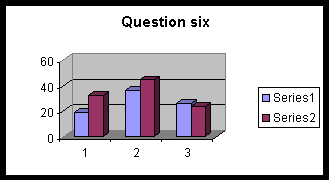
The range 4.5.6 (Improving to better) in the scales proved they were most popular with the readers and their answers reflected this to be the case. Q.5 4.5.6 = 47 and Q.6 4.5.6 = 42 both over 50% of all surveys completed and returned. These scaling type of answers allows the reader to have a broader scope in providing they answer. Rather then selecting yes, no or sometimes the scaling method allows them to be more precise and target their answer accordingly.
One could work at great length to qualify or to quantify these answers and being subjective without bias or personal opinion. By the process of empirical research using the survey forms received back completed as the device for information gathering or a communication instrument between the readers and the professional writer.
The only failing to our group (3) three reader's survey was that the recipients still went outside of the line of questioning and added they own small or unqualified information. This does appear to be the failing of written surveys forms in general. Face to face interviews allows the surveyor to qualify the extra information and then slot it into the generalisation of the original question or survey form.
Recommendations about the survey process.
original survey forms". If any more forms are required please
contact us on the phone numbers provided on the Letter of
Introduction.
survey forms provided, as these would not copy clearly.
Hassell Grove Public School lost the bulk of their survey forms given to them so they copied their own survey forms. Failing to see "please turn over" and only copied the front of the form. Eight copies of the survey form received didn't have side two or question (7) seven to (10) ten, "please turn over" in bold and at the bottom.
Then question one mightn't of meet the clients requirements as Janice Hall information allowed non teachers to complete the Graduate Certificate but the reward will not be issued. Question three tried to integrate the other support people of gifted children.
The survey options were Parents, teachers or a gifted child. Janice's information also mentioned community members and others but there was a clear decision to use the draft survey. The scope of the draft didn't include community members or others, this was mainly because we choose to survey teachers and support staff within the education system only.
The appendixes marked "A" and "B" were interesting research to the subject of gifted children. This was done by contacting the Department of Education and determining their stance or opinion as the primary employer and organisational body within the state of NSW for educational program for all children and not only gifted.
Appendix "A"
Gifted Children Program in Western Region of Sydney.
OC Classes. - Infant and Primary age children.
Schools
Blacktown South
Richmond
Matthew Priece
Wentworth Falls
Lithgow
Greystanes.
These two school share the intake on a rotation basis. Each school receive their new students every second year.
Selective High Schools.
Gifted and talented Coordinator:
Sue Vasilevaka 9561 8000
Kevin Bradburn Support field worker (Same number as above)
Note: Gifted - the academic ability and talented - the people with skills. (Music, art, drawing, etc.)
Appendix "B"
Department of Education.
Selected School Unit. Phone Number 9886 7480.
Mr. Bob Wingrave gave some departmental information.
The department only considered the academic gifted children, not these who are musically gifted because this could be a talent and not a gift.
He also gave a name of a professor in the States Professor Gagne.
Gagne defined the difference between gifted and talent.
Then for the local educational environment Dr. Mirica Gross at the University of NSW was our own expert in the education of children.
Dr. Gross lectures and clearly supports Professor Gagne's view and opinions.
Reference List
Anderson, Paul. 1995. Technical Writing: A reader centered approach. Miami University, Ohio. Harcourt Brace College Publishers.
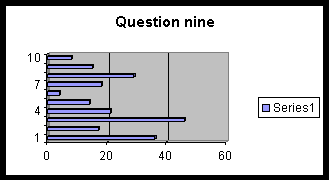
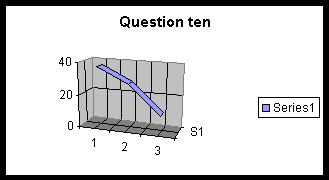
Graphic reflection of the Survey.
Attachments
Word Count 1054.
Appendix "D"
The Teacher's Qualifications indicated on the survey forms collected from William Dean, Hassell Grove and Plumpton Public School.
This list is only how the information was recorded.
Teaching Certificate
Bachelor of Education
Diploma of Education (Hon), Primary.
Teaching Certificate
Bachelor of Education
Bachelor of Arts, Diploma of Education
Bachelor of Arts, Diploma of Education
Diploma of Teaching and 25 years of experience
Diploma of Teaching
Diploma of Teaching
Bachelor of Education, Diploma of Teaching
Bachelor of Education, Special Education
Bachelor of Arts, Diploma of Education
Bachelor of Education, Gifted Education Graduate Diploma TESOL
Bachelor of Teaching, Graduate Diploma in Education Studies
Bachelor of Arts, Diploma of Education, Graduate Diploma Lit
Bachelor of Education, Diploma of Teaching
Bachelor of Teaching
A couple of staff didn't indicate their qualifications but then this could reflect the auxiliary or support staff members who mightn't have a formal teaching degree.
Copyright
Ó Kevin Wayne LukeUniversity of Western Sydney. 1998.