|
1. Off-Line or Standby UPS
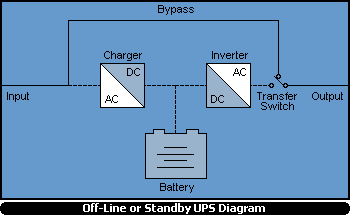
Off-Line or Standby UPS consist of a basic battery,
charger and a switch that senses irregularities in the electric
utility. The computer is usually connected directly to the utility
that serves as the primary power source, and power protection
is available only when line voltage dips to the point of creating
an outage. Come Off-Line UPS do include surge suppression circuits,
and some possess optional built-in power line conditioners to
increase the level of protection they offer.
In the case of power surges, an Off-Line UPS passes the surge
voltage to the protected system until it hits a predetermined
level, around 115% of the input voltage. At the surge limit value,
the unit then goes to battery. With high-voltage spikes and switching
transients, they give reasonably good coverage, but not the total
isolation needed for complete input protection. For power sags,
electrical line noise and brownouts, off-line UPS protect only
when the battery is delivering power to the protected system.
A similar limitation exists in the case of frequency variation.
An Off-Line UPS protects only if the inverter is operating and
on battery. If the input frequency varies outside the device's
range, the unit is forced to go to battery to regulate the output
to the computer. In very unstable conditions, this may drain the
battery making it unavailable during a blackout.
|