MIG-25
FOXBAT
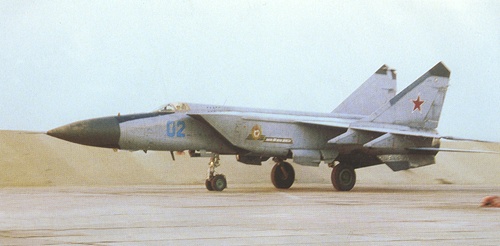 This
monster can take you going over three time the speed of sound, and flying
high to the edge of space (80,000 ft). Actually it has held many
unbroken records. Flying at the altitude over 120,000 ft is one of
them. Mig-25 is a heavy long range interceptor, or reconnaissance
aircraft. It was designed to encounter all air targets in all weather,
day or night, and in dense hostile electronic warfare environment.
The airframe can constantly sustain to 4.5 g (for such an interceptor,
it isn't neccessary for the aircraft to pull to 8g or 9g though).
The aircraft is a twin-finned high-wing monoplane with slightly swept wings
and a variable angle tail plane. It is powered by two R-15B-300 single
shaft turbojets, arranged in the tail section of the fuselage. The
engines develop 11,200 kgf of thrust with fully selected afterburner. The
engine's specific fuel consumption is 2.5 kg/kgf.h. It can provide
a maximum speed of 3,000 km/hour at high altitude.
This
monster can take you going over three time the speed of sound, and flying
high to the edge of space (80,000 ft). Actually it has held many
unbroken records. Flying at the altitude over 120,000 ft is one of
them. Mig-25 is a heavy long range interceptor, or reconnaissance
aircraft. It was designed to encounter all air targets in all weather,
day or night, and in dense hostile electronic warfare environment.
The airframe can constantly sustain to 4.5 g (for such an interceptor,
it isn't neccessary for the aircraft to pull to 8g or 9g though).
The aircraft is a twin-finned high-wing monoplane with slightly swept wings
and a variable angle tail plane. It is powered by two R-15B-300 single
shaft turbojets, arranged in the tail section of the fuselage. The
engines develop 11,200 kgf of thrust with fully selected afterburner. The
engine's specific fuel consumption is 2.5 kg/kgf.h. It can provide
a maximum speed of 3,000 km/hour at high altitude.  The
maximum speed at low altitude is 1,200 km/hour. The aircraft has
a service ceiling of 22,500 metres. The range at altitudes between
9 and 11 km with speed of Mach 0.85 is 1,950 km. At higher altitudes between
20 and 21 kilometres and speed Mach 2.35, the range is 1,650 km.
The aircraft's avionic is not really sophisticated. It is fitted
with electronic equipment, flight control and navigation aids. Due
to information from many source, Foxbat was designed to encounter the US
bomber XB-70. XB-70 was one of the US program of flying fast and
hight. Mig-25 was considered as an answer to XB-70. Eventhough
XB-70 was cancelled, MIG-MAPO still went ahead and finished their project.
Currently, there are hundreds of Foxbats service in many countries's Airforce.
Surprisingly, One of Iraq's Mig-25 successfully out-maneuvered a Nato's
F-18 and shot it down then in Gulf War. There is a rumour said that
the Foxbat was flown by a Russian pilot.
The
maximum speed at low altitude is 1,200 km/hour. The aircraft has
a service ceiling of 22,500 metres. The range at altitudes between
9 and 11 km with speed of Mach 0.85 is 1,950 km. At higher altitudes between
20 and 21 kilometres and speed Mach 2.35, the range is 1,650 km.
The aircraft's avionic is not really sophisticated. It is fitted
with electronic equipment, flight control and navigation aids. Due
to information from many source, Foxbat was designed to encounter the US
bomber XB-70. XB-70 was one of the US program of flying fast and
hight. Mig-25 was considered as an answer to XB-70. Eventhough
XB-70 was cancelled, MIG-MAPO still went ahead and finished their project.
Currently, there are hundreds of Foxbats service in many countries's Airforce.
Surprisingly, One of Iraq's Mig-25 successfully out-maneuvered a Nato's
F-18 and shot it down then in Gulf War. There is a rumour said that
the Foxbat was flown by a Russian pilot.
After Cold War was over, the
West had a few chances to look closer this "monster". They found
out that there hadn't been any transistor used on the aircraft. Foxbat
was still equiped with vacuum tubes. There are some sources said
that Mig-25's engines were the result of a Russian cruise missle engine...
(I have no idea). Moreover they stated that the engines were not
reliable, they frequently failed... and even worse they can't constantly
handle RPM changes... whatever the matter is, we can't find another interceptor
which has equivalent performance to this one from the West. Current
time, Mig-25 has been replaced by Mig-31 - Foxhound. It is a totally
different story about this Russian modern interceptor.
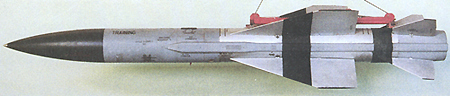 Foxbat is equipted with cannon at all. It relies on four R-40 (Nato
Code AA-6 Acrid) air to air missle for defense. The missles equipted
with infared and homing heads. The effective range against air target
(fighter size) is up to 60km. Also the aircraft can carry two R-40,
combined with four R-60 (Nato Code AA-8 Aphid) or two R-23 (AA-Apex) and
four R-73 (AA-11 Archer) which is condsidered as the best heat - seaking
missle in the world. R-73 Archer is superior to its analog US AIM-9
Side Wider due to the wide angle to lock on target and effective range.
Foxbat is equipted with cannon at all. It relies on four R-40 (Nato
Code AA-6 Acrid) air to air missle for defense. The missles equipted
with infared and homing heads. The effective range against air target
(fighter size) is up to 60km. Also the aircraft can carry two R-40,
combined with four R-60 (Nato Code AA-8 Aphid) or two R-23 (AA-Apex) and
four R-73 (AA-11 Archer) which is condsidered as the best heat - seaking
missle in the world. R-73 Archer is superior to its analog US AIM-9
Side Wider due to the wide angle to lock on target and effective range.
The derivatives of Foxbat,
Mig-25RB have capability to carry out ground mission. It can launch
Kh-58 (Nato Code AS-11 Kilter) anti-radar missle from a stand off range,
40km to 300km. After the missle launched the an autonomous controls
system within the missle stabilises the missle in roll pitch, and yaw.
Technical
information:
Manufacture:
Mikoyan - Gurevich OKB
Designation:
Mig-25
Nato Code
Foxbat
Type
Interceptor
Crew
One pilot
Year
1969
Engine
2 x R-15B-300, turbojet
Wingspan
14.0 m
Length
19.8 m
Height
5.1 m
Weight
36720 kg/38500 kg
Max. speed
3000 km/h (2.83M)
Range
1730 km
Armament
4 x Air to air missles AA-6, AA-8
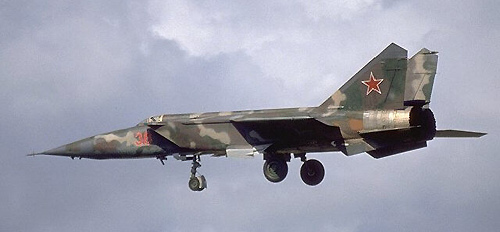 Mig-25
Foxbat with gears down
Mig-25
Foxbat with gears down
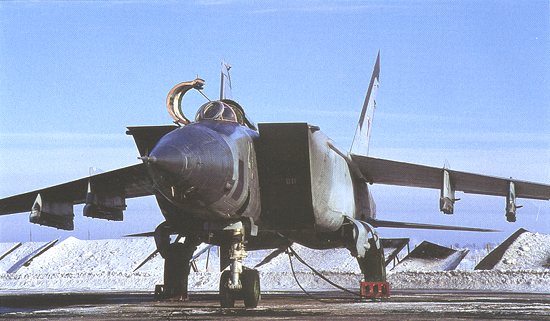 Mig-25
Foxbat at static
Mig-25
Foxbat at static
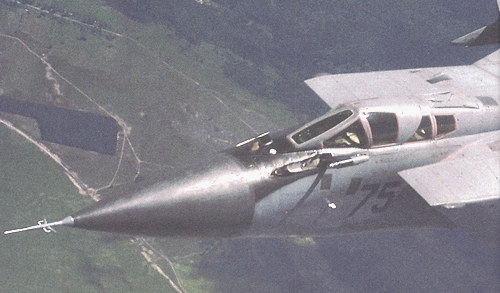 Mig-25
Foxbat closed up
Mig-25
Foxbat closed up
(Phong Nguyen Nov 20 1999)
Back to Mig-23 page
Go to Mig-27 page