|
|
|
Biography
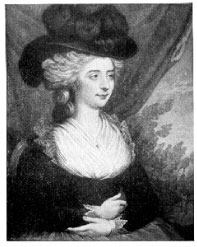
In her long life that spanned five reigns, Frances Burney d'Arblay (1752-1840) created a new genre in the English novel,
chronicled events ranging from George III's mad crisis to the aftermath of Waterloo, and wrote comedies that could have
rivalled Sheridan's had they been produced.
She was born June 13, 1752, in King's Lynn, Norfolk, the daughter of Esther Sleepe Burney and music historian Dr. Charles
Burney. From the time she learned her alphabet, she was a writer, composing odes, plays, songs, farces, and poems at an
early age. She burned them all at age 15, most likely under the influence of her stepmother, who didn't think it appropriate
for women to write. But Frances Burney's urge to write could not be stifled. At age 16, she began the diary that would
chronicle personal and public events from the early reign of George III to the dawn of the Victoria age. These included
first-hand accounts of the Johnson-Boswell circle, the trial of Warren Hastings, George III's mad crisis, Napoleonic France,
a mastectomy without anaesthesia, and the aftermath of the battle of Waterloo, which found her nursing the stream of English
wounded evacuated from the battlefield.
She knew luminaries such as David Garrick, Sir Joshua Reynolds, James Boswell, and Samuel Johnson through her father, and
her early diaries chronicle evenings spent in this circle at home.
Frances Burney left court in 1791, and in 1793, against her father's wishes, she married Gen. Alexandre d'Arblay,
Lafayette's aide de camp, who had fled France for England after the rise of Robespierre. The couple had one son and were
extraordinarily devoted to each other.
In hopes of recovering property lost during the French Revolution, Gen. d'Arblay moved his family to France in 1802, a
temporary arrangement that lasted 10 years because the Peace of Amiens ended while the family was still in France. While
there, Frances Burney d'Arblay made medical history by chronicling her mastectomy without anaesthesia.
After her father's death in 1814 and her husband's death in 1818, Frances Burney d'Arblay wrote no more fiction.
Her novels
Evelina (published in 1778)
Cecilia (published in 1782)
Camilla (published in 1796)
The Wanderer (published in 1814)
 |
|
|
|
|
|
|
|
|