Reviews
Review by Anthony Foy
Perhaps the most creative and innovative band emerging from the 1970's,
the blockbuster talents composing the Dixie Dregs were arguably the busiest
of musicians in the twilight of that decade.
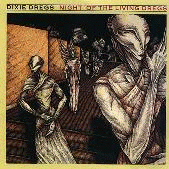
The quintet's 1979 release of Night of the Living Dregs, was the third
project
from the band in as many years, and finally treated it's following of
listeners
with a taste of what legions seeing the band in person had experienced -
live
recordings of music executed at a stunning level of excellence.
Half of this recording was captured at the July 1978 Montreux (Switzerland)
Jazz Festival. The bands newest material builds on and further enhances the
precision performance and breadth of style and compositional virtuosity
demonstrated on it's two earlier releases (Free Fall -1977, and
What If - 1978).
By this time, serious listening audiences could scarcely have overlooked
the
blossoming compositional excellence of Steve Morse, the bands unofficial
leader. With this release, the Dixie Dregs integrate more styles than fusion
followers could ever imagine were possible to be fused and do more than just
hint that they are up to the challenge of making live magic, performing material
perhaps assumed to be executable only in a studio environment due to it's
complex nature.
As if to say to followers, 'let's do it again, but this time...' Punk
Sandwich
opens the release with good old time rock and roll guitar that would cause
veteran listeners to reminisce to a year earlier to a similar opening of
the
prior release (What If), but almost imperceptibly, they hear more poly
rhythms in the emerging melody lines, staggered stacatto ensemble bridges,
galloping breaks, and instrumental counterpoints to Morse's melodic guitar
lines driving the band on. In these opening minutes, new listeners will feel
the celebration and joy that the bands music had expressed from the
be-
ginning and veterans might exclaim "these boys are still having them some
fun!"
And the fun continues... Country House Shuffle opens with drummer
Rod
Morgenstein's taking the listener around the world rhythmically, inviting
a
few seconds of mind's eye travel log, before settling into this now classic
tunes signature shuffle. For the next 20 years, audiences will rise up to
embrace this rhythm when treated to 'Country House' in Dregs gigs and
reunions. But it all started here, when some of the best of the Dregs times
were as Morse would describe Morgenstein's contribution to holding it all
together as his playing like a clock.
A classic Morse melody suddenly is overlain with a hint of dissonance, a
counter melody, then Mark Parrish's keyboard tonally announces a theme
almost sacred, then even this is abruptly truncated with an Allen Sloan
violin
dominated soaring and majestic melody line, but wait,catch Morse's back-
ground guitar here....if you can! You may want to stand up and cheer here
as
the songs main hook returns....but wait, there's a surprise melodic and
rhythmic variation on the dissonance's earlier hint. Taking control of his
composition, Morse harmonizes with himself, rips one tasteful shred, and
then
solos the song away, with guitar tones that will likely not be heard elsewhere
than where one finds his heavily customized 'rock & roll guitar'. This
tune is
a wild wild ride!
Following the two opening numbers, The Riff Raff seems purposely
placed in
the next play position to erase any doubt of the diversity of musical arenas
in
which the band members comfortably adapt to and command. Where 15 seconds
earlier, the band is rocking our socks off, the air is now filled with a
Morse/Sloan
duet of nylon string guitar and violin that is lighter and more delicate
than spun
glass! No obligatory acoustic offering this...the depth of formal musical
education
endowed to both Morse and Sloan is fully evident here as the duo wisks the
listener to a baroquish setting, strangely flavored with a dissonance that
will cause
one to think Bartok....Zappa simultaneously. However, what is being heard
is the
emerging and soon to be unmistakable writing of Steve Morse! More
impressive,
Morse's evolving compositional skills are affirmed here in the refined as
well as
in the rocking. The wide chasm of styles just amplifies Morse's and the band's
abilities.
Long Slow Distance settles into a style of it's own somewhere between
the earlier
rockers and the delicacy of the last track. The full ensemble joins Morse
and Sloan
for another of the bands epic journeys. The band awakens our imaginations
to what
probably each of us has experienced....distances covered much to
slow...mournfully
wishing to be at our destination, but excitedly anticipating the end of the
journey...
the Distance seems to spring from and put to melody the emotional drain of
endless
time on the road that is many musicians lifeblood and style.
This picture comes to life as each instrumentalist augments their own parts
with
acoustic and electric over tracking. An evolving melody over a complex background
resolves simply with Morse and keyboardist Mark Parrish's calling and answering
each other with instrumental emotion in a fully electrical dominated
environment.
'Distance' covered moments before deposits the listener at the setting
for the title
track. Night of the Living Dregs was recorded before a live audience
at the
prestigious Montreux, Switzerland Jazz Festival on July 23, 1978. The band
has
burst from the relative safety of the recording studios multiple takes, redubs
and
punch-ins that one would assume commonplace in order to capture the precision
and complexities of Morse's compositions. An intro of audience sounds
suggest
that Night is the opening number in this festival setting, where warm-ups
and sound
checks afforded to bands in any era are known to be at a minimum. What
effect
would this have on such rhythmic and tonally variable music?
The quintet wastes no time, establishing three short, but distinct themes,
each with
it's own melody, rhythmic complexities, and counter-backing duet instruments
in the
first one and one half minutes! Short instrumental solos follow, with keyboards
conjuring images of John McLaughlin's Mahavishnu Orchestra, admittedly a
large
influence on the band from it's inception. The listener is struck by the
sound quality
and separation, the later a critical component to the recording, for the
listener to
fully appreciate the lightning like interplay and harmonizing of each of
the
instrumentalists. The fluidity and creativity of Morse's guitar phrasing
complemen-
ting behind each of the other instruments is clearly recorded and this is
a special
treat, because even in the background, the guitar is just extraordinary!
But the
best is yet to come.
On occasion, live recordings have been made which capture such excellence
in per-
formance that the audience is forever in debt to those planning and executing
these
archivings. Many Dregs fans believe that one of the most magic of those
moments
follows. The Bash was probably not anticipated at a 'jazz' festival.
It would have
been no more expected from a classical-rock-fusion band as the Dixie Dregs
have
often been categorized as. This band had more than sufficient talent and
boldness
to add country swing to it's repertoire of style, but Bash is not just a
presentation
of the traditional Wabash Cannonball theme, but a chance to establish band
members Sloan and Morse as absolute masters of their instruments. The theme
is
announced, harmonically enhanced, then followed by Morse's writing his signature
as a technically astounding guitar player. Whether soloing at breakneck speed
(without the aid of any processed effect or overdriven amplifier), in duet
with Sloan's
'fiddle' or as comping background, Morse's performance is simply jaw dropping.
Near the midway point, the tunes C&W theme gives way to....well, let's
leave it at
the listener will wonder 'where's the accordion?' and Lawrence Welk followers
will
get happy feet! Sound bizarre? The reviewer strongly recommends HEAR THIS
SONG!!! It's music for the ages!
Leprechaun Promenade returns the band to a performance befitting
the more
traditional Montreaux fare. The piece borders on avant-garde as the mood
moves
through a dynamic variety of theme, tempo and in particular, decibel range
in this
violin dominated composition. Band members 'nail' precise, dramatic volume
changes,
often simultaneously incorporating extreme rhythm shifts, then pull out the
stops with
process effects of the day in a spacey, free form preview to a crescendoing
finale.
This song will be resurrected for fresh treatment in a Morse solo effort
in 1989 (High
Tension Wires), but this live unveiling with the full quintet remains distinct
in
character.
The Dregs close this milestone effort before the Montreux crowd with
Patchwork, which
in this listener's ears does homage to select roots of American music which
had
admittedly influenced Morse's compositional tendencies. After an introductory
tonal
cascade performed in ensemble, theme after theme are established, first somber
and
Copelandish, then agrarian, images of the heartland set to music. Morse stretches
out
in a solo that draws on some of his early, but unpublicized musical experiences,
that of
periodic stints in bluegrass bands. When not soloing, Morse's complimentary
back-
ground in duet with Parrish's piano or Sloan's violin together are things
of beauty.
The overall Night of the Living Dregs project captures the band at a time
when they
were playing or recording almost non-stop. Instrumentally, the members had
achieved
a staggering musical cohesivness considering the complexity and diversity
of the
material that they had mastered. In the studio, the Dixie Dreg sound was
being
recorded at an increasing quality level necessary to appreciate the interaction
of the
instruments. And the project proves that the band was skilled beyond expectation
to
perform the intricacies of what had come to be the bands signature sound.
Stereophile (2/93)
...innovative compositions, virtuoso playing, and an energetic chemistry
between
musicians...the sound is excellent: dynamic, immediate, and not overly
processed... -- |