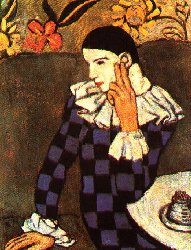
 Harlequinade
| Harlequin
[*] har.le.quin
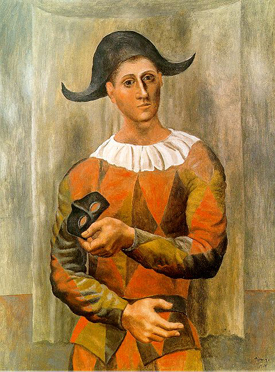
n [ultim. fr. It arlecchino, fr. MF Helquin, a demon] (1590) a cap: a character in comedy and pantomime with a shaved head, masked face, variegated tights, and wooden sword b: buffoon a: a variegated pattern b: a combination of patches on a solid ground of contrasting color. |
 |
Italian ARLECCHINO,
French ARLEQUIN:
one of the principal stock characters of the Italian commedia dell'arte often a facile and witty gentleman's valet and a capricious swain of the serving maid. In the early years of the commedia (mid-16th century), the Harlequin was a zanni (a wily and covetous comic servant), and he was cowardly, superstitious, and plagued by a continual lack of money and food. By the early 17th century, Harlequin had become a faithful valet, patient, credulous, and amorous. This last quality often led him into difficulties from which he managed to extricate himself by cleverness and irrepressible high spirits. He was amoral without being vicious, and, unlike his fellow commedia servants, he did not hold a grudge or seek revenge against those who tricked or cheated him. |
| Derived from the Italian commedia dell'arte, harlequinades came into vogue in early 18th-century England, with a standard plot consisting of a pursuit of the lovers Harlequin and Columbine by the latter's father, Pantaloon, and his bumpkin servant Pedrolino. In the Victorian era the harlequinade was reduced to a plotless epilogue to the main pantomime, which was often a dramatized fairy tale. |
| Arlecchino's costume was originally a peasant's
shirt and long trousers, both covered with many coloured patches.
By the 17th century, this had become a tight-fitting costume decorated with red, green and blue triangles arranged symmetrically and joined together with yellow braid. One hundred years later the triangles became diamonds, his soft cap was exchanged for a pointed one and he carried a batte, or slapstick. His black half mask has tiny eyeholes and quizzically arched eyebrows accentuated by a wrinkled forehead. The effect is one of satyric sensuality, catlike slyness, and astonished credulity. Now as Harlequin he still appears as a central character in English pantomime, carrying his wooden sword and wearing his black mask. |
 |
 |
 |