Nomi
is a teen-ager
An important
year in world & Jewish history
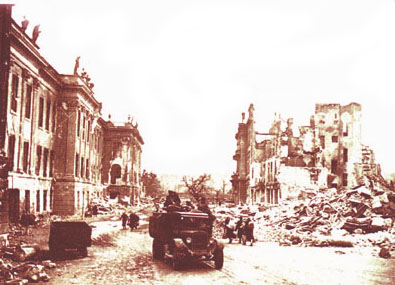 Dresden at the end of
the war
World
War II In Europe Ended - on May 7,
1945, German officials signed surrender documents with Allied forces. The
next day was proclaimed as V-E Day (for "victory in Europe) Some German
territory was transferred to Poland to make up for land taken from Poland
by the Soviet Union. The somewhat smaller Germany was then divided into
four zones under military occupation by France, Great Britain, the United
States, and theSoviet Union. Berlin, the capital, was similarly divided.
The country recovered from war rapidly, with the help of foreign aid, and
became the most prosperous nation in Europe by the 1970s.
East Germany,
on the other hand, remained economically stifled by Communist rule. And
unfortunately Nomi's house
stayed on the east side…
Dresden at the end of
the war
World
War II In Europe Ended - on May 7,
1945, German officials signed surrender documents with Allied forces. The
next day was proclaimed as V-E Day (for "victory in Europe) Some German
territory was transferred to Poland to make up for land taken from Poland
by the Soviet Union. The somewhat smaller Germany was then divided into
four zones under military occupation by France, Great Britain, the United
States, and theSoviet Union. Berlin, the capital, was similarly divided.
The country recovered from war rapidly, with the help of foreign aid, and
became the most prosperous nation in Europe by the 1970s.
East Germany,
on the other hand, remained economically stifled by Communist rule. And
unfortunately Nomi's house
stayed on the east side…
The
Founding of the Arab League
The Arab states of the Middle
East formed a regional association called the Arab League on March 22,
1945, in Cairo. Founding members were Egypt, Syria, Lebanon, Iraq, Jordan,
Saudi Arabia and Yemen. Other Arab states joined in the coming decades.
The Palestine Liberation Organization, a stateless society, joined in 1976.
The purpose of the league was to strengthen and coordinate political, economic,
and social programs of mutual interest for all the states involved. In
time the organization became increasingly political, mostly because of
the persistent Arab-Israeli conflict. The presence of Israel, however,
brought more internal dissension to the league than agreement.