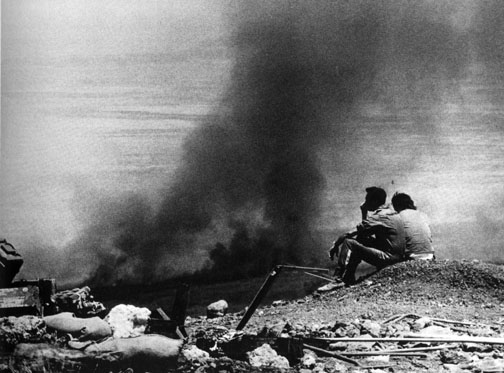
Yom Kippur War
The fourth Arab-Israeli war occurred on October 6, 1973. It is called the Yom Kippur War because it began on Yom Kippur, or the Day of Atonement, the holiest day in the Jewish religion. This was also the 10th day of Ramadan in Islam, and the anniversary of a crucial holy war fought by the prophet Mohammad. Israel was attacked in the southwest by Egypt across the Suez Canal and in the northeast by Syria across the Golan Heights. For the first time in this series of conflicts the Arab armies showed unusual energy and aggressiveness. This, coupled with the element of surprise, caused Israel's forces to suffer high casualty rates at the start of the war, but they eventually mobilized and began to surround the Egyptian Third Army. At the same time, the United States and Soviet Union began a battle of words that threatened to bring them into the war, but this battle was worked out in the United Nations, which also oversaw a cease-fire that went into effect between Israel and Egypt on October 24. A cease-fire on the Syrian front was finalized the following May.
Raid on Entebbe
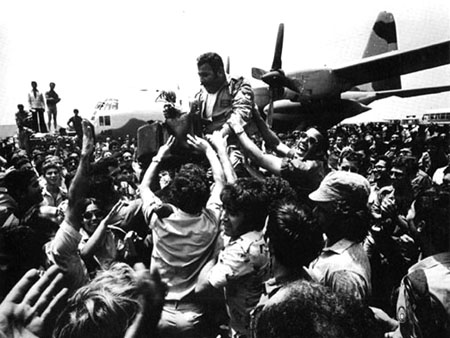
Soldiers are greeted upon their return from Entebe
The 1970s proved to be the first decade of international terrorism. One of the most notorious incidents occurred in 1976 with the hijacking of an Air France jet on its way from Tel Aviv, Israel, to Paris. The pro-Palestinian hijackers had the plane flown to Entebbe, Uganda. The dictator of Uganda, Idi Amin, was strongly anti-Israel. The hijackers demanded the release of colleagues imprisoned in Israel, Kenya, West Germany, and other nations.
On the night of July3-4, an Israeli airborne commando unit staged a raid on the Entebbe airport and rescued the 103 hostages. Seven of the terrorists were killed and 11 Ugandan military aircraft bought from the Soviet Union were destroyed. The Israeli mission of more than 100 elite anti-terrorist troops on three Hercules C-130H planes flew the 2,500 miles (4,023 kilometers) from Israel to Entebbe. The raid was the boldest successful anti-terrorist action ever taken. Palestinians and their supporters were outraged, while Israel and its allies rejoiced in the episode.
As the Israeli fighters were flying back home, with the freed hostages, a broadcast of the entire operation was playing on the radio, Nomi, together with the rest of Israel, were listening to every word, until the late morning hours. The celebration and world admiration lasted for a long time.
Islamic Revolution
in Iran & Camp David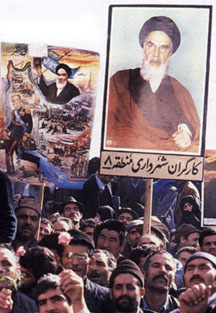
Islamic fundamentalism had been on the rise for several decades before it won control of the government in Iran. The creation of the State of Israel in 1948 had created a unity among Muslims of the region in their opposition to the new state. The encroachment of American and European ways also disturbed many Muslims. As oil prosperity washed over the Middle East after 1950, many Westerners worked there. Modernization of society threatened to undermine the traditional social and religious structures of Islam. Fundamentalists sought to roll back these changes and turn their states into societies guided only by Islamic law.
During the reign of Mohammed Reza Shah Pahlavi (1941-1979), Iran had changed swiftly. It had been transformed from a backward, rural nation into a major oil producer with a diversified economy. The uncontrolled economic growth brought people from the countryside to the cities with expectations that were often disappointed. The Muslim fundamentalists, moreover, resented the intrusion of Westerners into their country. In addition, the Shah was criticized for his vast wealth, while much of the nation was relatively poor. The mounting opposition to the Shah's dictatorial rule was led by Ruhollah Khomeini, an Islamic legal scholar whose title was Ayatollah. Protests within Iran grew powerful enough to force the Shah to leave on Jan. 16, 1979. Khomeini returned to Iran on February 1 from exile in France. After a national referendum on April 1, he declared an Islamic republic. The vehemence of the Iranian crowds against the West especially the United States forced most outsiders to leave the country. In November 1979 Islamic revolutionaries invaded the American embassy and took 66 hostages. After releasing 13, they held the rest until Jan. 20, 1981, the day that Ronald Reagan was inaugurated as president of the United States.
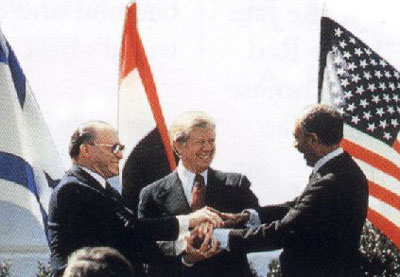
Camp David Accords
Egypt and Israel had been in a state of war since 1948, when Israel became a nation, although actual hostilities were intermittent. After Egypt's leader, Gamal Abdel Nasser, died and was succeeded by Anwar el-Sadat, the potential for peace between the two nations increased. Sadat took the unprecedented step of visiting Israel on Nov. 19, 1977, and peace negotiations began between the two nations. When talks reached a deadlock, Sadat and Menachem Begin Israel's prime minister accepted the mediation of United States President Jimmy Carter. They held a summit meeting at Camp David, Maryland, in September 1978 and hammered out two agreements. One called for Israeli withdrawal from the Sinai Peninsula, which Israel had seized in the 1967 war. Egypt guaranteed Israel's ships passage through the Suez Canal. The second agreement was an attempt to formulate peace arrangements for the Middle East, including self-government for the Palestinians. As a result of the Camp David Accords, Israel and Egypt signed a peace treaty on March 26, 1979. The state of war between the two countries was over, but Egypt had managed to alienate all of its former Arab allies in the Middle East. Sadat was assassinated in 1981 by a Muslim fundamentalist opposed to peace with Israel.
Another revolution was talking place that same year
The invention of the compact disc…

A new technique, invented in 1979, for recording sound and playing it back revolutionized the recording industry in the 1980s. The compact disc, or CD, has since replaced the older style long-play (LP) records in most music stores. Music CDs became available in Japan in 1982 and in North America and Europe in 1983. In making a master CD the sound (or other kind of information) is transmitted to a plastic disc by laser beam. The laser makes a series of minuscule pits in a spiral that begins near the center of the disc and moves toward the edge. One disc, which measures 4.75 inches (12 centimeters), can store more than one hour of sound. After laser coding, the master disc is dipped into an etching chemical that eats away the areas exposed to the laser, enlarging the pits. Duplicate discs are made in much the same way as phonograph records. The duplicates produced for sale are exposed to vaporized aluminum or silver and then sealed in acrylic. This gives them their metallic appearance.
Click here now!…