PROPECIA® is a medical breakthrough the first pill
that effectively treats male pattern hair loss on the vertex (at top of head) and anterior
mid-scalp area.
Does PROPECIA® really work?
Based on vertex studies at 24 months of men 18 to 41 with
mild to moderate hair loss, the clinical results of PROPECIA® are impressive:
83% maintained their hair based on hair count (vs. 28% with
placebo), 66% had visible regrowth as rated by independent dermatologists (vs. 7% with
placebo), 80 % were rated as improved by clinical doctors (vs. 47% with placebo), and most
men reported an increase in the amount of hair, a decrease in hair loss, and improvement
in appearance.
Only a doctor can determine if PROPECIA® is right for you.
PROPECIA® is for men only. Further, women who are or may potentially be pregnant
must not use PROPECIA® and should not handle crushed or broken tablets because it may cause
abnormalities of a male baby's sex organs. PROPECIA® tablets are coated and will
prevent contact with the active ingredient during normal handling.
You may need to take PROPECIA® daily for 3 months or more to
see visible results. PROPECIA® may not regrow all your hair. And if you stop using this
product, you will gradually lose the hair you have gained. There is not sufficient
evidence that PROPECIA®works for recession at the temporal areas.
If you haven't seen results after 12 months of using PROPECIA®,
further treatment is unlikely to be of benefit.
Like all prescription products, PROPECIA® may cause side
effects. In clinical studies, a very small number of men experienced certain side effects,
such as: less desire for sex, difficulty in achieving an erection, and a decrease in the
amount of semen. Each of these side effects occurred in less than 2% of men. These side
effects were reversible and went away in men who stopped taking the PROPECIA®. They also
disappeared in most men (58%) who continued taking PROPECIA®.
Taken once a day in tablet form, PROPECIA® is simple, easy,
and -most important- clinically demonstrated to be effective in most
men. PROPECIA® helps grow natural hair not just "peach fuzz"
and is as convenient to take as a vitamin: one pill a day.
How does PROPECIA® work?
Scientist have recently discovered that men who suffer from
male pattern hair loss have an increased level of a substance called DHT in their scalps.
PROPECIA® blocks the formation of DHT and in this way appears to interrupt a key factor in
the development of male pattern hair loss in men. Most important, PROPECIA ® helps grow
natural hair, not just "peach fuzz," and is as convenient to take as a vitamin:
one pill a day.
What is DHT?
DHT is one of many male hormones in the body. DHT is
developmentally important early in a man's life; however, it appears to be a cause of
hair loss as men get older. DHT shrinks the hair follicle until it no longer produces
visible hair.
Who should not take PROPECIA®?
PROPECIA®is for the treatment of male pattern
hair loss in MEN ONLY. Further, women who are or may potentially be
pregnant must not use PROPECIA® and should not handle crushed or broken tablets of
PROPECIA®
because it may cause abnormalities of a male baby's sex organs. PROPECIA® tablets
are coated and will prevent contact with the active ingredient during normal handling.
Does PROPECIA® work for all men?
At the conclusion of a 24-month study of men
age 18 to 41 with mild to moderate hair loss at the top of the head, 83% treated with
PROPECIA® maintained their hair as determined by hair count (vs. 28% with placebo).
Most men reported an increase in the amount of hair, a decrease in hair loss, and
improvement in appearance. Although results will vary, generally men will not be
able to grow back all of the hair they have lost.
Can PROPECIA® help maintain my hair count?
PROPECIA® is proven to maintain hair count in
most men. It's the medical breakthrough men have been waiting for. In
clinical studies, hair count was maintained in men taking PROPECIA®, while men taking a
placebo (a pill with no medication) continued to show progressive hair loss.
Imagine looking in the mirror two years from
now and seeing essentially the same amount of hair you saw this morning! Now,
PROPECIA® makes this possible for the vast majority of men.
Can PROPECIA® increase as well as maintain my hair count?
At 24 months, 66% of the men in our studies
regrew hair at the top of the head (vs. 7% with placebo) as determined by an expert panel
of dermatologists. An assessment by the study investigators rated 80% of men on
PROPECIA® as improved (vs. 47% with placebo). This was not just "peach
fuzz", but real hair and growth occurred on both the vertex (at top of the
head) and anterior mid-scalp area. There is not sufficient evidence that PROPECIA®
works for recession at the temporal areas.
How long will it take for PROPECIA® to work?
PROPECIA® begins to block the formation of DHT almost
immediately; however, because hair grows slowly, visible results from PROPECIA ® take some
time. In clinical trials, most men began to see the first benefit of PROPECIA®
slowing hair loss as early as 3 months. After 6 months, men may begin to experience
regrowth. If PROPECIA® does not work within 12 months, further treatment is unlikely to be
of benefit.
How long do I have to take PROPECIA®?
You need to take PROPECIA® for as long as you
want to continue to benefit from use. If you stop taking PROPECIA®, you will likely
lose any hair you have gained within 12 months of stopping treatment.
What about long-term use of PROPECIA®?
PROPECIA® has been tested for 2 years in clinical studies of 1,200 men.
Does PROPECIA® have any side effects?
Like all prescription drugs, PROPECIA® may cause side
effects. In clinical studies, side effects from PROPECIA® were uncommon and did not affect
most men. A very small number of men experienced certain sexual side effects, such as:
less desire for sex; difficulty in achieving an erection; and a decrease in the amount of
semen. Each of these side effects occurred in less than 2% of men. These side effects were
reversible and went away in men who stopped taking PROPECIA®. These side effects also
disappeared in most men (58%) who continued taking PROPECIA®.
If a man is taking PROPECIA®, is it present in his semen?
What effect does PROPECIA® have on semen?
Semen levels have been measured in 35 men taking PROPECIA®
daily for 6 months. In 60% of the samples, PROPECIA® levels were undetectable. The mean
PROPECIA® level was 0.26 ng/mL, and the highest level measured was 1.52 ng/mL. Using the
highest semen level measured and assuming 100% absorption from a 5 mL ejaculate per day
volume, human exposure through vaginal absorption would be 750 times lower than the
exposure from the no-effect dose for developmental abnormalities in male Rhesus monkeys.
There were no developmental abnormalities seen in male Rhesus monkey fetuses when PROPECIA ®
was given intravenously (into the blood stream) to pregnant Rhesus monkeys at 750 times
the estimated exposure of pregnant women from men taking 1 mg/day.
You should discuss this with your doctor and follow your doctor's instructions.
How does PROPECIA® compare with other products available for the treatment of hair loss?
PROPECIA® is the only pill indicated for male pattern hair
loss. Merck has not conducted clinical trials comparing PROPECIA® with other
medicines and therefore cannot make any comments. You should discuss this issue with your
doctor.
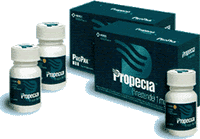
How is PROPECIA® supplied?
PROPECIA® is available as a 1-mg tablet. This tablet is tan
in color and is octagonal (has eight sides), film-coated, rounded, somewhat elevated
surface. Each PROPECIA® tablet is marked with a code of MRK 71 on one side and
PROPECIA® 1
on the other. The tablets are supplied as individual bottles of 30 tablets and in
PRO
PAK™ ,
a carton of 3 bottles each containing 30 tablets for a total of 90 tablets.
How should I take PROPECIA®?
The recommended dosage for PROPECIA® in men with male
pattern hair loss is a single 1-mg tablet taken by mouth once a day. PROPECIA® may be taken
with or without meals. You may need to take PROPECIA® daily for three or more months before
you see a benefit from taking PROPECIA®. PROPECIA ® can only work over the long term if you
continue taking it. Continued use is recommended to obtain maximum benefit. If you stop
taking PROPECIA®, you will likely lose the hair you have gained within 12 months of
stopping treatment. You should discuss this with your doctor, and follow your
doctor's instructions.






 Now there's an
easy, low-cost way to try Propecia: Order
Online!
Now there's an
easy, low-cost way to try Propecia: Order
Online!