JOB OUTLOOK: THOUSANDS OF JOBS IN INFORMATION TECHNOLOGY PREDICTED FOR THE FUTURE
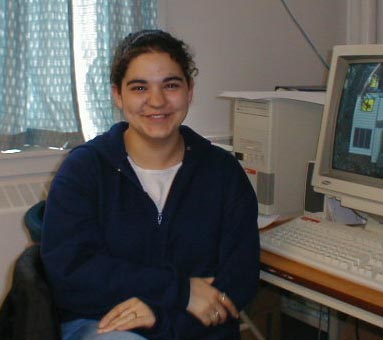
Cynthia's discussions with us and our own research have caused us to
come to an amazing realization. If we were to choose information
technology as a future career, we could go anywhere and we could do anything
because at the present time the information technology industry is growing
at a phenomenal rate WORLD WIDE.
50% of all jobs now require work with computers. The ability
to use a computer is one of the top four vital skills sought by employers.
One obstacle associated with expanding computer use is the inability of
different systems to communicate with each other. People like Cynthia
network or connect all the computers in an individual office, department,
or establishment. Networking allows users to retrieve data from a
mainframe computer or server and use it on their machine. This connection
also allows data to be entered into the mainframe from a personal computer.
Information technologists design the computer hardware and software to
allow a free exchange of data.
By the year 2002, 5000 high tech workers will be needed according to
a recent Nova Scotia survey. When the year 2000 rush
is over, the information technology industry will barely get
time to say "Whew!" According to Cynthia, the network systems side
of her work in particular is a rapidly growing field. At the
moment there are not enough adequately trained people for the work.
Some people are moving to the States to get the big bucks.
Others are getting into related fields like desk top support (fixing computer
hardware) or help desks (troubleshooting/fixing personal computer
problems). According to a 1999, survey by the HRDC of Nova
Scotia, information technology is a high demand career in most
regions, including Antigonish. So not only would becoming an
information technologist allow us to go anywhere, it would
also allow us to stay close to home. The reason for this
favourable job outlook in the information technology field is the explosive
growth of the technology industry sector and an apparently insatiable hunger
for educated experienced personnel.
There could be as many as 2000 other jobs created by the expansion
of current companies. Close to 84% of the 200-plus companies who
answered the survey will have fewer then 20 employees, while only a few
have 100 or more. That indicated a sector that's growing- but far
from the goal of the information technology industry everywhere- to be
truly global in market reach. A global leader must be of a certain
size having 500 or more employees, and it takes a lot of money to play
in the global league.
The industry must first address it's skill challenges. The current
demand, by priority, is for skilled employees who can be productive in
areas such as Oracle, C++, RPG400, system and network management
COBOL, UNIX, Java, multimedia authoring, visual basics, Access, and HTML
scripting.
The difficulty in finding workers whom companies consider adequately
educated means there has been a lowering of expectations of some 58% of
respondents. The companies replied that they hadn't or couldn't lower
their standards. According to Cynthia, the network system side of
her work in particular is a rapid growing field but employers find it difficult
to get employees with the proper training. Most companies want an
applicant to be experienced and have a University degree (preferably in
computer science or software engineering) or a certificate or diploma.
However, respondents also expressed concern about lack of standards among
the providers of certificates or diplomas.
The survey supplied this information on the Province Technology Infrastructure:
* 74% of the companies are owned in Nova Scotia, 20% are national,
4.4% are regional while international firms barely measure at 0.89%.
* Almost 60% of respondents have been around less then ten years.
* Almost 1/3 of companies are engaged in software design and development,
16% in consulting. The others range from 8.7% in system integration
to 0.7% in accounting and in computer hardware.
* Others include firms represented by single digit percentages -
telecommunications, system integration, software production
and distribution, multimedia, interactive entertainment, government,
computer retailers, cable and data networks, and broadcast and firm.
* IT companies have been successful in creating permanent jobs, ranging
from 81.7% of jobs in Cape Breton which are full time to 88.2% in the Halifax
Region Municipality.
Previous Person / Next Person