As we learned in Chapter 2, electricity flows through wires to light our lamps, run
TVs, computers and all other electrical appliances. But where does the electricity
come from?
In this chapter, we'll learn how electricity is generated in a power plant. In the next
few chapters, we'll learn about the various resources that are used to make the heat
to produce electricity. In Chapter 11, we'll learn how
the electricity gets from the power plant to homes, school and businesses.
Most power plants are big boilers that burn a fuel to make heat. That heat energy is
used to boil water to make steam. The steam is fed under high pressure to a turbine.
The turbine spins and its shaft is connected to a turbogenerator that changes the
mechanical spinning energy into electricity.
Lets look at a cross section of a power plant.
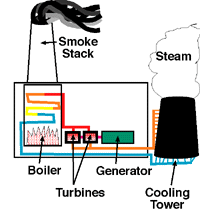 In most boilers, wood, coal, oil or natural gas is burned to make heat. Above that hot
fire is a series of pipes with water running through them. The heat energy is
conducted into the metal pipes, heating the water until it boils into steam. Water
boils into steam at 212 degrees Fahrenheit or 100 degrees Celsius. The steam (red
line) then goes under high pressure to the turbines.
In most boilers, wood, coal, oil or natural gas is burned to make heat. Above that hot
fire is a series of pipes with water running through them. The heat energy is
conducted into the metal pipes, heating the water until it boils into steam. Water
boils into steam at 212 degrees Fahrenheit or 100 degrees Celsius. The steam (red
line) then goes under high pressure to the turbines.
The turbine has many blades that look like the blades of a fan. When the steam hits
the blades they spin a shaft that is attached to the bottom of the blades.
After the steam goes through the turbine, it goes to a cooling tower (orange line)
where it cools off. It cools off and becomes water again. When the hot pipes come
into contact with cool air, some water vapor in the air is heated and steam is given off
above the cooling towers. This is not the same steam that is used inside the
turbine.
The cooled water then goes back into the boiler (blue line) where it is heated again and
the process repeats over and over.
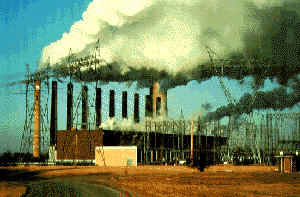 Most power plants in California use cleaner-burning natural gas to produce
electricity.
Most power plants in California use cleaner-burning natural gas to produce
electricity.
Other power plants use nuclear energy to heat water to make electricity. Still others
use steam or hot water found naturally below the earth's surface without burning a
fuel. We'll learn about those energy sources in the next few chapters.
The turbine is attached by its shaft to the turbogenerator. The generator has a giant
magnet inside a stationary ring wrapped with a long wire.
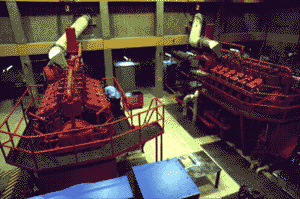 The shaft that comes out of the turbine and connected to the generator is turning.
As the magnet inside the generator turns, an electric current is produced in the wire.
The shaft that comes out of the turbine and connected to the generator is turning.
As the magnet inside the generator turns, an electric current is produced in the wire.
When a wire or any electrically conductive material moves across a magnetic field,
an electric current is produced in that wire.
A generator is just like a "reverse" electric motor. Instead of using electrical energy
to spin the motor and wheels, like in an electric toy car, the shaft from the turbines
spins the motor and electricity is produced.
The electricity then goes to huge transmission wires that link the power plants to
our homes, school and businesses. If you want to learn about transmission lines, go
to Chapter 11.
Here's What We Learned
- Fuels are used to heat water in a boiler to make steam.
- That steam turns a turbine.
- The spinning shaft of the turbine drives the generator.
- Many types of fuels are used in the boiler to heat the water.
- When a wire or any electrically conductive material moves across a magnetic
field, an electric current is produced in that wire.