ITC 525 - COMMERCE ON THE INFORMATION SUPERHIGHWAY
ASSIGNMENT 3
AUTHOR: ANGUS YOUNG (STUDENT NUMBER 9091344)
Contents
Integration of Front and Back Office Systems
Integration of CRM Strategies with the Internet
Customer Relationship Marketing (CRM) is often confused with cross selling and loyalty schemes or direct marketing. Many companies choose to replace CRM with more measurable but isolated short-term strategies such as cost reductions, customer retention or acquisition strategies. Such isolated strategies are often ineffective and costly. Loyalty schemes introduced in the grocery industry in the United Kingdom could reduce industry profit by as much as 20 percent. (McKinsey 1995)CRM is in fact a long-term strategy which encompasses all of the above.
According to a study done by McKinsey and Company (1995), successful implementation of a CRM strategy needs to adhere to several simple rules. The rules themselves are in essence a definition of CRM:
Research done by Hatton Blue (Hatton Blue 1999), shows 90 percent of organisations realised that CRM does not enable a quick win. The following graph illustrates the perceived benefits of implementing a CRM strategy.
- Use the information you gather to serve your customers better.
- Focus on the true value drivers in your business.
- Build customer relationships, not just databases.
- Be willing to treat customers differently.
- Compete with skills, not capital.
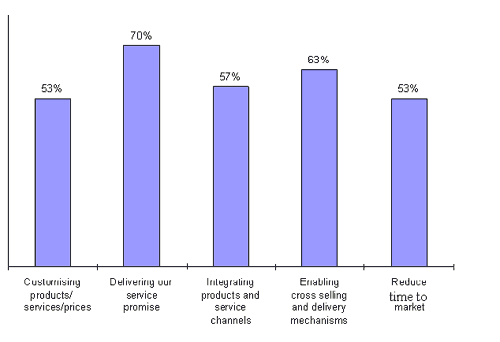
Figure 1. What will customer relationship management enable you to do?
According to McKinsey and Company (1995) the ultimate objective of CRM is, "creating substantially superior marketing strategies that build shareholder value".
Integration of Front and Back Office Systems..........
(23 November 1999)