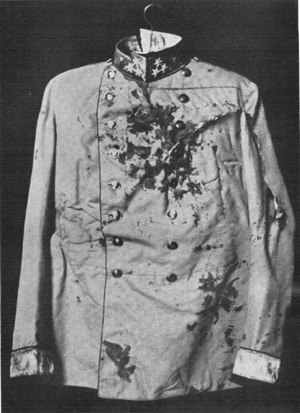




|
Born on December 18, 1863 to
Maria Annunziata and Archduke Karl Ludwig (brother of the Emperor Franz Joseph), Franz
Ferdinand Karl Ludwig Joseph Maria would become heir to one of the most powerful empires
in Europe. He led a quiet, happy childhood and despite his rigorous education he seemed to
be a mentally late developer. He matured quickly though, because of his status and
responsibilities. As revolution fever raged through Europe, Emperor realized that a new
face was needed to lead Austria into a brighter future. Instead of passing it on to his
brother Franz Karl, on December 2, 1848, the crown was passed along to his
eighteen-year-old nephew Franz Joseph, thus making him an archduke. His handsome, young
face and charming personality brought some stability back to the capital city and kingdom,
but they could not delay the cultural conflicts in the near future. The southern portion of the Austro-Hungarian Empire was made of a mosaic of cultures. The South Slavs -- Serbs, Croats, and Slovenes, were all located in this area. Despite their cognate ethnicity, they were quite dissimilar. Towards the end of the nineteenth century a cultural renaissance began in the South Slav groups. A resurgence of nationalism in these groups began and despite some early dissention a push for a South Slav nation for Serbs, Slovenes, and Croats began. This sign of possible revolt was evident to the rulers of Europe. By 1856 the Serbs had established their own state governed by an elected prince and they hoped that this state would later expand to include all Slavs in the Balkans. |
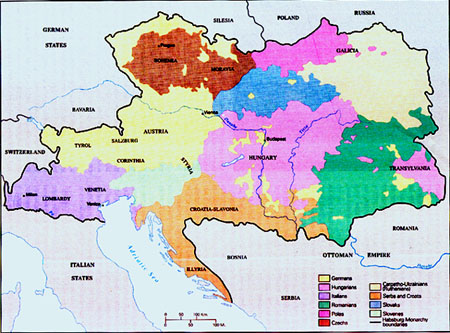
During the nineteenth century the Ottoman Empire began to crumble. The heavily Slavic populated Turkish territories of Bosnia and Hercegovina began to follow their neighbors and revolt against Turkish rule. As the conditions of Turkey worsened, Emperor Franz Joseph began to shift his attention towards Bosnia and Herzegovina. Knowing the volatile and dangerous situation he knew the importance of the outcome of the revolt.
"If for example Bosnia becomes independent we shall lose Croatia and Dalmatia. We can never agree to this, we have already lost enough territory… the western provinces of Turkey are my direct concern."
-Emperor Franz Ferdinand
| As the situation grew worse,
it looked that Turkey was on the verge of collapse. After a major war, and the defeat of
the Ottoman Empire, many new countries were set up in the Balkan Peninsula. As a
concession to the fighting, Franz Joseph pushed for and received control over the Balkan
territories of Bosnia and Herzegovina. During the mandate over Bosnia and Herzegovina, the
Emperor made strategic improvements to these lands by building roads and railroads. This
brought much work to the area and improved the lives of the business owning wealthy.
However, they did nothing to improve the economic and agricultural situation of the land,
which continued the trend of a poor lifestyle. As the Austro-Hungarian mandate over
Bosnia-Herzegovina continued, increasing Slav propaganda and tightened restrictions on
Slav political gatherings led to much animosity between the two groups. As tensions began
to grow, hatred towards the Habsburgs began to run through the veins of the up coming Slav
generations, one of them Gavrilo Princip. In 1907, tensions continued, but Archduke Francis Ferdinand realized the importance of the peoples’ allegiance to the crown. He declared that actions must occur to improve the economic situation of the people their, but Emperor Francis Joseph and other head figures did not make improvements. As time passed, the Austro-Hungarian hierarchy grew increasingly in disarray and pressure continued to build up in the "Powder keg of Europe". |
|
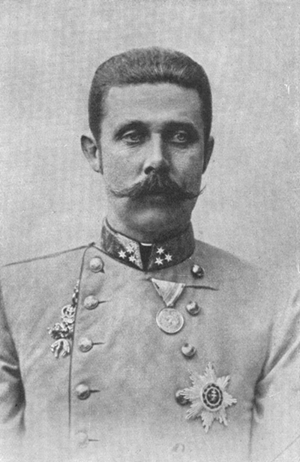
In 1908, Franz Joseph saw his chance to strengthen the Austrian presence in the Bosnia-Herzegovina when Turkey had been taken over by a coup and forced the Sultan to agree to a Parliamentary constitution. This threatened the Austro-Hungarian mandate over Bosnia-Herzegovina. The decision was dangerous, but necessary and despite Franz Ferdinand’s disagreement, on October 6, 1908, Franz Joseph announced the annexation of Bosnia-Herzegovina. This announcement was met with much rage in the Balkan Peninsula and throughout the rest of Europe. Despite their cries, Alexander II was faced with a crisis of his own people and could not help the
| Serbs with their problems with the annexation. This forced Serbia to back down and relieve the crisis for a short while. In Europe, the Powers were alarmed by the upset of the balance of power. Germany was forced to agree with the annexation because of their alliance (Triple Alliance: Germany, Italy, Austria) with Austria and its prospect of being completely surrounded with enemies (the Triple Entente: Britain, France, and Russia). Not much heavy resistance was encountered in Bosnia or Herzegovina, but they would continue to build up pressure. Time continued and the creation of radical terrorist groups, such as the Black Hand, were formed to put an end to the Austro-Hungarian rule in the Balkans. The Black Hand was well publicized throughout the Balkans for their hatred towards the Habsburgs. Their assassination plots were also well known to the Austro-Hungarian officials, but most of them ignored. By June of 1914, Archduke Franz Ferdinand was ready to make his first trip to Sarajevo, Bosnia, which would change the fate of the world forever. |
|
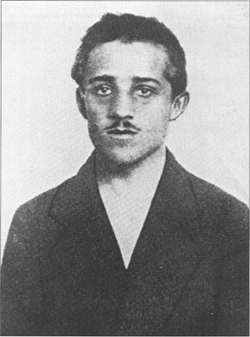
June 28, 1914:
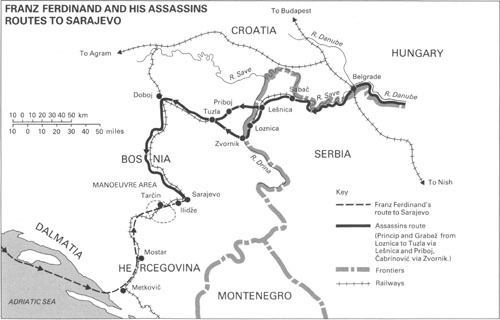
| On the morning of June 28, 1914, Franz Ferdinand prepared for his six-car procession through Sarajevo towards town hall. In his convertible sat a chauffeur and Franz Count Harrach; in the rear, himself and his wife, Sophia. Dressed only with a specially constructed bulletproof vest, his neck and head were vulnerable to any would-be assassin. As the entourage traveled down Appel Quay, the widest street in Sarajevo, the crowds were festive all cheering Zivio! Then from a new army barrack across the Cumurja Bridge, a bomb was hurled out of the crowd directly at the transport. The bomb bounced off the arm of Ferdinand and he was left unharmed; however, the car following | 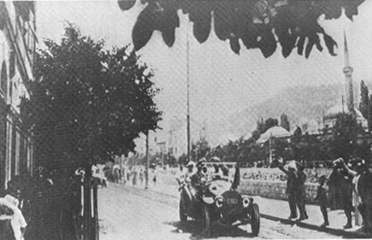 |
|
Ferdinand’s took the bulk of the punishment injuring Colonel Merizzi. The entourage then proceeded hastily towards town hall. |