The assassination of Archduke Francis Ferdinand was the culmination of much
tension leading to World War I. It was the spark that lit the fires of the Great War.
However had Ferdinand survived, World War I would still have occurred. The war would still
taken have place, although the number of civilian and military casualties would have been
far fewer and the war would have concluded much sooner. But, Germany would not have been
completely annihilated and another superpower would have soon risen in the East to
threaten the rest of the world. (Note: this is merely a hypothetical situation based on
facts).
The Hapsburg Empire at this time was a far cry from its glory days of
power. It was in complete disarray and chaos. In a time of great nationalism, the empire
was severely fragmented into more than eleven different nationalities. There was much
tension and dissension between the various ethnic groups and civil war would have broken
out in due time. Had Ferdinand lived to become emperor, he would have spent much of his
reign trying to restore the prestige of his once glorious empire.
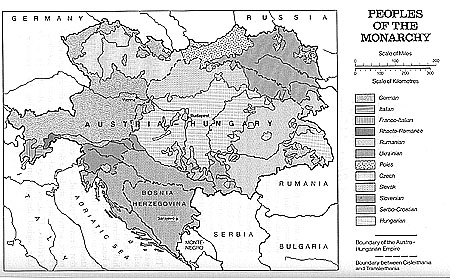
If order needed to be restored in the Austro-Hungarian Empire, Germany
and Russia would have played a major role. The Hapsburg Empire was primarily divided into
three major ethnic divisions. The Germans at 23 percent, the Magyars at1 11 percent, and
the rest comprised of various Slavic groups. If the empire were to disintegrate, the
Germans and Magyars would most likely favor union by Germany, as would the Slavs and
Russia. This would bring the two nations into direct conflict with each other over
specific boundary disputes. There was already much tension between these two behemoths and
further aggravation of boundary disputes would most likely lead to war. War between Russia
and Germany would mean war in all of Europe, due to the entangling alliances systems of
the Triple Entente and Triple Alliance, thus World War I would still occur.
This scenario of World War I would be no war of stalemate or attrition.
It would be fast paced with lighting attacks and brilliant battle tactics. The war would
be based on who could achieve victory fastest. This would be true because war would not
have occurred as soon as it did. World War I started in 1914 soon after Ferdinand’s
assassination. Had he lived, it would have taken a few more years before the Hapsburg
Empire would have been in serious decline and Russia and Germany to reach the peak of
tension. Therefore, more time would have meant more time to develop new technologies and
arms, which would result in mores catastrophic deaths and destruction.
In no one country would this growth be greater than in Russia. Although
the Japanese in the Russo-Japanese War had only a few years earlier humiliated Russia, it
was still growing at an astounding rate. Between 1848 and 1914, Russia’s population,
already the largest in the Europe grew from 70 to 174 million. In 1890, the nation began
rapid industrialization and by 1910 its iron and steel production was half that of
Britain’s. With each passing decade, Russia was growing stronger and much more
powerful.
Thus a delay in the battle cry of war by a couple years or so would
have been very beneficial to Russia. It would have given the country much needed time to
prep and mobilize for war. Thus, when war would break out, Russia would be a much stronger
power in the east and Germany would be even more hard-pressed to earn a quick, decisive
victory. The Germans had to hope for a quick victory of face eminent defeat. They could
not afford any form of stalemate or trench warfare.
However, the Central Powers did have one advantage. The United States
probably would not have entered the war. Prior to the actual entrance of America into
World War I, there was much isolationist feeling throughout the nation. America entered
the war because Germany had continually violated American naval rights (i.e. sinking of
the passenger ship Lusitania). There was also the Zimmerman Telegram, in which Germany
proposed an alliance with Mexico to invade America and seize territory, which further
antagonized the Americans. Had World War I occurred a few years later, these events would
not and could not have occurred. Germany would not have the capability or idiocy to do
such events. Germany was vastly outnumbered in all aspects of the war; it could not
realistically afford to waste precious torpedoes on passenger ships.
Because of such Allied superiority in most aspects of war, World War I
would have ended much sooner than it did. Germany would have been defeated earlier and the
number of deaths, civilian and military would be far less, since there would be no
stalemate or trench warfare.
At the end of the war Germany would have gotten off much easier than it
did in the actual World War I. Because there would be less deaths and destruction, the
would be less animosity towards the Germans. Therefore, Germany would have had no desire
for vengeance against the allies, Adolf Hitler would have continued to struggle as a
painter and end up doing odd jobs, but World War II would have still occurred.
In post-World War I, Russia would have emerged as a true juggernaut. It
would have gained much prestige over its victory over Germany and command much respect.
With this pride would come the need for Russia to expand its boundaries, particularly in
the Eastern European. The remaining allied powers naturally would come to the defense of
these countries and World War II would have begun. However instead of the Allies and
Russia fighting against Germany, it would have been the Allies and the Germans facing the
Russians.