|





|
|
|
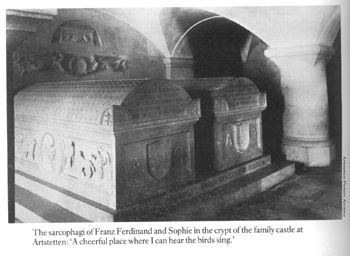
In 1914,
the assassination of the Archduke of Austria in the Balkans sparked a series of events
that eventually led to the outbreak of the First World War. Immediately following the
assassination, Germany pledged its full support to Austria-Hungary. This blank check
pressured the Austrians to declare war on Serbia, while France secured its backing of
Russia. On July 28, 1914, Austria-Hungary declared war on Serbia. One day later, Russia
ordered a partial mobilization against Austria-Hungary in support of Serbia. The Germans
threatened with war if the Russians did not demobilize. On August 1, Germany declared war
on Russia, and two days later, on France. The German invasion of Belgium to attack France
directly violated Belgium’s official neutrality. This provoked Britain to declare war
on Germany. The First World War had finally begun. |
 |
The outbreak of war stressed the need for civilian participation
towards the war effort. Many participated in the production of guns, munitions, and other
supplies. Thus, World War I was considered a total war. |
|
The dawning of World War I led to many new innovations. The
British introduced an armored vehicle with caterpillar treads. By 1915, airplanes and
balloons were being used to carry passengers and take photographs of enemy positions.
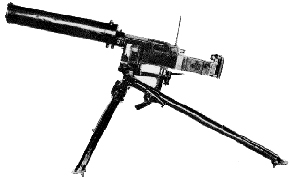
Anthony Fokker introduced the developments of a machine gun that could be synchronized
with the propeller of an airplane. Biological warfare also came to be a result of the war.
|
|
Germany’s
unrestricted submarine warfare swayed the American people against Germany. Most Americans
also objected to Germany’s violation of Belgian neutrality. Americans soon came to
the conclusion that democratic government would be unsafe if Germany won the war. On April
6, 1917, Woodrow Wilson declared war on Germany. |
|
The
first act of peace after the war was to draw up a constitution for a League of Nations.
The League was designed to reduce the chances of another war. The first decision that was
made was the formation of the treaty of Versailles. |
|
The
Reparation Commissions decided that a sum of 132 billion gold marks would be a suitable
sum to pay. Germany immediately stopped all reparation payments after France and Belgium
occupied the Ruhr coal and iron district on the bank of the Rhine. An economic panic
followed, German money became worthless and many Germans were financially ruined. |
|
After
1929 a worldwide depression set it. As it spread, more of the Versailles treaty agreements
broke down. In 1933, Adolf Hitler became head of the German government. |
|
It
soon became evident that another war was coming into the picture. Italy, under Benito
Mussolini allied his nation with Germany. The Axis powers seized Ethiopia and Albania.
Next, it moved into Czechoslovakia. When Hitler’s troops invaded Poland on September
1, 1939, France and Great Britain declared war on Germany. These events soon became the
beginning of World War II. |
|
|
|