


|
|
|
The Mortar Cannon

This cannon was used to fire cannon balls were the other cannons could not. Mortars were mostly used by the Union although both sides used them in the war. They ranged from weighing 300 pounds all the way to 17,120 pounds. The biggest mortar cannon could fire a 220 pound bomb 4,325 yards. Siege Mortars fired 44 to 88 pound shells respectively. This is some out of a lot of information about the Mortar cannon.

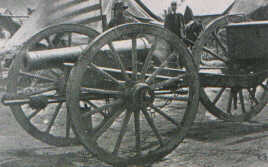
Napoleon
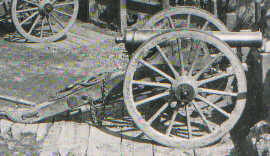
The Napoleon was the most popular, common, and deadly field piece during the Civil War. The barrel was of bronze, it fired a 12.3 lb projectile and had a maximum effective range of about 1,600 yards. The barrel with its carriage weighed 2,445 pounds, light enough to be hauled by men for short distances, however, the usual method of transportation was by a six horse team with a driver aside one of each pair of horses. Union Napoleons had a slight swell at the muzzle of the 4.62 inch bore. Confederate made pieces were generally tapered and some had a band reinforced breech. Artillery men favored Napoleons because their bronze barrels were stronger than those made of iron.
3 inch ordnance gun
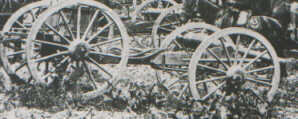
This was a rifled cannon made of wrought iron and was along with the 12 pound smooth bore Napoleon, the mainstay of field artillery batteries. While the Napoleon was the weapon of choice for short range fighting, the ordnance gun was valued for its long range accuracy. A one lb charge of gunpowder could accurately propel a 10 lb elongated shell a distance of 2,000 yards at only 5 degrees of elevation. Longer distances, but less accuracy, could be achieved with higher elevations. Artillery men preferred this piece because it did not have the tendency to explode upon firing. These cannons cost about $350 each.
Parrot Rifle Cannon
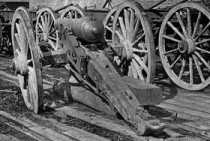
This was a cast iron cannon that was a workhorse of the artillery for the first years of war. These weapons were used primarily by the Union forces, although the South created a copy called a Brooke Rifle Cannon. This Parrot sold for about $187 each.
Whit worth Breech Loading Cannon
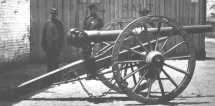
This cannon was an English model gun imported by the Confederacy during the early months of the war before the blockade was tightened enough to be effective. It was the most accurate of the South's artillery weapons. The Whit worth's bore, instead of using rifling groves was a spiral hexagonal shape. Ammunition for this cannon had to have the same shape as the bore. A good portion of the equipment used by Southern forces during the war was captured from the Union during the early battles.
Brooke Rifle Cannon
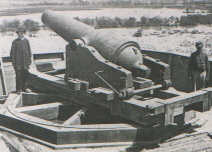
The Brooke Rifle, named after its develop John Mercer Brooke, closely resembled the Parrot guns used by the North. The Brooke Rifle was a breech loading gun which had a long, heavy tapered barrel constructed of cast iron. Brooke Rifles came in a variety of caliber's, 6.5; 7; 8; 10 an d11 inches, but it was the smaller 3 inch field piece that became the backbone of Southern artillery. The 3 inch cannon weighed 900 lb sand could fire a 10 lb shot 3,500 yards and its relative lightness required fewer horses to pull it.
Rodman
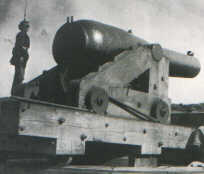
The Rodman is actually a manufacturing process rather than a cannon; developed by LT. Thomas Roman in the mid 1840's for casting large iron cannon. The process made the guns stronger, longer lasting, and less likely to develop cracks. The 15 inch Roman Columbaid was the largest actually used by the Union during the Civil War. It was bottle shaped and weighed 25 tons.
Armstrong
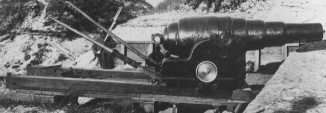
The Armstrong was a large rifled cannon invented by an Englishman, Sir William George Armstrong in 1854. It's most noticeable feature was the series of graduated coils over a lengthwise tube, causing it to look like a giant collapsible telescope pulled out in overlapping circles. Because exploding guns were a constant problem, the Armstrong design was a huge success. Armstrong's fired a grooved projectile which weighed 12 pounds out a distance of 2,200 yards. 3 inch breech-loading Armstrong's fired a 12 pound projectile out a distance of 2,100 yards.
Blakely
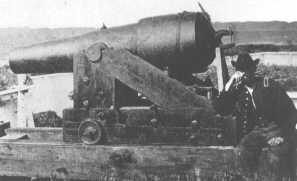
The Blakely cannon, imported from the British by the south along with the Whitworth and Armstrong guns, was invented by English Captain Alexander Blakely. The most commonly used Blekely's had a bore of 3.1 to 10 inches and used a variety of ammunition, including flanged and studded projectiles. The Blakely gun quickly became obsolete and soon was seeing little services as more advanced gun designs were produced.
Dahlgren
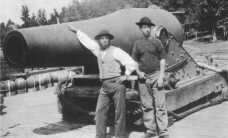
The Dahl cannon was strong enough
to fire a 170 lb solid shot which was more effective against the newly
encountered ironclads of the war. The 15 inch gun weighed over 20,000
lbs and required a hoist and a two man crew to load the 400 lb spherical
shot