Pinelands High School
|
Pinelands High School
|
|
|
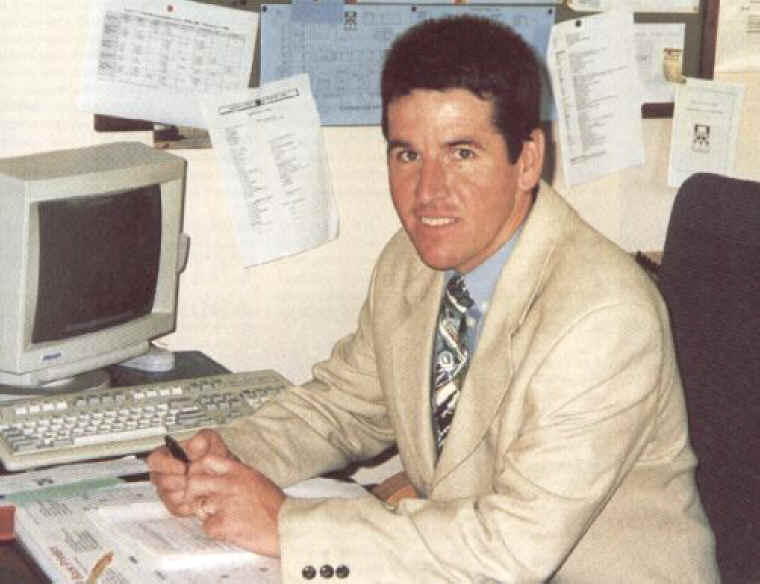
From the Principal's DeskMr D.I. Arguile
A Time For Keeping Records.........
An Extract from the 1999 Pinelands High School magazine:
"A thorough, critical analysis should convince you that Pinelands High is a very special school, one worthy of being labelled as a top school".
This school magazine, if it fulfils it’s function, will convey a positive picture of Pinelands High School as it has gone about it’s business during 1999. It will reflect on a very full curriculum, on many successes, on learners who made full use of what this school has to offer and on much more. The photographs and the tone of the various articles should give the reader a good idea of the "character" of Pinelands High. The magazine, not unlike a testimonial, will not dwell on negative aspects. It will not focus on discipline problems, on social problems, on financial stresses, on staffing difficulties, etc. We very definitely experienced some of these this year but I am pleased that they were heavily outweighed by all that was positive. I thus ask that as you page through this magazine you "read between the lines". A thorough, critical analysis should convince you that Pinelands High is a very special school, one worthy of being labelled as a top school. The Sunday times recently published this year’s list of top 100 schools. PHS was again included in this list after deciding to participate in the survey for the first time last year. This decision to participate was not an easy one. We first needed to satisfy ourselves that the survey was not an exercise in elitism. A major motivation was that we felt that the very detailed questionnaire could serve as a useful benchmark for the school. This has proven to be the case as completing it for the second time this year has indicated areas where we have made progress and areas where we are in danger of stagnating. The Outreach Category was particularly important to us and we were thus very pleased to be recognised as being one of about thirty schools with significant outreach programmes. We were very disappointed to discover that this category was discontinued last year and subsequently expressed this concern in a letter to the organisers. I am also concerned about what I perceive to be an over-emphasis in the survey on Matric exemption and on 100% pass rates. With regard to the first issue, we at PHS attempt to prepare learners for tertiary training of one form or another by offering a broad curriculum. While many of our learners go on to do exceptionally well at university, we should not be trapped into forcing learners in that direction when, for example, Technikon education is possibly more appropriate. We council our learners, assisting them in making wise subject choices and trying to ensure that these subjects are studied at the appropriate level (Higher or Standard grade). We then do what we can to ensure that the learner is successful in the examinations. While we obviously aim at 100% pass rates and must always question whether we as teachers are adequately preparing our matric candidates, the learner is ultimately accountable for his or her success. We will continue to council learners and communicate with their parents in order to encourage good decision making, but will not "manipulate" the composition of our matric classes in order to ensure 100% pass rates. We will also continue to celebrate the success of those learners who produce their best to only scrape a pass, just as much as we celebrate the A-aggregates. The test of whether or not our education is truly effective only becomes apparent years after a learner has left school and for that reason is difficult to measure. Our commitment to Total Quality Management necessitates that we do most of what the Sunday Times Survey sees as being important. Pass rates have value but we are concerned with Value-added education and it is in the broader curriculum where much of this value is to be found. Formal and informal teaching of lifeskills can, for example, separate top schools from merely good schools. I trust that after reading this magazine you will agree that Pinelands High does offer value-added education and that you will feel challenged to help ensure it continues to do so in future.
Mr D.I. Arguile.
Chairman’s Address:
"If each of us, learner, teacher, parent, guardian, past pupil or member of the community address the future of the school within this framework of a community of learners, then I know that we will do great things together".
My dictionary defines a school as an "institution for educating children or giving instruction." Today, I would suggest, this definition is wide of the mark. At best it gives one narrow facet of what a school should be about and, in particular, what our school is about. However for many parents, learners and teachers in South Africa "an institution for educating children or giving instruction" is still the working definition. When analysed, the listener will note that the operative words are educating and giving and perhaps there lies the clue to the inadequacies of the description, for they suggest a one way process that involves the pupils only at the receiving end.
Last year our theme for the school was partnership, and the mutually inclusive nature of this word exemplifies for me what education should be all about and what is lacking in the dictionary’s definition. I would like to suggest that we think of the school as a community of learners, and by community I mean, not only teachers, parents and, in context, the broader community in which the school is placed.
The fact that we now call pupils "learners" already exemplifies the change in attitude at Pinelands High. Our teachers will not be surprised to hear themselves included in the community of learners. They should, and do, continue daily to learn more about the process of teaching itself. A teacher who is not open to learn is not going to transmit that same attribute in the classroom. Parents, on the other hand, recognise their role in the education process but may not see themselves as learners. But we do learn. In one sense, if we are lucky, some isolated gems of knowledge are relayed to us at the dinner table at the end of the school day, or we pick up something whilst helping with homework. In a deeper sense though we learn a great deal about ourselves as we interact with the maturing minds of the young adults in our homes, as they, in turn, interact with peers and teachers.
This process has become more explicit in recent years. The mindset of a decade ago, that schooling is the (almost) sole responsibility of the State, has changed for good and, I believe, in some ways for the good. The impact most felt by parents is clearly financial. Provision for primary and secondary education now forms a considerable part of the household budget. Today the last generation of non-fee paying learners has worked its way out of the system and fee-payment has become an accepted fact of life. I foresee that, as the financial management of schools like ours settles down, the new issues that will arise will be educational. Firstly we have to come to terms with Outcomes Based Education (OBE). At present in the process of design and implementation, it appears to be a mix of good and bad, with many issues unresolved. Our relatively new minister of Education, Kadar Asmal, is having a fresh look at curriculum 2005. All of this presupposes that teaching staff will be in good shape so that schools can cope with the changes. I have every confidence in the staff at Pinelands High but am deeply concerned for the majority of the country’s schools most of which are far less fortunate than ourselves. Secondly, the competition for good teachers will intensify as the Education Department comes to terms with a future shortage of teachers. Already there is a shortage of suitably qualified Mathematics and Science teachers, although the Department has still to acknowledge this.
The good news is that, because of the devolution of responsibility to the School and the Governing Body, parents and educators are, more than ever before, in a commanding position to shape the future of the school. The wider community must also play its part. After all, one of the major factors in choosing a home is the quality of the nearest school. What of those of you whose remaining school days can be counted on your fingers? The alumni of the school will have an increasingly important role to play. Tonight you may have other things on your mind, such as examinations and a future career. But when you have established yourselves, think of this community of teachers, continue to be part of it by joining the Past Pupils Association, and support the school by coming to its plays and musicals, reunions and sports matches.
If each of us, learner, teacher, parent, guardian, past pupil or member of the community address the future of the school within this framework of a community of learners, then I know that we will do great things together.
Professor C.R.A. Gilmour |
|
We strive to be a world-class school, rooted in Africa, that facilitates a quality, all-round education in a caring and disciplined environment. Webmaster: Harvey Muzzelle: [email protected]
Send mail to [email protected] with
questions or comments about this web site.
|