
 |
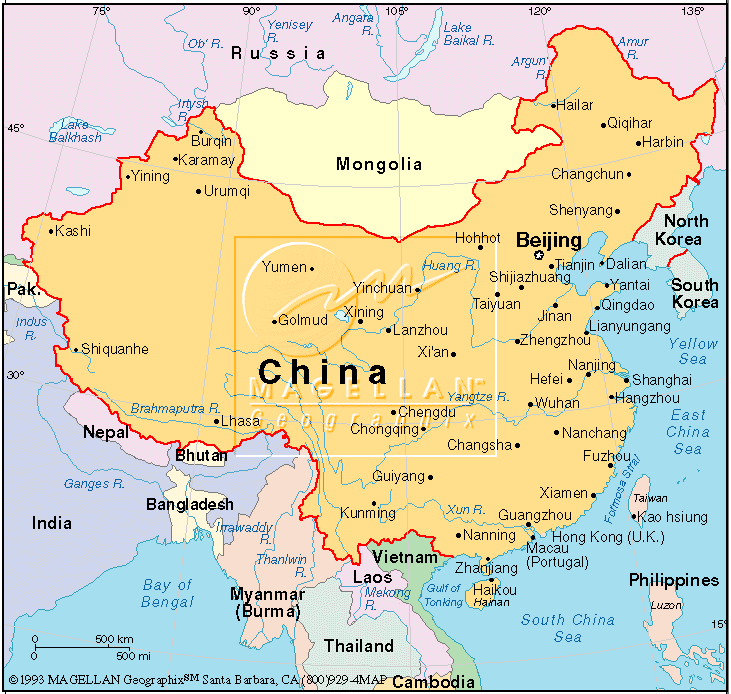
China is one of the most exciting countries in the world to tour, if you are willing to face some adversities. Here are some suggestions about getting to China and travelling in China.
The first step is the same for everyone. Get a passport! These are available through your local post office, should still be under $100.00, and take about 6 or so weeks to process, faster if you give them priority envelopes. Getting a visa is the next step. There are at least two Chinese embassies in the USA, in Washington and New York. (Actually, the one in NY is a consolate). They will issue you a VISA for about $100.00
The money system in China is fairly easy to get used to. The currency is called Ren Min Bi, which means "The People's Money". Most foreigners who don't speak Chinese call it RMB for short, or for linguistic sanity. Until about 1994, the exchange rate was 5 to 1. Then China suddenly wanted to join the General Agreement on Trade and Tarriffs. To do so they had to stop stealing foreigner's money and the rate went to 8 to 1 overnight. To adjust for the loss, it also seemed like the foreigner price at tourist sites also jumped twofold. At any rate, you'll find that a dollar can go pretty far in China. Below are a list of suggestions for using your RMB wisely in China. If you are not frugal like me don't worry there are suggestions for you too.
Making it last in China.
1. Take only busses and trains. The bus is almost free, and trains are also reasonable. Even if you break your arm fighting to get on an overcrowded bus,
medical care if quite cheap, and accordingly useless. Some cities have a
foreigner's window for train tickets. Another suggestion is to go to a university and find a few students who speak English. They will be happy
to have an opportunity to practice their English and make a friend, and
you will have someone to help you get around or buy train tickets.
Of course, if you're loaded and can't be bothered with the hassle, ignore
these suggestions, take airplanes and the most expensive taxis.
A) Make sure taxi drivers run their meters.

B) If they refuse, get another taxi.
C) If your in a city where they all refuse you can:
   1.  pay only the minimum fare (about 10-20 chinese$) or:
   2.  take down their licence plate number, identification number, and
       ask for a receipt.  They will often get nervous and charge you
       the right amount, or:
   3.  if your in a group or really brave, just don't pay them, Or:
   4.  make an offer you think is reasonable.
2. If it's not a state run store, bargain for everything you buy. My wife has become extremely successful with this art. One time she had a man selling something so cheap that his wife slapped him when she overheard he was getting ready to sell it lower than their own cost. You won't be quite as successful if you do not speak Chinese. If you don't try though, you will be overcharged on more than one occasion. Always bargain cheerfully and humerously, rather than with suspicion and scorn. Show them the holes in your jeans and gesture as much as possible.
3. Don't go to fancy restruants. Often their food is not any better than curbside restruants and it's certainly a lot more expensive. Chinese food is cooked in oil at high temperatures, and so the inexpensive restruants serve quality food even though they may appear to be dumps. If you order anything by weight, ask whether you are being charged by the pound or Chinese ounce, 10 ounces in a pound. I once ordered a one pound turtle. I thought it was $4US/pound. Other meat dishes are about $2US, so I thought double the price was about right. It came out that the dish was $4US an ounce and I got a bill for $40US and the waiter had to bail me out. Finally, whether you eat at expensive restruants or cheap, you certainly do not need to waste money tipping. It's not a custom in China.
4. Become a Lonely Planet reader. This excellent manuel lists tourist attractions, and other interesting things to see and do while you are in China. To help with your expenses, it lists places to lodge from the most expensive to the really inexpensive. If your really a budget traveller though, look for other backpackers and ask around. I have found hostels even cheaper than the ones listed in Lonely Planet. The cheapest I ever found was 80 cents a night. Of course, that was after bargaining for a special student price, and it was a few years ago.
Hope these tips were helpful. If you want more information check out some of the sites on my links page. You will also want to see my pictures before you leave.



 |
 |
 |
 |
 |
 |
 |
 |
 |
 |