Smooth
newt Triturus vulgaris
and Palmate
newt Triturus helveticus
Description
These species
are similar in their appearance and ecology. Both reach a maximum
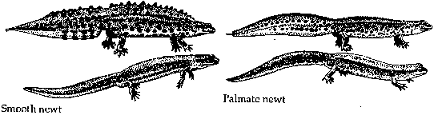
adult size of around l0cm. Male smooth newts have a distinct
wavy crest all the way down the back and tail; this along with
their colouration becomes more pronounced in the breeding season.
Male palmate newts have more of a ridge than a crest, and a
distinct "thread" at the end of the tail. Female smooth
and palmate newts are almost identical in colouration. Both
species have widespread distributions, but palmate newts are
more restricted in their habitat preferences, and occur more
frequently in areas with acidic substrates. Palmate newts tend
to be the more common species in the west of the country and
on heathlands and boggy sites. Elsewhere smooth newts tend to
be found more frequently. Both newts tend to occur in small
to medium sized ponds, and have undergone declines in some areas
of their range.
[NOT
TO SCALE]
Life
history
Both newts breed in the spring, from around February through
to May or June. Males court the females with an elaborate dance.
The females lay eggs individually on the leaves of aquatic plants.
The eggs hatch out after around three weeks and the newt larvae
take a further two months to transform into juveniles, at which
point they leave the water. Unlike frogs and toads, newt larvae
are entirely carnivorous (as are the adults), the front legs
appear before the rear ones, and they have large, feathery gills.
Adult newts only return to the water to breed. Hibernation occurs
from around mid~October to mid-February; however, sometimes
newts (including larvae) will remain in the water overwinter.
Critical factors - smooth and palmate newts require:
- Ponds
for breeding - generally shallow to medium depth, well vegetated,
unshaded pools that may or may not dry up in summer.
- No
fish - newt larvae are eaten by fish.
- No
waterfowl - newt larvae and aquatic plants (and hence eggs)
are eaten by waterfowl.
- Submerged
aquatic vegetation for egg-laying.
- Easy
exit from the pond for emerging juveniles and adults (i.e.
no steep sides).
- Damp,
vegetated areas around the margins for cover for emerging
juveniles.
- Areas
of rough grass for foraging and cover.
- Daytime
refuges, such as logs, rocks and shrubby vegetation.
- Areas
of woodland or similar habitat for hibernation. .
 
(Provided
by and reproduced with permission of: English Nature)
|
|