Albany Committee Chamber
June 7, 1776
Lewis Van Woert
Lewis Van Woert, (also commonly spelled Louis in the historical record) was the nineth child, fourth son, of Jacob and Hendrikje Van Woert. He was born in Albany and baptized in the Reformed Dutch Church of Albany on 1/11/1738, with Louis and Hiltje Credel witnessing.1
Lewis grew up in the Albany area, receiving property from his uncle in Rensselaerwyck Manor at about age 28 years.
Deed per Will - Albany County Clerk's Office Book 1, Wills. page 320 - Date March 26, 1763 - recorded November 17, 1766 - Peter Van Woort, by Will, grantor - Lewis Van Woort, grantee - House and land in the Manor of Rensselaerwyck and personal property. Casparus Pruyn and nephew Cornelis, son of brother-in-law Clae Van Den Bergh, executors. Peter Van Woert’s will was taken from the Early Records Of Albany, Mortgages 1658-60 and Wills 1681-1765. 2In 1765 he married Catharina Van den Bergh, daughter of Volkert (Folkert) Van den Bergh, also from Albany. In his Will made September 1766 and proved July 16, 1767, Volkert Van den Bergh mentions his son-in-law Lewis Van Woert.3
The Dutch Reformed Church, Albany, has the following records:When Louis was about 33 years of age he took his wife and three young children and moved northeast to the Hoosick - Schaghticoke - Cambridge area.Marriages
"October 10, 1765 - License of Sept. 24 - Lowis Van Woert and Catharina Van den Bergh, young people of Albany."Baptisms
1. Hendrikje, of Louis V. Woert and Catharyntje V. D. Berg, born 8/2/1766, baptized
8/3/1766. Witnesses: Yzac J. and Annatje Lansing. Married Adriaan Lambertus De
Ronde 1/12/1787.2. Catharina, of Lowys Van Woert and Catharina V. d. Berg, born 10/23/1768, baptized
10/23/1768. Witnesses: Adriaan and Folkje Qwakkenbusch. Catharina married
Johannes (John) Quackenbosh and had two sons named Harmen/Hermen (one
evidently died), and one named Daniel.3. Jacob, of Louys Van Woert and Catharina V. d. Berg, born 3/5/1771, baptized
3/6/1771. Witnesses: Jacob and Elizabeth Van Woert. Jacob married Neeltie
Quackenbush, daughter of Harmon and Judith Quackenbush.4. Folkje, born June 5, 1773, baptized 7/30/1773. Witnesses: Adriaan and Folkje
Quackkenbusch6. Rachel, baptized 10/28/1778. Witnesses: Adriaan and Folkje Quakkenbusch. Rachel
married James Baget (Badgett or Bogert) in the year 1802.
Baptisms
5. Sarah, of Lewis (Jacobse) v: Woert and Cattrina v: Denberg, born 10/17/1775.
Witnesses: Cornelius v: Ness and Alida v: Woert. Sarah married Nicolaas Groesbeck7. Folkert, of Lewis v: Woert and Cattrina v: Denberg, born 2/5/1781.
Witnesses: Burger v. Denberg and Folkye v. Denberg.8. Petrus (a.k.a. Pieter or Peter), of Lewis V. Woert and Cattrina V. D. Bergh, born 10/7/1783.
Witnesses: Petrus V. Woert and Rachel Vedder.9. Lewis, of Lewis van Woerd and Catrina vandenberg, born 1/18/1787, baptized
2/16/1787. Witnesses: Burger van den Berg and Hendrika van woerd
"When first erected, Cambridge included its present territory the towns of Jackson and White Creek, and part of Vermont, and was within the jurisdiction of the county of Albany. By the act of dividing the county of Albany into districts, passed on the 12th of March, 1772, it was enacted that all that part of Albany county lying north of Schaghticoke and east of Saratoga be what was then called a district, and named Cambridge, and it was thereby enabled to elect certain officers to manage its local affairs, and a supervisor to act in county affairs with those of the other districts." 4
Lewis Van Woert, was man of good reputation and esteemed by his peers for his leadership abilities. He involved himself in his district's civil government as the minutes of the 1776 meeting reveals:
"At the annual district meeting of Cambridge, held at the house of Simeon Covel, at White Creek, the first Tuesday in May, 1776, Lewis Van Wort, moderator (presiding officer); John Youglove, clerk; David Sprague, supervisor; Joseph Younglove and Seth Chase, assessors; John Youglove, treasurer; Isaac Wood, Jabes Mosher, James Cowan, and John Morrison, poormasters; James Patterson and David Harrow, constables; David Harrow, collector; Philip Van Ness, Samuel Hodges, Simeon Covel, John Allen, Jabes Mosher, John Morrison, Isaiah Younglove, John Wood, Captain Henry Sherman, Samuel Bell, Joseph Youglove, Captain Edmund Wells, Moses Cowan, James Ashton, Elisha Wadsworth, Samuel Heth, and Richard McClaughrey, pathmasters; Joseph Wells, Gershom Woodworth, Samuel Hodges, John Hogel, fence-viewers and appraisers, Isaac Perine, Abraham Wright, John Pierce, Benjamin Tiffany, Oliver Selfridge, Alex Shelly, Samuel Morrison, Robert Christie, firemen; Samuel Hodges and James Cowden, poundmasters. Voted five pounds' fine for any person or persons who shall willfully or through neglect fire in the woods; to be collected by the committee and appropriated to mending the highways. Voted that every male above the age of sixteen years shall work on the roads six days, unless lightened by their bail; and any who shall neglect or refuse to conform to this vote shall be muleted the sum of five shillings, - three of the members of the committee to grant a warrant to the overseer of the highway for the recovery of said fines, - which, also, is to be laid out on the highways. Voted as committee-men: Comfort Curtis, David Preston, Phineas Whiteside, John Youglove, James Ashton, Samuel Hodges, John Blair, and Henry Smith. Voted as committee in reserve: Edward Rigg, James Green, Levi Preston, Gershom Woodworth, Cornelius Doty. Voted that the field-officers for the Eighteenth Regiment of militia be chosen the 11th instant, at the house of Captain John Wood. May 11, 1776, met according to the vote; at the house of Captain John Wood, and voted Lewis Vandevort, colonel; John Blair, second colonel; James Ashton, first major; Ebenezer Allen. second major; John Youglove, adjutant; Asa Flint, quartermaster."5"In 1816 the towns of White Creek and Jackson were set off, leaving the Town of Cambridge with its present area, twenty-two thousand six hundred and fifty-seven acres, and the following bounds: north by Jackson; east by White Creek, the boundary line being the turnpike; south by the Hoosick river and Rensselaer county; and west by Easton. Its position relative to the other towns in the county is the southernmost in the middle tier.New York Historical Marker #2744 is placed at the site where these field officers were elected. (Select Washington County: White Creek, Town of: Site of Home, John Wood)
The surface of the town is pleasantly varied by hills and dales, the summits of the hills rising from two hundred to three hundred feet above the valleys, and descending in elevation towards the Hoosick river, where the country is generally level. Along the eastern border is a portion of the valley of the Owl Kill, or the famous Cambridge valley, whose reputation for fertility and beauty is world-wide. The town was originally well timbered, a considerable portion of the lowlands with pine. A fair proportion of the uplands are yet covered with fine groves, whose contrast with the well tilled fields and attractive buildings produces a happy effect. The soil is a loam, varying from a sandy composition to a light clay, with occasional lots of a gravelly nature. It is generally very productive, and especially adapted for the culture of flax, potatoes, and garden seeds. The production of the latter forms an important industry. The town has but few streams, and none larger than a brook, but these are well distributed and afford good drainage.
Cambridge embraces a part of the Hoosick Patent, which was granted on both sides of that stream in 1688, the principal portion being in Rensselaer county. About four thousand acres are included in Cambridge. The remainder of the town was a part of the Cambridge patent, granted in 1761 to Isaac Sawyer, Edmund Wells, Jacob Lansing, Wm. Smith, Alexander Colden, Goldsboro Bangor, and others, on condition that immediate settlements be made. The tract included thirty-one thousands five hundred acres, north of the Hoosick patent and extending up the valley, which took the name of the patent.
To induce settlement on the Cambridge patent, the patentees gave one hundred acres to each of the first thirty families who would become actual settlers. The names which are now know of the first settlers are John McClung, James and Robert Cowan, Samuel Bell, Colonel Blair, George Gilmore, George Duncan, David Harrow, Wm. Clark, John Scott, and Thomas Morrison (whose son was the first-born child among the settlers). These came to the lands in 1761-63. Other early settlers in the vicinity were Ephraim Cowan, Robert Gilmore, Austin Wells, Samuel Clark, Jonathan Morrison, Edwin Wells, John Allen, David Sprague, Seth Chase, John Woods, John Harrow, Thomas McCool, Thomas Ashton, Simeon Fowler, John Young, Josiah Dewey, Rael Beebe, Samuel Clark, Wm. Eager, Wm. Selfridge, John Younglove, and John Corey.
On the Hoosick River and partly in the town of Cambridge, is the village of Buskirk's Bridge (this is part of the Hoosick Patent). The place derived its name from Marten Buskirk, an early settler, who built the first bridge across the stream. He was also a pioneer tavern-keeper, his house on the Cambridge side having a wide reputation. Philip Van Ness, John Quackenbush, and Colonel Lewis Van Wort, of Revolutionary times, were among the early prominent settlers near Buskirk's. There was a store kept by Carpenter, and afterwards by Allen, which enjoyed a large trade in those days. But the business interests have all passed to the Rensselaer county side."6
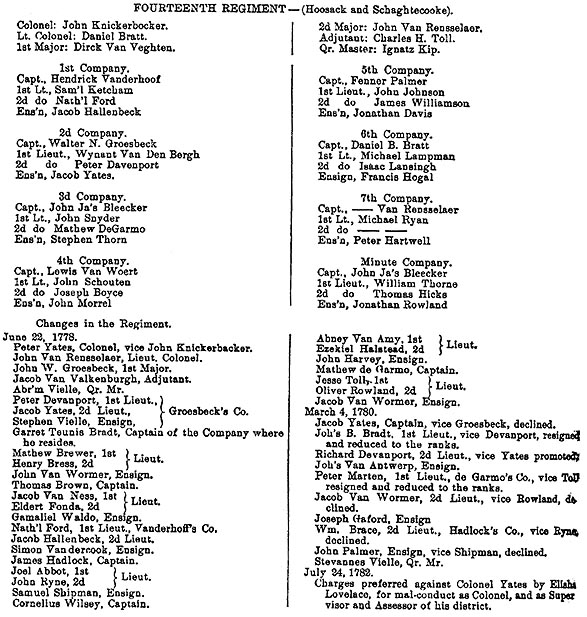
"Louis Van Woert was one of the early settlers on the Hoosack Patent."7Lewis Van Woerdt was listed in the American Revolutionary War as Captain of the 4th Company, 14th regiment; Mr. Knickerbacker was Colonel. These recruits were from the Hoosack and Schaghtekooke district. The commission was issued 10/20/1775.8The following deed was located in the Albany County Clerk's Office:
Book 9, page 179 - Dated 12/14/1771 and recorded on 3/15/1773 - John R. Bleeker and wife Elizabeth, grantor to Lewis Van Woert, residence Manor of Rensselaerwyck, grantee - Lot 34, 1,176 acres north side of Schachtikook River, Hoosich Patent, near Tajagrook, Albany County, NY. (The property mentioned lies east of the Hudson River.)
Albany Committee Chamber
June 7, 1776
The Committee of Cambridge requested fifty pounds of powder and a proportion of lead to be delivered to Coll. Lewis Van Woerdt."The Sixteenth Regiment of Albany County Militia took to the field, Col. Lewis Van Woert commanding, from August 13, 1779, to November 30, 1780."10Resolved that twenty pound of gun powder be delivered to Lewis Van Woerdt and Phineas Whiteside, and that they be accountable for the same, and return what remains after the exploit to the District Committee or such person as they shall appoint."
Following is a copy of a letter from Major General Schuyler to Colonel Van Woert and Mr. Edmund Willis (Wells?), chairman of the Committee of Cambridge, dated Fort Edward, July 12, 1777. This letter was produced at the trial of Major General Schuyler.
"Gentlemen,Your letter of the 10th instant I have received. The information that four or five hundred Indians were on their way to New-Perth is totally groundless. There are not even any so high up Wood Creek as Fort Ann, where we have a large body of troops. If it was necessary to send troops to White Creek, I would most readily do it. My care shall be extended to every quarter, and if my country-men will support me with vigor and activity, we shall be able to prevent the enemy from penetrating much farther into the country; but if they suffer their spirits to sink, and meanly despond, the worst of consequences are to be apprehended.
I am informed that several people, for-getting the duty they owe their Country, discourage the good inhabitants, and are ready to take protection from the enemy. Any that have made such declarations, I would advise to have immediately secured and sent prisoner to Albany.
The enemy's view, in offering protection, is only to prevent the inhabitants from acting spiritedly; to get into the country, and, when once there, to plunder indiscriminately, as well those that may have relied on their promises, as those that have gloriously stepped forth for the defense of their country, and those blessings which they can only enjoy by having that country free: Let every one therefore exert himself and all will go well.
Maj. Gen. Schuyler."9
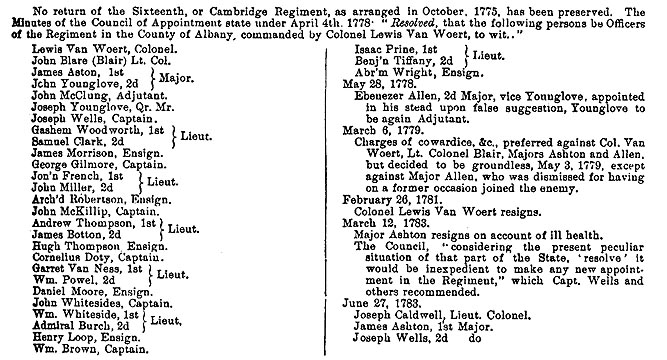
Following is a copy of a portion of a letter to Hon. Abram Ten Broeck, Brig. General of the Militia of the County of Albany, from Colonel Lewis Van Woert:A detachment of Col. Lewis Van Woert's Albany County regiment was ordered out to Skeensborough and about 40 to 50 men were taken prisoner.12"The enemy seem determined to distress this part of the Country and without your immediate assisting, we shall be all obliged to fly." Dated 10/26/178011

"February 26, 1781 - Colonel Lewis Van Woert resigns."13Lewis Van Woert applied, because of his services in the Albany County Militia, 16th Regiment, for land bounty rights at the close of the American Revolutionary War.14 Later he appears as an assignee and assignor on the land bounty rights issued by the government for War services.15
The Reformed Protestant Church at Sanckoyck, Town of Hoosick, County of Rensselaer, State of New York was organized from the Reformed Protestant Dutch Church of Schaghticoke, Schaghticoke, NY. The certificate of incorporation which was dated the 25th of February 1789, was signed by Cornelius Van Ness, David Becker and Lewis Van Woert. It is said that Cornelius Van Ness gave the piece of land on which the church was built. There are apparently no preserved records of this old church. The building was torn down in the year 1825.16
The following Will was found in the Surrogate's Room, Washington County, Salem, NY.References
Book 2, page 125 - Dated January 4, 1805, recorded 7/1/1806. In the Will of Lewis Van Wort (written also Van Woert), residence town of Cambridge, County of Washington, occupation farmer, wife Cathrina, he mentioned his farm located in the north part of lot #34 in the Hoosick Patent, bounded on the north and east by the lands belonging to my brother Peter Van Woert, deceased, and on the west by the west boundary line of the said great Lott, and south extending southerly towards the Hoosick river until it takes in 100 acres. He gives the farm to his eldest son Jacob. Besides Jacob, the following children are mentioned: daughter Rachel; daughter Hendrike; daughter Cathrine; son Volkert; son Peter; son Lewis; and daughter Sarah. A John Van Woert was witness to the signature.