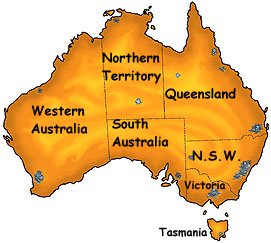
There are rainforests and vast plains in the north, snowfields in the south east, desert in the centre and fertile croplands in the east, south and south west. About one third of the country lies in the tropics. Australia has a coastline of 36,735km. Queensland comprises the north-eastern part of Australia and ranges from the Tropics to more temperate areas.The continent is one of the oldest land masses - continental bedrock exposed by erosion is more than 3,000 million years old - and is the flattest of the continents. The average elevation is less than 300 metres, compared with the world's mean of about 700 metres. The Australian Alps in the south east contain Australia highest ground, the highest point being Mount Kosciusko (2,228 metres). Vast areas are arid or semi-desert, unsuitable for settlement. The coldest regions are in the highlands and tablelands of Tasmania and the south-eastern corner of the mainland.
Australia is an independent Western democracy with a population of more than 17.6 million. It is one of the world's most urbanised countries, with about 70 per cent of the population living in the 10 largest cities. Most of the population is concentrated along the eastern seaboard and the south-eastern corner of the continent.
Australia's lifestyle reflects its mainly Western origins, but Australia is also a multicultural society which has been enriched by nearly five million settlers from almost 200 nations. Four out of 10 Australians are migrants or the first-generation children of migrants, half of them from non-English speaking backgrounds. They come to Australia for various reasons - partly because of the climate and partly because of our wonderful lifestyle.
Isolation of the Australian island-continent for 55 million years created a sanctuary for the flora and fauna. Pictured are the blossoms from Australia's National plant, the Golden Wattle.
Australia's national anthem, Advance Australia Fair, is a revised version of a late 19th-century patriotic song. It was declared the national anthem in April 1984, replacing God Save the Queen, which was designated the royal anthem. Waltzing Matilda, Australia's best known song, was thought to be unsuitable for state funerals! (Waltzing Matilda was written by Banjo Patterson. One of Australia's most well known poets. See Australian Poetry.) In the same year, Australia officially adopted green and gold as its national colours .
Australia's official language is English, by common usage rather than law. Australian English does not differ significantly from other forms of English, although some colloquial and slang expressions are unique.
The flag of Australia is the only one to fly over a whole continent. The small Union Jack represents the historical link with Britain, the large seven-pointed star represents the six States and the combined Territories, and the small stars form the Southern Cross - a prominent feature of the southern hemisphere night sky.
Australia's coat of arms - the official emblem of the Australian Government - was granted by King George V in 1912. The arms consist of a shield containing the badges of the six States. The supporters are native Australian fauna - a kangaroo and an emu. A yellow-flowered native plant, wattle, also appears in the design.
Australia's national day, Australia Day, on 26 January, marks the date in 1788 when Captain Arthur Phillip, of the British Royal Navy, commanding a fleet of 11 ships, sailed into Port Jackson (Sydney Cove). Phillip formally took possession of the eastern part of the continent for Britain and established a settlement, now Australia's largest city, Sydney.
Air travel and the great variety of Australia's attractions are combining to bring more international tourists to Australia every year. Overseas tourists are drawn by Australia's sunshine, sandy beaches, the vast outback, rainforests, the Great Barrier Reef, unique flora and fauna, the Sunshine Coast of Queensland, and the attractions of the cities, Australia's friendly, multicultural society, and the safe and welcoming environment. Tourism is one of Australia's largest and fastest-growing industries. In 1992, 2.6 million international tourists visited Australia.
|
Flora & Fauna |
Waltzing Matilda |
Advance Australia Fair |
My Country (poem) |
|
Snowy River (poem) |
Waratah & Wattle (poem) |
Old Ted (poem) |
|
|
|
|
|
|
|
|
|
|
|
|
|