Flora & Fauna
Marsupials were saved from competition
with more highly developed mammals. Birds unique to Australia also survived,
and distinctive trees and plants developed. There are 230 species of native
mammals, 800 of bird, 300 of lizard, 140 of snake and two of crocodile.
 Australia's
best-known animals are the kangaroo, koala, platypus, wombat and spiny
anteater. Isolation enabled the Australian continent to become a sanctuary
for marsupials - mammals that suckle their young in pouches. Among Australia's
marsupials are grazing animals, tree climbers, amphibians, earth burrowers,
and the counterparts of cats and dogs and rats and mice. There are about
50 species of kangaroo, ranging from some that stand as tall as a man to
others as small as cats. (Pictured are three Koalas at Lone Pine Sanctuary.)
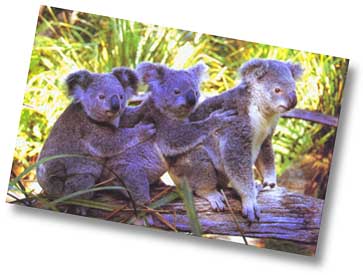
Australia's
best-known animals are the kangaroo, koala, platypus, wombat and spiny
anteater. Isolation enabled the Australian continent to become a sanctuary
for marsupials - mammals that suckle their young in pouches. Among Australia's
marsupials are grazing animals, tree climbers, amphibians, earth burrowers,
and the counterparts of cats and dogs and rats and mice. There are about
50 species of kangaroo, ranging from some that stand as tall as a man to
others as small as cats. (Pictured are three Koalas at Lone Pine Sanctuary.)
 Of the bird species listed in Australia, 400 - including the large, flightless
emu - are found nowhere else. Isolation also allowed for the development
of strange birds - as strange as the kangaroo and the koala. They range
from tiny honeyeaters to the flightless emu which stands nearly two metres
tall. There are 55 species of parrots in Australia, and the birds are as
numerous as they are colourful. A map by one of the earliest navigators
suggested the Australian continent should be called Terra psittacorum,
land of parrots. Some of these birds are worth thousands of dollars a pair
overseas, whereas in Australia they are almost an everyday sight. Cockatoos
and Galahs have been classified as pests in some parts because of their
abundance and the damage they do to crops. (Pictured is the Emu.)
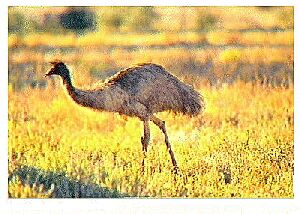
Of the bird species listed in Australia, 400 - including the large, flightless
emu - are found nowhere else. Isolation also allowed for the development
of strange birds - as strange as the kangaroo and the koala. They range
from tiny honeyeaters to the flightless emu which stands nearly two metres
tall. There are 55 species of parrots in Australia, and the birds are as
numerous as they are colourful. A map by one of the earliest navigators
suggested the Australian continent should be called Terra psittacorum,
land of parrots. Some of these birds are worth thousands of dollars a pair
overseas, whereas in Australia they are almost an everyday sight. Cockatoos
and Galahs have been classified as pests in some parts because of their
abundance and the damage they do to crops. (Pictured is the Emu.)
 Australia has 20,000 species of plants, including living fossils such as
the cycad palm and the grass tree, and brilliant wildflowers such as the
waratah, Sturt's desert pea, the flowering cones of banksia trees, and
the red and green kangaroo paw. The continent has 700 species of acacia,
which Australians call wattle, and 1,200 species in the Myrtaceae family
which includes eucalypts or gum trees. Wildflowers turn the arid and savanna
grassland areas of Australia into carpets of colour after rain. Native
forests are limited mainly to wetter coastal districts and rainforests
are mainly in Queensland. (Pictured is the Banksia.)
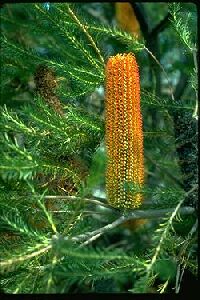
Australia has 20,000 species of plants, including living fossils such as
the cycad palm and the grass tree, and brilliant wildflowers such as the
waratah, Sturt's desert pea, the flowering cones of banksia trees, and
the red and green kangaroo paw. The continent has 700 species of acacia,
which Australians call wattle, and 1,200 species in the Myrtaceae family
which includes eucalypts or gum trees. Wildflowers turn the arid and savanna
grassland areas of Australia into carpets of colour after rain. Native
forests are limited mainly to wetter coastal districts and rainforests
are mainly in Queensland. (Pictured is the Banksia.)
 The subdued and sombre tones of the eucalypts give the face of Australia
its distinctive appearance. Eucalypts truly occupy the continent, from
the snow country of the south to the tropics of the north, salt-laden estuary
banks and harsh deserts. Some species hug the ground while others reach
towards the sky and specimens more than 150 metres in height have been
recorded. (Pictured is the Eucalyptus tree.)
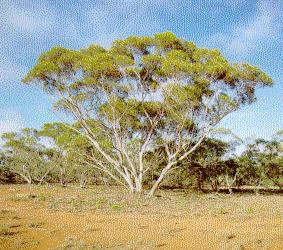
The subdued and sombre tones of the eucalypts give the face of Australia
its distinctive appearance. Eucalypts truly occupy the continent, from
the snow country of the south to the tropics of the north, salt-laden estuary
banks and harsh deserts. Some species hug the ground while others reach
towards the sky and specimens more than 150 metres in height have been
recorded. (Pictured is the Eucalyptus tree.)