|
There is a special group of people who 'live for lighthouses'. Vacations are planned around visiting the "next lighthouse". Many stay at Lighthouses that have been converted to "bed and breakfast" places. These travelers are enthusiasts of lighthouse history and preservation. It is thanks to their efforts that we still have many beautiful and historic lighthouse structures today. One day, Ben and I will travel to many more of these guardians of our coasts. |
| Guarding
our Coasts "Cape Hatteras is on the move.
June 17, 1999 Source: Cheryl Roberts HATTERAS ISLAND, NC
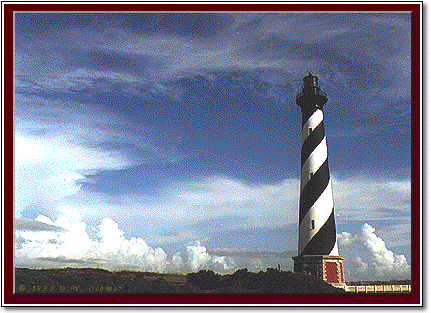
The Cape Hatteras Lighthouse began its journey to the relocation site, June 17th, at 3:00 pm, Eastern Daylight Time. The first push was five (5) inches with a subsequent ten feet having been gained as of 6:15 pm. Shoring towers have been removed, oak cribbing has been placed as support, and the roll beams with rollers have been put into position under the jacks within the main beams. Record numbers
of visitors are at the light station to witness the historic moment. Scores
of local and national media, including all major networks, are on hand
for the first push."
LATEST LIGHTHOUSE PROJECT UPDATE Tuesday, August 31, 1999: A quick assessment of the Cape HatterasLighthouse & its construction area reveal that 90% of the site is under 1 or 2 feet of fresh water and seawater including the foundation hole where the brick work was being completed. The Construction Zone fencing was blown or washed away. The weather monitoring station at the top of the lighthouse was destroyed by wind. |
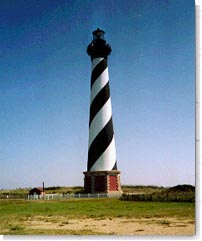
But the lighthouse has survived in good order pumping of the water will begin/continue until the foundation hole is again dry and ready to complete the "bricking". There appears to be road damage just northof Buxton; a complete assessment by county, state and National Park Service people will be made today of the extent of the road damage. Hurricane Dennis,
while causing a great deal of damage on Hatteras Island, had little effect
on the Cape Hatteras Lighthouse. The lighthouse faired very well during
the storm, sustaining only superficial damage. A
The only other
damage was a sixth level window that was blown out during the height of
the storm. The foundation was flooded by ocean overwash and heavy rainfall
and is currently being pumped dry. The flooding will delay the brick foundation
work for a day or so. The project work will begin again as soon as employees
can access the Buxton, NC area.
|
Hurricane Dennis
Scraps Ceremony for Cape Hatteras Lighthouse Relighting
The September 4th, 1999 relighting ceremony planned for the Cape Hatteras Lighthouse was cancelled due to the impacts of Hurricane Dennis on Hatteras Island. As a result of damage from ocean overwash, North Carolina Rt. 12 has been closed to all traffic south of the Bonner Bridge at Oregon Inlet. The North Carolina Department of Transportation does not expect NC 12 to be reopened in time for the scheduled ceremony. The relighting will be re- scheduled when the Island is safe for automobile travel, the villages have recovered for the hosting of visitors and tourists, and the people of Hatteras Island are ready to participate in the relighting celebration.
Hurricane Dennis, while causing a great deal of damage on Hatteras Island,
had little effect on the Cape.
|
| Source: Florida Lighthouse Page
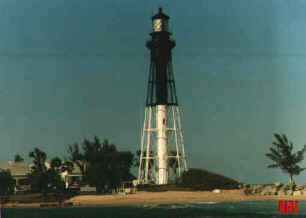
Hillsoboro Inlet Light in the 1920's. USCG photo.
First proposed as early as 1851, Hillsoboro Inlet lighthouse wasn't funded until 1902. Additional funds were appropriated in 1903 and 1905. The lantern room and cupola of the lighthouse was displayed at the 1904 Great St. Louis Exposition, while the remainder of the tower was built later in Detroit, Michigan. The lighthouse was first lit in 1907. The 145
foot tall lighthouse was accompanied by three identical wooden dwellings
for the keeper and his two assistants. The lighthouse housed a second order
bivalve classical lens made in Paris in 1905. The lens floated on a pool
of
With no lifesaving station at the inlet, the keepers were frequently called upon to perform rescue work, but they weren't always eager. There are several recorded instances that the 1st Assistant Keeper had to be ordered to row out to grounded and wrecked ships in 1908. In 1919, the keepers assisted five seaplanes and two boats.
|
A hurricane in 1926 extinguished the light and marked the first of many years work to protect the lighthouse station from beach erosion. The effects of a hurricane in November 1936 were recorded in a letter from the keeper: "I respectfuly give report on storm of November 4. On November 4, at 5 a. m., barometer reading 29.79; at 11 a.m., wind NE, about 70 miles per hour, barometer reading 29.30; at 4 p. m. wind SE. about 50 miles per hour, barometer reading 29.60. Seas swept across entire reservation from 11 a. m. to 3 p. m. Steps and platforms of dwellings and base of tower were covered under sand; also concrete walks. Grounds were covered with trash and debris. Some mercury was slopped out of tub in tower, but lens operated O. K. No damage was done to Government property. Electric current went off at 11 : 30 a. m. There are uncertain as to when it will be restored to station. We are operating on stand-by plant. Switch box on stand-by is out of commission, but I can start the plant by hand. Station is being cleared of debris as fast as possible." Efforts to protect the station failed in 1947 when another hurricane destroyed the head Keepers dwelling. The other two dwellings remain to this day. This lighthouse was electrified in the early 1930's. It was automated and unmanned in 1972. Although unmanned as a light station, the dwellings were converted into recreational cottages for senior military personel. In 1978, the lighthouse and dwellings were placed on the National Register of Historic Places.
|