7 th Day

|
7 th Day |
|
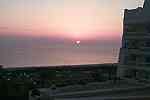
 Sousse is the centre for some of the fastest advancing investment schemes
of Tunisia. All along the northern beach, modern hotels have been, and are still
being, built. They all come in the same fashion: Hotel with bar, restaurant and
swimming pool. If you cross the main road, you're right on the
beach.
Sousse is the centre for some of the fastest advancing investment schemes
of Tunisia. All along the northern beach, modern hotels have been, and are still
being, built. They all come in the same fashion: Hotel with bar, restaurant and
swimming pool. If you cross the main road, you're right on the
beach.
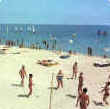
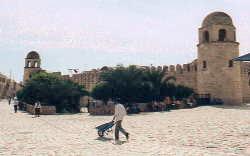 The
beach strip closest to the centre of Sousse is extremely crowded, mainly by
Tunisians, coming here as full sized families.
The
beach strip closest to the centre of Sousse is extremely crowded, mainly by
Tunisians, coming here as full sized families.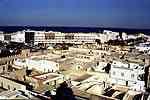
|
|
NAME: From the French " monastère", or " monastery").
LOCATION : 165 km south-east of Tunis, 24 km east of Sousse, 80 km east of Kairouan. Railway station at Sousse. Skanes-Monastir international airport.
DIALING CODE: 03.
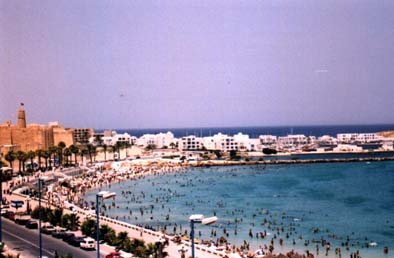
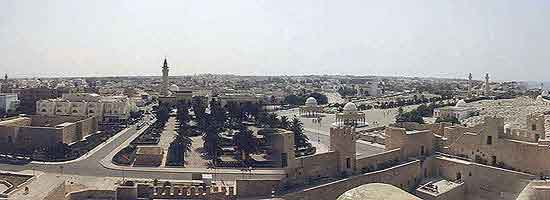
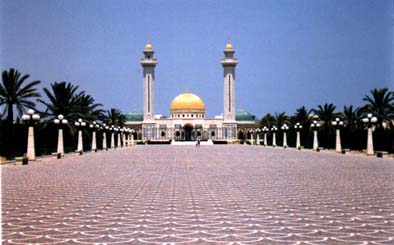
Monastir, 9th century walls and an imposing Ribat tower over a modern resort complex and the result is amazingly harmonious.Monastir captures that blend of the traditional and modern that characterizes Tunisia. A marina nestled in the shade of the walls provides a enjoyable promenade as does the long avenue that offers the bluest of Mediterranean seas on one side and open air terraces of hotels, restaurants and coffee houses from where you can enjoy the view.
The "monastery" after which the town was named, was built by an Islamic religious order in 797 to defend the town from roaming nomadic tribes and Byzantine warships. The fortress houses a lovely museum of Islamic art and artifacts.
|
|
The promise of Mahdia has a tendency of coming almost true. While wandering around the city, many of the elements of the city's past is spotted, but it either is too obviously restored, or too little. In the 10th century Mahdia was a very important city, but even more, it was the capital of one of the Muslim worlds most important line of rulers, the Fatimids. The first Fatimid ruler declared himself as the Mahdi, the last prophet of Islam.
The Fatimids moved their centre to Egypt after conquering Cairo, and Mahdia had been the capital for just 50 years.
Mahdia was chosen as the capital because of the proximity to the sea, and the promontory on which an important military settlement had been since the time of the Phoenicians. With a wall 10 metres thick, man and nature had built one of this coast's best fortresses. The move of the Fatimids did mean that it was less thoroughly defended, and invasions by Christians, Normans and Turks in the following centuries lead to heavy destruction of the original bastion.
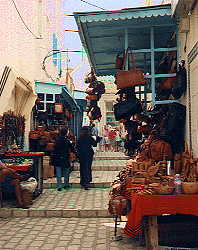
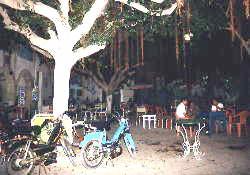
Entering today's Mahdia is greatest part of the visit. As you pass through the 10 meter thick wall, that functions as the gate to the city, history feels close. The city never opens after this, and all over Mahdia narrow streets never extends beyond small squares. Mahdia's great charm are the narrow streets, trees, the life of the locals, the cafés. The only really open part of the city is in front of the Great Mosque, which is only great in size,- otherwise it is a sad attempt to reconstruct the mosque of the first Fatimids. The base of the old city of Mahdia is not tourism, but weaving. In the Arab world, quarters and cities often specialized in one product which they sold widely around, and Mahdia has a large part of the production of wedding cloth for the rest of Tunisia.
|
|
|