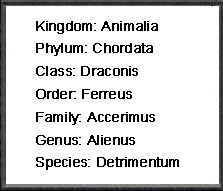
Because this is so, a Dragon is as broadly classified as primates(which could be from Pygmy Marmosette to Human) and
what may not seem to be a Dragon, does in fact have a sufficient amount of similarities to be classified as one.
Dragons have been kept within their own species(no crossbreeding) because if one type of Dragon crossbreeds with another,
then the offspring will be deformed and most likely die at birth. This biological 'booby-trap' has kept the different
Dragon types purebred for thousands of years.
Dragons are usually 30-50 feet long, depending on the species. They come in a wide range of colors. The colors do not
determine any characteristics or special abilities, like most other animals. The color usually depends on what color
or colors the parents were, rarely there will be a Dragon with half-half colors, and very rarely there will be an
albino Dragon, only one, to my knowledge has ever been spotted.
Some Dragons have very long necks(usually lined with fins), and some have short. The ones with longer necks have been
found to be more frequent flyers and the ones with shorter necks stay on the ground more often. This is probably
because of the streamline effect of a longer neck, it helps the Dragon go much faster when in the air.
Another thing that differs greatly from species, to species, are the feet. The shape of the feet depends on the
behavior of the Dragon and also the terrain in which it lives. A mountain Dragon would have feet simmilar to the
woodpecker's, two long toes in the front, and two in the back. This enables the Dragon to grip and hold on to the
sides of mountains easier for more nimble climbing. A ground dwelling Dragon would have feet similar to most ground
mammals, four toes infront, and one higher up on the heel, this helps the Dragon to move faster on the ground. A tree
dwelling Dragon(very few of these, the ones that do exsist are exceptions to the average size of a Dragon) would have four,
long toes in the front and one, directly in the back. This enables better grip on tree branches.
Most dragon scales are the same they are about the size of a credit card, with an angled end. The other end has a very thin
membrane which attaches to the epidermis of the Dragon. The scale is made of a compact calcium compound, it is very strong
and supplies a good amount of protection. Scales cover every part of the Dragon except for the under-neck and between the
hind legs. This area is covered by a sectioned callous material. Under the scales the Dragon is covered by a tough leathery
skin, which would be a hard task to cut through, even if the Dragon was already dead. So over all the Dragon,is very well
protected. The scales fall of continuously and are regrown. When they fall of sometimes the Dragons will eat them in order
to obtain the minerals they are made of.
A Dragons wings, similar to a bat, are the extended 5th and 6th limbs which have elongated fingers. Across these fingers there
is a large thin membrane of skin. The membrane, while extremely thin, is very tough, some say that it is bullet-proof(I don't
know about that one). On the tips of each finger is a small horn-like fingernail, which some say is getting smaller with
evolution. The fingernail is blunt and not used as weapons. The wings connect just above, or between, each shoulder blade. The
muscles at the base of the wings are extremely powerful and can lift more weight than the fore-arms. Dragons sometimes find a
shady spot and spread their wings, the extra exposed surface area causes the Dragons to cool-off quickly.