Created: 17-JUL-99
Last Updated: 17-JUL-99
Created: 17-JUL-99
Last Updated: 17-JUL-99
|
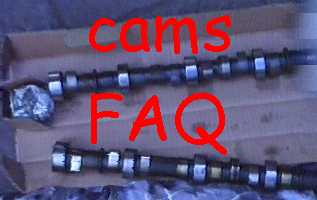
Details and pics of how I installed a cam in my 3TC Toyota motor, click here General Cam stuff: Heres what I know: Generally there are four things used to describe a cam: INLET/EXHAUST duration at 0.050 IN/EX advertised duration IN/EX Valve Lift Inlet lobe lift at TDC (Top Dead Centre) on overlap DURATION AT 0.050 AND ADVERTISED: ================================ EXTRACTED FROM A MESSAGE BY GARY M ([email protected]) The .050 figure is what really counts. This is the degrees of crank revolution that the valve is open more then .050 inch. This is about the least valve opening that allows good flow. The Advertised degrees is how far the lobe is off of the base circle. This is always a bigger number, but the smaller it is, the faster the cam gets the valve open. A hot race cam will have the adv. And .050 duration's very close. Milder cams have them further apart, and that will be easier on the valvetrain with less acceleration forces on the rockers and all. VALVE LIFT: ========== The height (in thousandths of inches) that the lobe lifts the (�lifter which lifts the�.) valve INLET LOBE LIFT AT TOP DEAD CENTER (TDC) ON OVERLAP ================================================= A hot aftermarket cam usually has been designed in such a way that both the inlet and exhaust valves are open at the same time. This is called overlap. The amount of overlap depends on how wild the cam is and generally how tall the lobes are (to allow the springs some time to return so as not to bounce). The overlap is what causes a loss of compression, rough idle and loss of vacuum (A thought added by john [email protected]) "I thought the rough idle comes from low airspeed thru the ports and hence bad cylinder filling at idle rpm. the 'on-cam' rush that happens further up the rpm range with a hot cam is where the air velocity reaches a point at which cylinder filling becomes much better. <Perhaps the low airspeed thru the ports has something to do with the overlapping?> With a turbo u want a decent bit of lift but not too much duration/overlap.. dont want fuel and air getting blown out the exhaust valves by the turbo boost, altho ppl differ on this.. in his book maximum boost, corky bell seems to be more of the opinion that its best to keep fairly conservative cam specs on a turbo engine in order to maintain driveability, and just let the turbo force air in at high boost. i dunno about that tho.. the idea of driving something where nothing much happens down low, then all hell breaks loose in the mid-upper range kinda appeals.." OTHER RELATED CAM TERMS: =================== Lifter: this is the bit that touches the cam on a side cam (non OHC) engine, the pushrods dont actually touch the lobes of the cam, they sit inside the lifter Springs: The springs that return the valve to their closed condition. Bounce: Springs will start to bounce if you do too many RPM, or if the lobe height is extreme. In this case multiple valve springs should solve the problem (I have dual valve springs. its like one spring coiled inside the other in the opposite direction) Anyway, heres the specs on my old engines (3TC) cam, you should now be able to identify what it all means: (these are what crow CROW CAMS cams printed out for me after they computer selected what I wanted)
Click here for some specs on 2T/3T cams from CRANE CAMS (courtesy of "Michael Capobianco" [email protected]) More conversations between myself and Bill Sherwood Ugg, im lost! Sorry if im sounding stupid, but im not just not familiar Completely with the operation of the cams in the first place, dont they just spin as a pully spins in time with the engine, to control which valve is opened when, determined by the position of the lobes on the shaft, Yup, but they spin at half engine speed. This is because you only want a valve open every fourth cycle, and that's why the cam also only has one 'bump' per lobe. So the 'lumpiness' and the width of the lobe can be used to control the response of the engine - changin its properties at different RPM's...the lumpier the cam, the 'wilder' It is and the more fuel you pump in? the wider the lobe, the longer you allow a valve to be open?... I'm not quite sure why this helps though... Yeah, pretty much that is the case. The whole business of cam timing is super important. I won't go into it very far (I have been know to go on for hours ... :):) ) but basically the more the valves stay open the more power you can make. A typical road type cam might have the inlet valve open for 240deg of the entire 720deg four stroke cycle. A full race cam might be as high as 330deg. Is doesn't sould like a huge change, but it really does make a big difference! There's FAR more to it than that, of course, but that'll do for now. ;) The other thing to look at if valve lift - Again, a typical road type grind might have 0.300" (7.5mm) lift, but in the same engine you might go for a race grind that would have a lift of 0.430" (11mm) One important thing to remember is that simply throwing in a bigger cam often won't make the engine go as well as it should, and can often make it run worse at lower revs. It's often very hard to tell what a cam is like just by looking at it - As an example, when I first put the 4AGE in my Sprinter, I accidentally put a 320deg/0.360" cam in the inlet side and a 288deg/0.290" in the exhaust! Unless you look *very* closely, you really can't tell the difference. (I could when it ran though, 'cause it sounded like a sick peripheral port rotary!) If you want to have a good book to read on the subject, spend a few dollars and get copies of - "Power Secrets" , by Smokey Unick, and the later copies of the excellent books by David Vizard and A Graeme Bell. (I can't remember the names of the last two books, but they are both worth getting!) If you want to learn how to makes suspension work, then get "Prepare to Win," By Carrol Smith. If you can get those books, and have the time to read and soak up what they say, then you'll be a *quantum leap* ahead of most people that you meet. You won't have to ask too many questions, because you'll *know*! |
|||||||||||||||||||||||||||||||||
| Top | Main Tech Page |