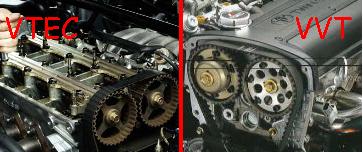
VTEC AND VVT - Whats it all about, which ones better?
Created: 17-JUL-99
Last Updated: 17-JUL-99
VTEC AND VVT - Whats it all about, which ones better?
Created: 17-JUL-99
Last Updated: 17-JUL-99
|
Below is a modified version of a conversation between myself and Bill Sherwood. I recommend reading the general Cam FAQ before proceeding as this section assumes some general knowledge on cams. VVT Can someone explain the principals of the VVT engine? im not exactly sure what they mean by 'variable valve timing' and why does it increase power? The Toyota Variable Valve Timing device is a gadget that fits onto the front of the inlet cam on the 20v 4AGE. (Have a look at this picture of a turboed 4AGE 20v, you can clearly see the VVT controller on the front of the inlet cam.) 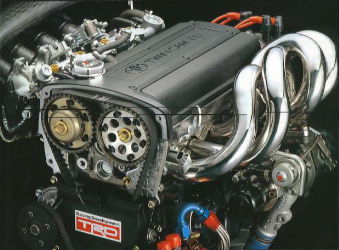 Also check out this schematic of a VVT system.
Ok, what it does is simply alter the timing of the inlet cam as the revs of the engine change. It doesn't do it progressively, but in one single step at about 4500rpms as you accelerate. At lower revs, the inlet cam is advanced, and when the computer signals for the VVT to do it's thing a small valve on the side of the head opens (called the OCV, or Oil Control Valve in the GIF) and that allows oil pressure to flow into the VVT pulley. (Show on the wrong side of the engine in the GIF!) The oil pressure pushes the internal piston out, which causes the part of the VVT pulley mounted to the cam to alter it's angle relative to the cam wheel itself. About 15deg, in fact. (Crank degrees) At low revs, the inlet cam is advanced, and at high revs it's retarded. The reason for doing this is simple - The more overlap you have (ie, a retarded inlet cam & advanced exhaust cam) the more power you will make at higher revs. The tradeoff is that the bottom end is worse and you often have a rough idle. If you have the cams so that you have good bottom end power and a smooth idle, then you are invariably missing out on top end power. So, the smart thing to do is to make the cam so you can alter the timing for the best of both worlds. I'd say that the cam that Toyota picked for the inlet in the 4AGE 20v was about as big as they could go and still have a smooth idle so as to give the engine as much top end as possible. Note that with 'bigger' cam, the effect is reduced and you eventually get to a point where it's not worth it. I think that the 'crossover' point is about a 270 - 280 deg cam for a 4AGE - I have run some numbers through a software 'dyno' on my computer and with the 320 deg cams I'll be using in my new 4AGE there's no advantage at all in using VVT gear. And FWIW, I was at a workshop the other day where a respected engine mechanic was working on a 20v head - I picked up the VVT cam wheel and was rather surprised how heavy it was! It confirmed to me that I *don't* want one on my engine due to the weight of the darn thing. (BTW, the mechanic in question was getting 242hp from the early big port 4AGE's! at 10,000rpm! Not bad, eh?) (In reference to the above schematic of VVT system) I cant seem to see the piston, but i think im understanding it so far.. The piston, (Which you are quite right, isn't in the pic) sits right in the middle of all of the helical gear stuff. As it moves backwards and forwards, the helical gears mesh and so move the outside part of the wheel compared to the inside part, thus altering the timing. So your saying that the cam is rotated a little to increase the 'duration' of the valves being open? No, the cam lobes stay the same, but the timing of them is altered. Think of it as the inlet cam wheel 'jumping a tooth' on the cam belt so that the inlet cam is would back a little. Those helical gears inside the VVT wheel do that, and when the oil pressure dissapears, the action of the helical gears causes the inlet cam to advance back to 'normal' How can this be done if the cam is constantly spinning? It's all done inside the VVT wheel, by means of those helical gears. Remember, all they do is change the angle of the centre of the VVT wheel (The bit that bolts onto the front of the cam itself, and the outside of the VVT wheel. (The bit that the cam belt runs on.) So we are effectively advancing the timing? Nope - It retards the inlet cam, to give a bigger overlap between the inlet and exhaust cams when scavenging. (more power at higher revs, etc) What your trying to say is that the inlet and exhaust cams move in opposite dirs to alter this 'overlap' other wise wouldn't moving both cams in the same dir, the same amount achieve nothing but make the cam go around a little bit faster for a fraction of a second, while they are moving The exhaust doesn't move at all, just the inlet. And yes, I guess for a brief moment the inlet cam would turn a fraction slower as the VVT did its thing. (Hardly enough to worry about though, as the outer part of the cam wheel moves 30deg, which would be about 1.5" on the belt. At the 4000rpm odd that this happens, the belt is moving at (*very* roughly!) 72mph, so an inch or so here or there is no big deal. :) The principal behind the VVT: to allow the best of both worlds, a stock cams good idle/low end performance, and the hi-end performance of a lumpy/wild cam. How it achieves this, I'm not quite sure i understand as yet...At the moment I'm picturing the oil pump turning, causing the belt to move the VVT pulley which is (this is where I'm lost) rotating the cam itself a little to adjust timing of the inlet cam. My problems are: if the cam is spinning how did they make the VVT pulley to reliably allow the cam to do its thing during normal operation, and allow it to 'freewheel' within the pulley. Obviously this pulley only moves occasionally, but the cam is rotating all the time. And then engage when it needs to adjust the position of the cam?? see where I'm lost? I'm obviously thinking incorrectly somewhere along the line.. Like I described earlier on, it's the internals on the VVT wheel that make the inside and outside move relative to each other. The inner part bolts to the cam itself, and the outer run on the cam belt, so as the VVT works, the angles between the inlet cam and the cam belt change. So its not really anything special? it seems a great idea - from what I understand of it... No, I'd say that for the majority of road cars it's great, but it serves no purpose on a racing car. VTEC Also, is VVT similar to Honda's VTEC? I mean is it the same sorta principal or a completely different thing all together Completely different. VTEC stands for Variable Valve Timing and Lift Electronic Control. The Honda VTEC system uses a multiple rocker system that makes the rockers that follow the cam sit on different parts of the cam as the revs change. One side of the cam lobe has a 'boring' street type profile, and the other has a much more aggressive profile that makes a lot more power at higher revs. An electronic switch shifts between the two profiles at a specific rpm to increase peak horsepower and improve torque. Each cam profile would be hopeless at the other's rev range, so on first inspection the end result would seem to be similar to the VVT system, but it's actually very different. The VTEC uses a completely different cam profile when it does its changing trick, so the cam timing can be set to whatever give the best performance at high rev with no regard to how it would otherwise perform at low revs. A true 'Jeckle and Hyde' personality! I don't like the system, however, because of it's inherant complexity and I don't like rockers in a modern engine. I would also be worried about how all those little bits & pieces would be after a few years of hard use. The VVT system is relatively very simple by comparison, and has little to go wrong. It can't make *quite* as much power (All things being equal) but I think it's a better system in the long run. 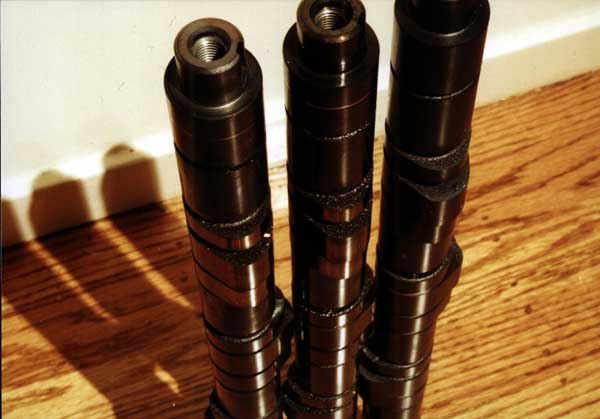
If so, what is VTEC, and is it better than VVT equipped engines For performance work neither is of any use at all. As I've mentioned when you have big enough cam in an engine to make usefull amounts of power, eg, 100 - 120 hp/litre - neither system will be of any use anyway. But then you sacrifice on or the other part of the powerband, either hi or Low end.. something's gotta go.. True, but for racing the bottom end performance isn't important anyway. FWIW though, (Got a million of these!) the McLaren F1 cars in 1996 that used the Mercedes Illmour engine had a farily flat torque curve from 4000rpm up to 16000rpm, so that means that they had a useful rev range and power band of 12000rpm!!! WOW!!! FWIW, there are a number of manufacturers that are using the VVT system, BMW for one, but I don't think that too many are using the VTEC style system. Good for road cars getting the shopping done, though .... ;) I guess VVT is the way to go then, otherwise heap of other companies would use it.. It may well be, and maybe Honda had licensed the technology so that it's too expensive for anyone to use. The VVT idea isn't new however - I can remember seeing in my Father's 1969 catalogue from the US a kit for small block fords that did a very similar thing ... Does the VTEC cam actually change shape during use? like hydraulic bits move the shape for the lobes or something? or are you saying that the computer tells the engine which part of the cam to respond to? maybe i need to check up on how cams work, cos i don't seem to be understanding everything completely... Nope - The cams stay the same, it just uses a completely different lobe that has a 'bigger' profile. I'm not 100% sure how it works either, but I know that they use a hydraulic system to make a different set of rockers work when they need to, to engage the bigger cam lobes. Seems overly complex to me, but Honda have been doing stuff like that for years, eg, their two cylinder four stroke GP 500cc motorbike engine, the NSR. It had just the two pistons, but they where sort of oval shaped, (conventional round ends, but with straigh sides between them, so they sort of looked like a party sausage shape!) had four inlet and four exhaust valves per cylinder, and twin spark plugs! Not surprisingly, they had a LOT of trouble getting the rings to work, so the whole thing was canned in the 80's some time. They eventually *did* get it to work, but by then the two stroke four cylinder 500cc engines were far too powerful. They decided to still use the technology though, and made a limited number of NSR road bikes, which where about Aus$70,000 each! 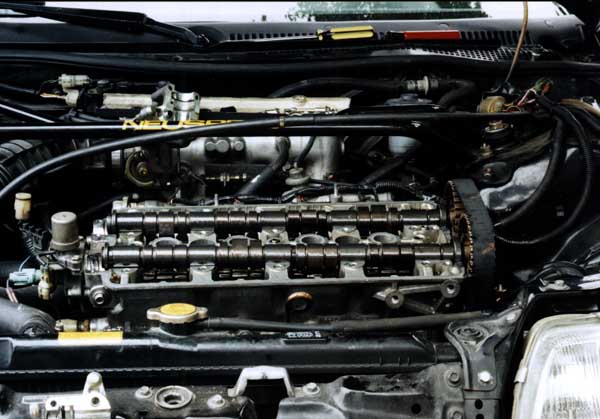
|
| Top | Main Cars Page |
