
XKaT
XKaT (X-band Ka-band Testbed) is proposed as an experimental facility to validate the KaTE experiment on-ground and in-orbit.
ESTEC Laboratory XKaT Facility
The ESTEC laboratory within the TOS-ET division has a series of end-to-end TTC testbeds. Within the future investment plan it is foreseen to include an X-band Ka-band testbed (XKaT).
This facility has been explained in the "TTC Lab Dossier", the relevant section is quoted below:
The new Ka-band (32/34 GHz) is planned to be introduced on several future deep space missions, such as MERCURY or VSR. A Ka-band experiment is also planned to be implemented onboard SMART-1. The band offers significant improvement of the telemetry link capacity over the X-band (8 GHz) and is of very high value for radio science, especially when combined with a coherent X-band link. However, in order to properly understand the actual performances which can be offered at Ka-band to future ESA missions, a number of specific features inherent to this very high frequency band need to be evaluated, such as technology capability, atmospheric attenuation, Doppler environment, antenna pointing, etc.
XKaT will be fully reusable for near earth missions that will operate at X-band in the near future.
Thus far, XKaT implementation has not started.
The key role of the facility would be:
Evaluation by lab tests and field tests of the performance of Ka-band TTC links with XKaT, in collaboration with TOS-EE, in support to D/SCI. This includes:
- performance assessment of links at Ka-band for deep space applications
- exhaustive testing of the breadboard X/X-Ka DST in the future operating conditions of SMART-1 and MERCURY
- support to the operations of the SMART-1 X/Ka transponder payload (optional, to be discussed/negotiated with the project). For these tests, XKaT could be transported to e.g. Villafranca where Ka-band capability could eventually be deployed.
The ground segment laboratory facility would be based on a portable dual fed 2.4m reflector with a 20W TWTA X-band uplink, an X-band and a Ka-band receiver with the characteristics detailed below.
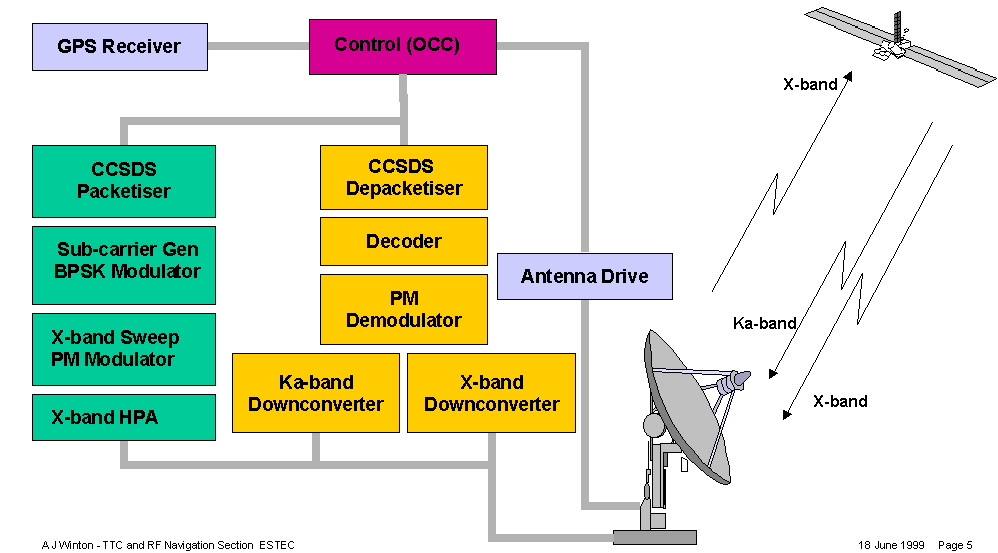
| ESTEC Laboratory XKaT 2.4m | Noordwijk |
|||||||||
| Geographical | Longitude East | [deg] |
4'29 |
|||||||
| Latitude North | [deg] |
52'09 |
||||||||
| UPLINK | Ant Polarisation | [circular] |
LHC, RHC |
|||||||
| Ant Gain | [dB] |
44X-Band |
||||||||
| DOWNLINK | Ant polarisation | [circular] |
RHC, LHC |
|||||||
| Ant Gain | [dB] |
44X-Band 57Ka-Band |
||||||||
| TIMING system synchronisation to UTC | [microsec] |
GPS Reference |
||||||||
UPLINK |
NOM |
ADV |
FAV |
|||||||
| EIRP | (20W TWTA) | X-Band [dBW] |
54 |
. | . | |||||
| Pointing Loss | 0.05 |
. | . | |||||||
| Axial Ratio | 0.50 |
. | . | |||||||
| DOWNLINK | . | . | . | |||||||
| Effective G/T | @ 10 deg elevation | X-Band [dB/K] |
23 |
. | . | |||||
Ka-Band[dB/K] |
29 |
. |
. |
|||||||
| Pointing Loss | X-Band [dB] |
tbd | . | . | ||||||
Ka-Band [dB] |
tbd | . | . | |||||||
| Axial Ratio | [dB] |
tbd | . | . | ||||||
| PLL Bandwidth 2Bl selectable 0.3 - 300 | [Hz] |
NOM |
. |
. |
||||||
| TM demodulation technological losses | [dB] |
0.50 |
. |
. |
||||||
| Ranging Tone Loop Bandwidth | [rad/sec] |
10-3 to 1.5 |
||||||||
| Required Ranging Loop S/N | [dB] |
19.00 |
19.00 |
19.00 |
||||||
| Required C/N in PLL for no data degradation | [dB] |
No Coding | 10 |
|||||||
| Convolutional | 15 | |||||||||
| Concatenated | 17 | |||||||||
| Required TM Eb/N0 | [dB] |
See ESA PSS-04-103 |
||||||||
| STATION EQUIPMENT | Low Noise Amplifier |
tbd | ||||||||
Receiver |
tbd | |||||||||
Demodulator |
tbd | |||||||||
Telemetry |
tbd | |||||||||
Decoders |
tbd | |||||||||
Telecommand |
tbd | |||||||||
Tracking |
tbd | |||||||||
Data Communication |
tcp/ip | |||||||||
Timing System |
GPS | |||||||||
Station Control |
Windows NT | |||||||||