Helga's retina
book:
Ron Douglas:
Contents and links:
Helga's retina
book:
Ron Douglas:
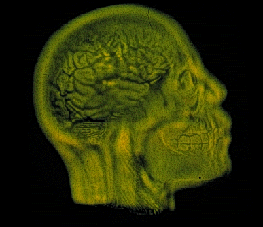
| About 60% of the human brain are devoted to vision. Half of this only compiles signals coming from the central fovea, a small pit of about 1 mm diameter which is the area of highest visual acuity. |
In the first few chapters of this essay, I will try to show that, indeed, the retina is capable of performing the above mentioned tasks and, actually quite a bit more which will be the subject of the consecutive pages.
I. Gross Anatomy:
Let’s start with some gross anatomical findings. There is one thing
that has to be mentioned before going any further. In vertebrates,
the photoreceptors stick out from the back of the retina, and thus, all
the light that hits them, has to pass through the entire thickness of the
retina. At first glance, this doesn’t seem to make too much sense but it
is important and I will get back to that subject later.
Above, I mentioned the term fovea centralis which means “central pit”.
This pit can be seen with the naked eye but it is more obvious in
the examination of histological sections.
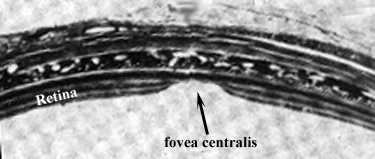
| Histologic section of the human eye. Note that the retina itself is only a very thin layer which rests against the thick supporting structures as choroid and sclera. Click here to see a better image of the fovea of a monkey retina |
The relevance of this pit was believed longtime to provide the easiest
possible route for the rays of light captured by the photoreceptors without
any interference from overlaying neuronal tissue. This point is certainly
valid up to now but in 1941, Snyder and Miller made the interesting discovery
that in birds of prey such as eagles and falcons, also known for their
exceptional visual capabilities, this fovea is expressed to a degree which
doesn’t make sense if its only purpose were to push other nerve cells out
of the lightpath. Particularly, the small spot in the middle is flanked
by the pit’s walls which rise at a steep slope making the pit almost paraboloid
in shape. The reasoning is actually quite simple. If the retinal
tissue could provide enough interference to severely distort the optical
image projected onto the photoreceptors, then, increasing angles of the
light rays hitting the interface between the retina and the vitreous body
(a jelly-like compartment in the posterior chamber of the eye) would also
increase the refraction. Thus the progressive distortion of
the image resulting from an increasing angle of the pit’s walls would severely
undermine the benefits obtained from undisturbed passing through of a few
rays in the center.
So, what else could be the benefit obtained from such a design? The
answer is not so difficult, all one has to do is to measure the angles
between the light beams and the retinovitreal interface and to know the
refractive index. Then one can apply the laws of physical optics and calculate
the further path a ray of light takes until it hits the sensory cell which
absorbs it, the photoreceptor.
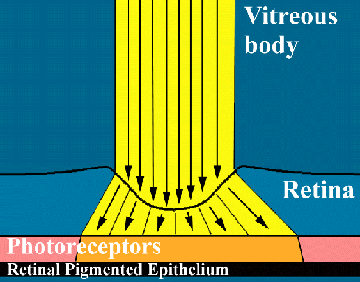
| Schematic drawing of the refraction of a beam of light falling onto the fovea which results in a magnification of the optical image |
As one can see, the fovea centralis does something very important, it acts like a magnifying lens in that it spreads a bundle of light in a fashion that enlarges its diameter to about 150 % of the original size. Thus, within the retina, there exists another tiny structure, which performs the task of selectively magnifying the images which deserve the highest attention. Still, magnification by a factor of 1.5 does, by no means, account for the magnification found in the measurements of Daniel and Whitteridge. So what else could play a role?