Helga's retina
book:
Ron Douglas:
Contents and links:
Helga's retina
book:
Ron Douglas:
Contents and links:
Helga's retina
book:
Ron Douglas:
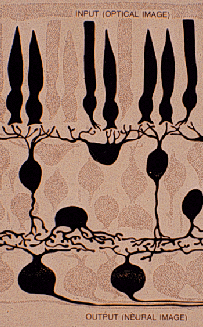
The neural retina consists of 5 basic classes of neuron:
Photoreceptors, which absorb quanta of light and transform them into
chemical signals in form of glutamic acid (glutamate)
Bipolar cells, which connect the photoreceptors to the ganglion cells.
These cells are further subdivided into 11 classes, which signal either
light ON or light OFF further down to the ganglion cells
Ganglion cells, which collect the information generated in the retina
and transmit it to the brain. Unlike the other classes of cell which act
in an analog manner, ganglion cells have to transmit their signals over
long distances and use electric spike modulation (digital signals) because
these can be amplified easily and amplitude deterioration only marginally
affects the content of the message.
These 3 classes of cell are commonly referred to as the vertical retinal
pathway
In addition there are laterally integrating interneurons which can
be divided into two major classes, according to the layer within the retina
where they make their synaptic connections:
Horizontal cells which have their terminals in the outer synaptic (plexiform)
layer (OPL).
Amacrine cells which connect exclusively in the inner plexiform layer
(IPL).
.
 |
Photoreceptors
(Rods and Cones) Outer Plexiform Layer
Amacrine cells
Retinal Ganglion Cells
|


The synaptic or plexiform layers are two horizontal bands containing
only processes and terminals at which information in form of chemical
substances named neurotransmitters is released and received. The majority
of neurotransmitters are simple amino acids such as glutamate glycine and
?-amino butyric acid (GABA)
As a rule of thumb, one can assume that the vertical pathway generates
primarily excitatory signals by means of the amino acid glutamate, which
is released upon excitation by all of its cells and stimulates neuronal
activity. On the contrary, the neurons that can be classified as laterally
integrating cells use inhibitory signals in the form of the amino acids
GABA and glycine which decrease neuronal activity.
In addition a variety of neuromodulators, including biogenic amines
such as dopamine, histamine and serotonin as well as neuropeptides such
as opiates are used by specific classes of cell for the fine-tuning of
neuronal activity which changes the transmission properties of the cells
affected.
Above, I mentioned the “vertical” pathway, which is the direct gateway
from the photoreceptors to the brain. In real histologic specimens, however,
it soon becomes obvious that the vertical pathway very often is not vertical
at all. In fact, most of the time, the bipolar cells run at a more or less
pronounced angle through the inner nuclear layer before they dip perpendicularly
into the IPL and establish their synaptic connections with the retinal
ganglion and amacrine cells.
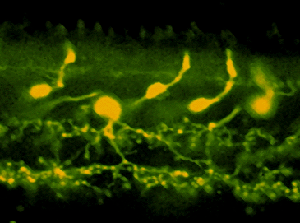
| This picture shows a micrograph of a frozen section of the turtle retina stained by an immunoreaction against serotonin. There are three labeled bipolar cells and one amacrine cell. The thick, club-like upper tip of the bipolar cells is called the Landolt's club |
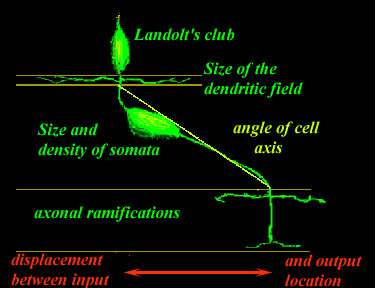 |
Bipolar cells transmit the information generated by photoreceptors to the inner retina, i.e. primarily the retinal ganglion cells. They receive input at their dendrites which form the dendritic field. The Landolt's club (Landolt's Keulenfaden) is an extension of these cells that is present only in retinas with mostly cones. Its function is unknown. Often, the output location is shifted laterally from the input location, the center of which is marked by the Landolt's club. This particular cell would fall into the category of OFF center cell |
Quite often the deviation from the vertical axis is so pronounced that
it results in a dramatic lateral shift between the location where they
receive input from the photoreceptors and the location where they pass
on this signal to the retinal ganglion cells. In the section shown below,
this lateral displacement between the input and output location exceeds
0.3 mm which is an enormous value, considering the fact that the total
diameter of the eye of this particular animal was only about 6 mm.
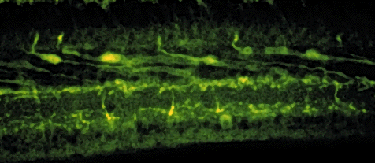
| Section of the midperiphery of a turtle's retina. Note the strong lateral offset between the input and output location of bipolar cells |
Turtles, on the retinas of which this study was conducted, do not have a real fovea centralis, instead, their central visual area is elongated into a horizontal band spanning the entire horizontal axis of the eye. This particular structure is named “visual streak” to distinguish it from the fovea. An interesting detail here is that the development of a fovea as opposed to a visual streak is not a feature of the family tree of the individual species but is rather a feature induced by the habitat. Thus, animals which live in plains and need good surround (2D) vision, as e.g. horses or cheetas have developed a visual streak, whereas animals relying more heavily on binocular vision (stereopsis) to take advantage of better depth perception (3D vision) possess a fovea. Examples are all animals that have their eyes frontally located, resulting in pronounced binocular overlap of their visual fields.
If one looks at a section of the retina cut orthogonal to the visual streak, one notices that, in it the very center of the streak, the projections form the photoreceptors to the ganglion cells made by the bipolar cells take, indeed, the shortest possible route and run perpendicularly through the retina. However, at even the slightest eccentricity, the bipolar cells turn away from the center and from each other to assume an outwardly directed, oblique course towards the inner retina. This behavior results in a fan-like spreading of the signal from where it is generated to the location where it is passed on to the next level of processing.
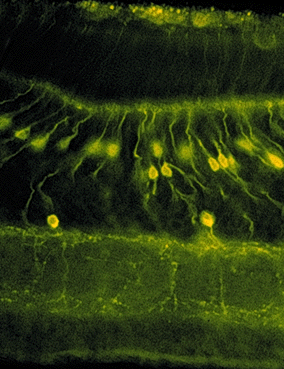
| In the visual streak, bipolar cells display a fan-like arrangement which results in pronounced magnification of the optical image on the way to the output location |
Another area of non-eccentric projection is found in the retinal periphery, close to the edge of the retina.
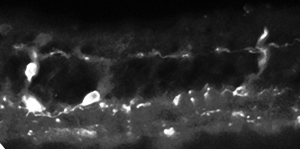
| Section of the far periphery of the retina. Note the low density of labeled bipolar cells and the enormous length of their processes in the outer plexiform layer |
In contrast to the visual streak, however, here the signal is not spread or magnified but, on the contrary, the axes of the cells appear to bend towards each other, resulting in a compression of the optical signal.