VRMol lets you generate VRML plots (*.wrl) of chemcial structures obtained from various sources. Once all executable files have been moved to a directory in your PATH (or your PATH has been modified to include the VRMol exe directory), you can start the program by simply entering the command
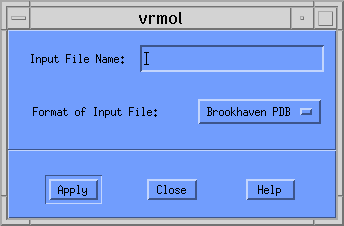
At this point, the following window appears.
In the upper box, you enter then name of the file containing the structure, and from the lower, pull-down menu you select the source of this file. The structure files currently supported by VRMol are given in the following table.
| Source | Description |
|---|---|
| Brookhaven PDB | Though BNL no longer maintains the Protein Data Bank, this label is used to denote a "standard" PDB file. |
| Brian's PDB | This is a PDB-like file that is used for input and output structures from various programs I have written (EPOPT, GENOPT, SimVol and others). |
| Gaussian Output | This is an output file from Gaussian9x. |
| Mopac7 Output | This is an Output file (not an Archive file) from Mopac7. |
| SimVol Output | This is an output file from the program SimVol. By default, this file is named PDBOUT and contains two overlapped structures in my PDB-like format. |
Once the file name has been entered and the source of this file selected, simply click the [Apply] button.
Please note that this window stays after [Apply] is pressed so that you can generate multiple VRML structures each time the program is run. To close this window and exit VRMol, simply click the [Close] button.
The best way to describe the capabilities of this program is to show various examples. All of the required input files are present in the input subdirectory, and various VRML files are stored in the output subdirectory. The following links show you how to generate these VRML files for each of the supported input types.
Disclaimer
Please note that this free package is distributed "as is" and comes with no
explicit or implicit warranties. The program author is to be held blameless
for any actions that occur while running the package.
� 1999 Brian T. Luke, Ph.D.