|
|
. |

 IF (Graphic Interchange Format) is originally owned by CompuServe.
It was designed and launched for the purpose of uploading files to online services. Over the
years, GIF has become one of the most common and widely used graphic formats of the World Wide
Web. Currently, there are two versions of GIF format: 87a and 89a. Version 89a allows us to create
animations. IF (Graphic Interchange Format) is originally owned by CompuServe.
It was designed and launched for the purpose of uploading files to online services. Over the
years, GIF has become one of the most common and widely used graphic formats of the World Wide
Web. Currently, there are two versions of GIF format: 87a and 89a. Version 89a allows us to create
animations.
Main Characteristics
GIF provides us with highly compressed graphics. This format uses LZW
compression scheme. This compression scheme allows the picture to be compressed as part of the
requirements of GIF format. However, the scheme protects the quality of the image while compressing.
This means that through the process of compression, the image doesn't lose its quality. GIF is used
for 8-bit format, which supports 256 colors.
This is intended to reduce the file size. This format
also allows us to create transparent images.
Main Uses
GIF is best used in creating buttons, icons, banners, or background images.
Another important use of GIF is animations. An animated GIF is a large GIF file, comprised of several others,
which loop in a certain condition.
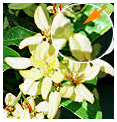 |
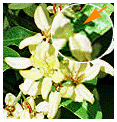 |
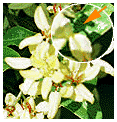 |
| 256 colors 14kb |
128 colors 12kb |
64 colors 10kb |
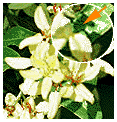 |
 |
 |
| 32 colors 8kb |
16 colors 6kb |
8 colors 5kb |
Legal Issues
Every time we are dealing with Internet materials, we face some legal issues as
to the rights of using certain formats. The compression technique of the GIF format was announced in early
1995, which led to some confusion as to the legality of using this format. Initially, CompuServe had the
absolute ownership of GIF. Later, CompuServe had and agreement with its patent holder (Unisys), which gave
some programs like Photoshop to use GIF format.11 If someone is very concerned about the copyright violation,
it's recommended that a patent-free format of graphic be used. One such format is the
PNG (Portable Network Graphic).
|

 GIF Format