Helga's retina
book:
Ron Douglas:
Contents and links:
Helga's retina
book:
Ron Douglas:
Contents and links:
Helga's retina
book:
Ron Douglas:
III Some physiologic aspects:
One major advantage of the vertebrate (including human) retina is that it utilizes two entirely separate channels for transmitting the signals from the photoreceptors to the brain: the so called ON and OFF channel, respectively. Each of these channels serves its distinct purpose of generating signals that indicate either an increment or a decrement in light. In other words, if one looks at a gray background, one needs the ON channel to see a white (or lighter gray) spot and one needs the OFF channel, in order to see a black (or darker gray) spot. For about 3 decades, this idea was purely hypothetical because there was no real way of proving that cellular properties could have this much impact on real vision. In an elegant series of sophisticated experiments, however, Peter Schiller and coworkers showed that, indeed, monkeys were unable to see a lighter spot on a gray background if the light ON channel in the retina was blocked pharmacologically whereas no deficit in the detection of dark spots (light OFF) was noted.
This dichotomy of the visual pathway into separate ON and OFF channels originates right at the first synapse in the retina, i.e. the connection between the photoreceptors and the bipolar cells. That is, all bipolar cells (with a few exceptions) can be classified as either being stimulated or inhibited by a flash of light into the center of their receptive field (observed first by Naka and Matsumoto, 1969 and then shown in detail by Werblin and Dowling, 1971). This separation of light ON and OFF channels persists through all stations of the visual pathway up to the visual cortex with only marginal cross talk between the channels.
Anatomically, the two channels can also be distinguished from each other
in that they occupy different output locations in the inner plexiform layer.
This phenomenon was first observed by Edvard (Ted) Famiglietti, Ralph Nelson
and Helga Kolb in 1972 (***). The general scheme is that all OFF
responses are handed down to third order neurons (retinal ganglion cells)
in the outer half of the inner plexiform layer. All bipolar cells which
do not make axonal branchings in the outer IPL strata have been found to
react with excitation to light, classifying them as light ON cells.
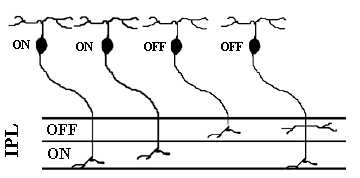 |
Schematic drawing of the different levels of IPL stratification of bipolar cells and the correlation to their physiologic responses. Note that all cells that ramify in the outer strata of the IPL are OFF center bipolar cells whereas those cells that lack the outer ramification are ON center cells. In other words, the presence of an OFF output overrides an additional ON output in determining the polarity of the cell |
Still, separate ON and OFF channels do not help with contrast enhancement
and edge detection because each channel signals exactly what it sees without
caring about what is going on in its neighborhood. One has, however, only
to look at a checker board to notice that the edges of the individual fields
appear to be high-lighted, that is, the edges of black fields appear much
darker than the centers of the same field, similarly, the edges of the
white fields appear whiter than their center areas.
To accomplish such a phenomenon, also known as “Mach Bands” one has
to postulate that neighboring units talk to each other. More precisely,
opposite signals enhance each other whereas similar or equal signals in
the same neighborhood weaken each other.
Such Mach bands are a common feature of all our sensory systems. A
simple demonstration can be done by putting an ice cube on the skin, this
naturally feels cold. Now, if one adds something warm around the ice cube,
the ice cube all of a sudden feels a lot colder while the warm stimulus
feels much hotter than if it were applied just by itself.
The weakening of similar sensations over a larger area is called lateral inhibition between neuronal units sensing them. The cellular origin of this sensation was found to be a distinct center-surround antagonism of nerve cells, described in the retina first by Baylor, Fuortes and O'Bryan (****). What they described in their milestone article was that retinal cone photoreceptors of the turtle have a receptive field center and a receptive field surround and center and surround possess antagonistic properties. In other words, a cell that responds with excitation to a small spot of light falling into its receptive field center, will respond with an inhibition (measured against its baseline/ resting potential) when exposed to a ring (annulus) of light sparing the center.
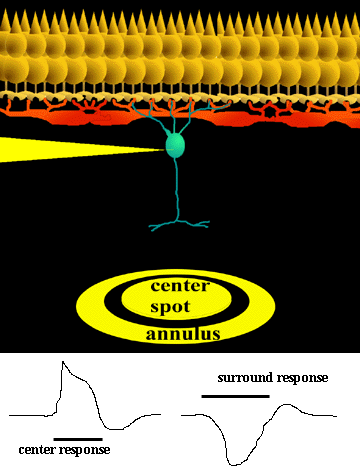 |
This is approximately what the outer part of a retina looks like. The
ochre cells are the photoreceptors which have rather large terminals (so
called axon pedicles) at their bottom at which they release glutamate.
The cells drawn in red are the horizontal cells which provide the lateral
integration of signals in the outer retina. The turquois cell is
a bipolar cell which is impaled with a glass electrode to record its electrical
responses. In this case the cell would be an ON center (OFF surround) cell.
The yellow spot and circle give an approximation of the kind of light stimuli
that are used to elicit the responses shown at the bottom. At rest, the
cells are sitting at about -30mV (resting potential), that is, the intracellular
charge is about 30 mV lower than the extracellular fluid. The membrane
acts as an insulator but contains pores that can be opened selectively
for positive or negative charges which then change the transmembrane potential,
depending on the stimulus. The main kation (positively charged ion) going
through these channels is Na and the driving force is the negative charge
of the cytoplasm. The main anion (negatively charged) is Cl and the driving
force is its absence (or low concentration) on the inside.
In this particular case, the cell responds with a depolarization to a center spot, that is, the membrane potential becomes more positive, whereas the surround response is a hyperpolarization, i.e. the membrane potential becomes more negative than the resting potential. (special thanks to my wife Etha |
This phenomenon is called the center-surround organization or center surround antagonism of sensory cells. While the effect itself has been investigated in detail numerous times, there is still no agreement regarding the mechanism responsible for its generation.
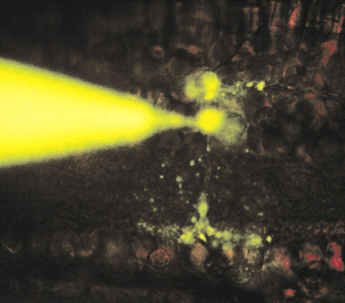 |
This picture was sent to me by Dr. Wallace B. Thoreson at the University of Nebraska and shows a living slice of retina (in this case of a mudpuppy) with one ON-center bipolar cell that he is just recording from. The axon of the cell ramifies, according to the blueprint, only in the innermost (towards the bottom) portion of the IPL, directly adjacent to the retinal ganglion cells. The rather thick columns in the top tier of the picture are the photoreceptors, in this case mainly rods. |
The cartoon below shows the different responses of an (in this case
ON center bipolar cell) to either a flash of light to its center or a large
annulus of light which leaves the center in darkness.
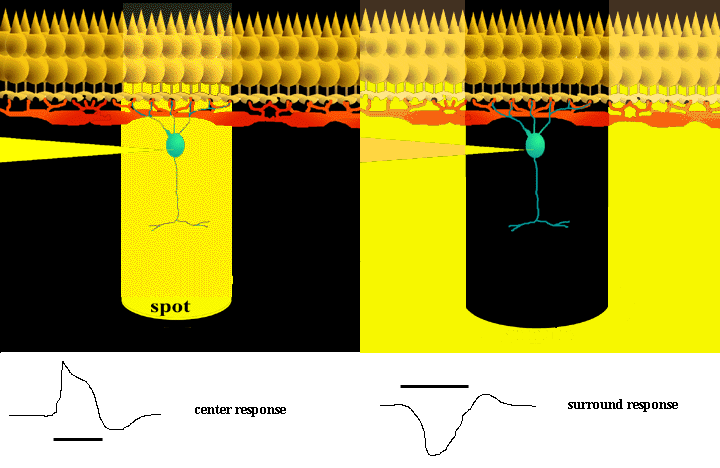 |
Below each cartoon, the typical response trace as seen in an intracellular
recording is shown. Note that the membrane potential goes up (which means
excitation) to a sharp peak (transient response) and then gradually returns
to a plateau (sustained response) which is maintained as long as the light
is on (stimulus duration given by the horizontal bar). In the case of the
surround illumination, the cell'sresponse goes in the opposite direction
and also slightly trails behind the light stimulus. After turning off the
stimulus, both center and surround responses return to baseline levels
(after a short overshooting into the opposite direction). If the bipolar
cell depicted in the cartoon were an OFF center bipolar cell, the responses
would be reversed, that is, center light ON would result in a hyperpolarization
(excitation would decrease) and surround would result in excitation. The
profile of the responses would however remain the same, that is, a fast
response to a spot and a slower, delayed response to the annulus. (special thanks to Etha, my wife, for her help with the animations) |