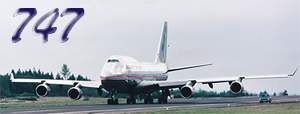
There are 6 million parts in the 747. Three million
parts are fasteners, and about half of those are rivets.
Airline cargo handlers use the 747's lower-lobe baggage
and cargo handling system to load or unload 85,000 pounds (38,500 kg) of baggage -- the
equivalent of 3,400 pieces of luggage -- in less than seven minutes.
The wing area of the 747-400 is 5,600 square feet
(524.9 m2), an area large enough to hold 45 medium-sized automobiles.
The diameter of the 747 engine nose cowl is 8 feet 6
inches (2.6 m).
Four World War I vintage JN4-D "Jenny"
aircraft could be lined up on each of the Boeing 747 wings.
One wing of the 747 weighs 28,000 pounds (12,700 kg),
10 times the weight of Boeing's first airplane, the 1916 B & W.
More than 15,000 hours of wind-tunnel testing were
completed on the first 747.
The 747 flight-test program leading to certification
for commercial service in December 1969 employed five airplanes, lasted 10 months and
required more than 1,500 hours of flying.
Seventy-five thousand engineering drawings were used to
produce the first 747.
There are 15 models of the 747. These include
all-passenger versions, passenger and cargo configurations and all-cargo models. The
newest model, the 747-400 Freighter, rolled out in February 1993 and was delivered later
that year.
The 747-400 contains the greatest passenger interior
volume of any commercial airliner at 31,285 cubic feet (876 m3), the equivalent
of more than three 1,500-square-foot houses.
The 747 has 16 49-inch main landing gear tires and two
nose landing gear tires.
The 747 has been in service since Jan. 21, 1970,
carrying more than 1.8 billion passengers more than 24.7 billion miles.
The tail height of a 747, at 63 feet 8 inches (19.41
m), is equivalent to that of a six-story building.
The Wright Brothers' first flight at Kitty Hawk could
have been performed within the 150-foot (45-m) economy section of a 747-400.
Engine thrust on the 747-400 has grown from 43,500
(19,730 kg) to approximately 60,600 pounds (27,490 kg) per new generation engine. By
comparison, total takeoff thrust of the four-engine 707-120 was 54,000 pounds (24,300 kg).
The first 747 had a design range of 5,290 miles (8,510
km). The 747-400 has a design range of 8,290 miles (13,340 km).
The 747-400 consumes 8 percent to 13 percent less fuel
than the 747-300, depending on engine selection. This is an improvement of up to 17
percent over the first 747s.
The difference between the maximum takeoff gross weight
(MTOGW) of the first 747 and the -400 is 165,000 pounds (78,840 kg). This is more than the
MTOGW of the 737-400.
There are 365 lights, gauges and switches in the
747-400 flight deck, down from 971 on earlier 747 models. That's fewer indicators for a
four-engine airplane than on some twin-engine jets.
The 747-400 can carry more than 57,000 gallons (215,745
L) of fuel. This makes it possible for the airplane to fly extremely long routes, such as
between San Francisco and Sydney.
The 3,300 gallons (12,490 L) of fuel carried in a tank
in the horizontal stabilizer (tail) can take the 747-400 an extra 400 miles.
How much weight does an additional 6-foot (1.8 m)
wingtip extension and winglet add to the 747-400 wing? NONE! A weight savings of
approximately 5,000 pounds (2,270 kg) was achieved in the wing by using new aluminum
alloys, which offset the weight increase of the wingtip extension and winglet.
Redesigned "flexible" cabin interiors not
only improve passenger conveniences and appeal, but allow airlines to rearrange seats and
class configuration overnight (in eight hours). They also permit 48-hour conversion times
for changes in galley and lavatory locations.
According to one 747 operator, no less than 5.5 tons of
food supplies and more than 50,000 inflight service items are needed on a typical
international flight.
Engine noise from today's 747-400 is half what it
was on the original airplanes delivered in 1970.