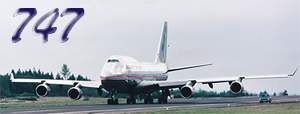
The Boeing 747 has
changed the face of aviation forever. It's big with graceful lines -- the definitive
"flagship" for airlines worldwide. Its characteristic fuselage hump draws it
forward, giving the illusion of movement even when the aircraft is still. It dwarfs the
people who design and build it. It looms over service vehicles that approach it. Even
other commercial airliners, in comparison, look small.
The
mid-1960s saw the development and introduction of many new jetliners. None, however, has
matched the dramatic impact of the 747. Helped by affordable fares, air-passenger traffic
grew explosively during the 1960s. Increasingly crowded skies and the availability of
large-thrust engines added to the incentive for creating the giant 747.
To
build the new plane, Boeing constructed a $200 million plant in Everett, Washington, 30
miles north of Seattle. The world's biggest airliner would be assembled in the world's
largest building (by volume). From the beginning, the 747 has relied on more than 1,100
domestic and international suppliers. With 79 percent of its sales outside the United
States -- nearly $98.3 billion in current dollars -- it has contributed to the positive
ledger of the U.S. balance of trade.
The
747 was, and continues to be, truly monumental in size. The fuselage of the original 747
was 225 feet long; the tail as tall as a six-story building. Pressurized, it carried a ton
of air. The cargo hold had room for 3,400 pieces of baggage and could be unloaded in seven
minutes. The total wing area was larger than a basketball court. Yet the entire global
navigation system weighed less than a modern laptop computer.
Passenger
747s
Pan Am launched the 747 program in 1966 with an order for 25 of the huge
747-100s. The -200B developed from that, capable of lifting even more. Powered by four
Pratt & Whitney JT9D engines of 47,000 pounds thrust each, range was pegged at 6,600
miles (10,600 km) with a "standard" load of 374 passengers. The 747-100B offered
a 710,000-pound (319,500-kg) maximum takeoff weight. A shortened version of the 747-200,
the 747SP, began flying in 1975. Featuring a top speed of Mach 0.92, it could also fly
farther nonstop than any other jetliner in the world. Altogether, Boeing delivered 167 of
the 747-100s, nine -100Bs and 225 new 747-200s in all-passenger configurations.
The
next major external change to the 747 came with the 747-300, with its extended upper deck.
Capable of carrying 10 percent more passengers, its improved engines reduced fuel burn by
25 percent per passenger. Boeing delivered 56 passenger-only 747-300s, beginning in 1983.
747
Freighters
Boeing has been the world leader in civilian jet air cargo
since the 707 Freighter was introduced over 30 years ago. From the beginning, the 747 was
designed to serve as an all-cargo transport. The first 747 Freighter could easily carry
100 tons (90,000 kg) across the Atlantic Ocean or across the United States. Its operating
cost was 35 percent less per ton mile than 707s configured as freighters. Starting in
1972, Boeing delivered 73 of the 747-200 Freighters. In addition, each year more and more
of the early 747s are converted into freighters after serving many productive years as
passenger planes.
Passenger/Freighter
Mixes
The 747-200 Convertible responded to airlines' needs for a flexible,
large airplane that could carry passengers or cargo, or combinations of both. The
Convertible was certified by the FAA on April 24, 1973. Boeing delivered 13 versatile
747-200Cs. The "Combination" 747s began service in March 1975. They were
passenger airplanes with a large side cargo door on the main deck. This allowed airlines
to make better utilization of their routes during different parts of the year. Boeing
delivered 78 new 747-200 Combis and 21 later -300 Combis.
In 1989,
Boeing introduced the 747-400, now the only 747 type available. Based on the success of
earlier 747 models, it is now available in all four passenger and freighter versions:
passenger, domestic, freighter and combi.