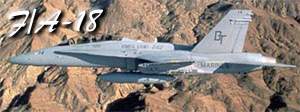
The F/A-18 Hornet is a single- and two-seat, twin-engine
multimission tactical aircraft. It is the first tactical aircraft designed from its
inception to carry out both air-to-air and air-to-ground missions.
Today, the F/A-18 is in service with the U.S. Navy, U.S. Marine
Corps and the air forces of Canada, Australia, Spain, Kuwait, Finland, Switzerland,
and Malaysia. Hornet pilots have accumulated more than 3.4 million flight hours and, in
the process, are establishing new records daily in safety, reliability, maintainability
and mission performance.
A key aspect of the Hornet
’s popularity with pilots is the ease with which the
aircraft can be converted from fighter to strike mode and back again; it’s as easy as flipping a
switch. During Operation Desert Storm, F/A-18s routinely performed fighter and strike
missions on the same sortie. Fulfilling a variety of roles—air superiority, fighter escort, suppression of
enemy air defenses, reconnaissance, forward air control, close air support, and day and
night strike missions—the F/A-18 has proven to be the most versatile combat aircraft in service.
Reliability and maintainability are also designed into the
Hornet. These factors result in significantly lower operating and maintenance costs for
the F/A-18 compared to other U.S. Navy fighter and attack aircraft; and life cycle costs
comparable to other modern multi-role aircraft.
Survivability is another key Hornet feature. The F/A-18
employs a number of systems and technologies that increase its likelihood of reaching a
target undetected, of escaping unhurt if it is detected, and of returning its crew safely
if it is hit. These systems and technologies have been enhanced in the F/A-18E/F Super Hornet to improve
survivability.
To maintain its advantage over the threat, the F/A-18 has
been upgraded regularly since entering service in 1983. In November 1989, the first
F/A-18s equipped with night strike capability were delivered.
Since 1991, F/A-18s have been delivered with F404-GE-402
enhanced performance engines that produce up to 20 percent more thrust than previous F404
engines. The Hornet
’s two engines deliver about 36,000 pounds combined thrust and a top speed of more
than Mach 1.8.
In February 1992, the Marine Corps began taking delivery of
Hornets with provisions for a reconnaissance package. Now, under the leadership of the
Boeing Company, a program is under way to integrate the Advanced Tactical Airborne
Reconnaissance System into Marine Corps F/A-18Ds. Operational evaluation is scheduled for
November 1998 through January 1999, with initial operational capability planned for March
1999.
Since May 1994, the Navy has been taking delivery of F/A-18s
equipped with an upgraded radar. This upgrade, known as APG-73, substantially increases
the speed and memory capacity of the radar
’s processors. In addition, today’s Hornets have a laser
target designator/ranger, housed within the targeting forward-looking infrared sensor,
that enables the aircraft to deliver precision laser-guided bombs with pinpoint accuracy.
The Hornet
’s exceptional operational record and its continuous
improvements have sparked ongoing international interest. The Philippines, Chile, the
Czech Republic, Hungary and Poland have all expressed interest in the Hornet for future
procurements.
Canada was the first international customer for the F/A-18,
and its fleet of 138 Hornets is the largest outside the United States. Deliveries to
Canada were completed in 1988. Canadian CF-18s operate out of Canadian Forces Base Cold
Lake, Alberta; and Canadian Forces Base Bagotville. The Canadian Forces are currently
planning an aircraft modernization program, which would significantly upgrade the avionics
of their CF-18s.
The Operational Conversion Unit at Royal Australian Air Force
Base Williamtown received its first Hornets in May 1985. Hornets delivered to the RAAF
were assembled in Australia. Aircraft are located at Williamtown, in the east, and RAAF
Base Tindal, in the north. Deliveries were completed in May 1990. Currently, the fleet is
undergoing a two phase upgrade to include advanced avionics, new countermeasures, a new
radar and an advanced air to air weapons system.
The Spanish Air Force procured 72 EF-18s from 1986 to 1990.
The SAF operates Hornets from air bases at Zaragoza, Torrejon and Meron. In September
1995, the SAF signed a letter of offer and acceptance to procure an additional 24 F/A-18As
from the U.S. Navy inventory. To date, 13 of these aircraft have been delivered to the
SAF.
Kuwait signed a letter of offer and acceptance for 40 F/A-18
aircraft in August 1988. Delivery of the 40 aircraft was completed in August 1993. The
aircraft are based at Al Jabar Air Base, near Kuwait City. Kuwait received the first
F/A-18s powered with General Electric
’s new F404-GE-402 enhanced performance engines.
Currently, Kuwait is in a post-production support mode. The
United States continues to support the Kuwait Air Force with program management, contract
administration, logistics, field team visits and sustained engineering.
Finland signed a letter of offer and acceptance for 64
aircraft in June 1992. The Boeing Company delivered seven F-18D two-seat aircraft to the
Finnish Air Force in 1995. The first of 57 single-seat aircraft, all C models, were
delivered in June 1996 by Boeing
’s subcontractor Finavitec in Halli, Finland.
Finavitec is scheduled to deliver the final F-18 in 2000.
Switzerland is procuring two complete F/A-18s, 32 F/A-18
kits, support equipment and services. An F/A-18D and F/A-18C were delivered to Switzerland
in December 1996 and early 1997 respectively. Kits for the remaining 32 aircraft were
delivered in 1997. They are currently undergoing final assembly and ramp operations at the
Swiss Aircraft and Systems Co. in Emmen, near Lucerne, Switzerland. Malaysia signed a
letter of offer and acceptance for eight F/A-18 aircraft and support in December 1993. All
eight aircraft were delivered during 1997.
The Boeing Company leads a nationwide industry team that
builds the F/A-18 Hornet. Boeing builds the forward fuselage and wings, and conducts final
assembly. Northrop Grumman Corp. is the principal
airframe subcontractor, supplying the center and aft fuselage. General Electric Co. produces the Hornet
’s engines, and Raytheon provides the aircraft’s
radar.