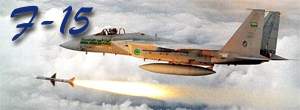
The F-15 Eagle is the most capable production fighter in the
world. Since entering operational service in 1974, the F-15 has attained a perfect air
combat record of 96.5 victories and zero losses. F-15s destroyed 33 of the 35 fixed-wing
aircraft Iraq lost in air combat during Operation Desert Storm.
The F-15E dual-role fighter, meanwhile, provided
devastatingly effective flying at night and in bad weather to attack numerous mobile Scud
missile launchers and other high-value military and ground targets. The F-15E also
maintained a 95.5 percent average mission capable rate, the highest of any fighter in the
war.
Production of the F-15 has been extended into 1999 by orders
for 72 F-15S aircraft for Saudi Arabia, and 25 F-15I aircraft for Israel. Deliveries to
Saudi Arabia began in mid-1995. Israel took delivery of its newest fighter in January. In
addition, the U.S. Air Force contracted for five new
attrition reserve F-15E aircraft for fiscal year 1998.
The F-15E can carry payloads of up to 23,000 pounds and is
the only fighter in U.S. production capable of performing the interdiction mission. It
also retains the full air-to-air capability of the F-15C.
F-15Es are powered by twin Pratt
& Whitney F100-P&W-229 engines, generating 29,000 pounds of thrust each.
The Hughes APG-70 radar provides high-resolution
ground-mapping data to cockpit displays that enable F-15E crews to identify targets
clearly and at great distances, significantly increasing situational awareness. The Lockheed Martin LANTIRN (Low Altitude Navigation and
Targeting Infrared for Night) system gives the F-15E the ability to fly at high speed and
low altitude at night and in bad weather and to strike targets with pinpoint precision.
Boeing makes the F-15E at its plant in St. Louis, Mo.
Mitsubishi Heavy Industries produces the F-15J under license in Japan. Approximately 1,300
F-15s are in service worldwide with the U.S. Air Force and Air National Guard and with the
air forces of Israel, Japan and Saudi Arabia.