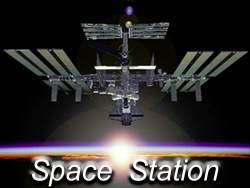
In 1984, after a
review of many studies, President Reagan committed the United States to developing a
permanently occupied space station. He also stressed international participation and NASA
invited other countries to work with the United States to develop a space station concept.
Japan, Canada and nine of the 13 nations of the European Space Agency agreed to work
together on a space station program in September 1988.
In 1993, President Clinton directed NASA to redesign the station to bring its research
capabilities on line sooner, involve the Russians, reduce costs significantly, simplify
on-orbit construction, and streamline the organization of the program. The re-conceived
station was named simply, International Space Station.
Compared to the design of its predecessor, International Space Station will have the
ability to do more science, carry a larger crew, generate more electrical power for
research, be maintained in space with less effort, and handle contingencies more
efficiently.
Today, 16 countries are members of the International Space Station Team: Russia, Japan,
Canada, Italy, Belgium, the Netherlands, Denmark, Norway, France, Spain, Germany, Sweden,
Switzerland, the United Kingdom, Brazil, and the United States.
By the summer of 1999, International Space Station will support a crew of three. When
fully assembled in 2004, it will house a crew of six or seven -- working in 46,000 cubic
feet of pressurized volume (equal to the volume of two 747 jet liners) spread across seven
laboratories, two habitation modules, and two logistics modules.
Lifting the station’s components into space will require 43 launches using both
United States Space Shuttle fleet and Russian Soyuz and Proton vehicles. In all, more than
460 tons of structures, modules, equipment, and supplies will be placed into orbit.
Worldwide, more than 900 researchers are working on experiments to be carried out on-board
in the areas of biotechnology, combustion science, fluid physics, materials science, life
sciences, engineering and technology, and Earth sciences.