Batteries ARE Included ?quot;
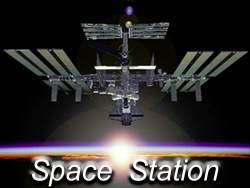
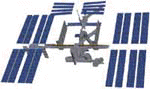
- There are four U.S. photovoltaic
modules, each with two arrays measuring 112 feet long by 39 feet wide. Each module
generates about 23 kW. They rotate to face the sun, which provides maximum power to the
station.
- The solar array surface area is 27,000
square feet, or more than half an acre.
- The thermal radiator (heat reflection
for the four PV modules) area covers 2,200 square feet.
- The electric power system is connected
with 42,000 feet, or eight miles, of wire.
- The batteries, lined up end-to-end,
measure 2,900 feet, or 1/2 mile long.
- The total weight of electric power
system hardware is 140,000 pounds or 70 tons.
- Electrical and electronic parts include
1,900 different types of resistors, 500 types of capacitors, 150 types of transistors
(note that this is not the part count, rather, it is a count of different types of
hardware).
Room With A View
- The station will have four windows for
looking at Earth to conduct Earth observation experiments and other applications. It will
also have 11 external payload locations for mounting experiments.
- The station will have a Habitation
Module for the crew as well as seven laboratories for research -- two U.S. (a laboratory
and a Centrifuge Accommodation Module), one European Space Agency facility, one Japanese
module and three Russian research modules.
Compute This
- Fifty-two computers will control the
systems on the International Space Station. There will be more than 400,000 lines of
software for 16 of those computers which, in turn, talk to 2,000 sensors, effectors and
embedded "smart" hardware controllers.
- Two computers in the U.S. Laboratory
module are dedicated to keeping the station in proper orientation (attitude) as it orbits
the Earth once every 90 minutes.
- Twenty two computers mounted outside
the station control such functions as electrical power switching, solar panel alignment,
disposal of heat generated from the station's environment and electronic equipment, and a
mobile transporter that travels along a rail the length of the station.
- The flight support software has 1.7
million lines of code (includes test control and simulation software).
Robot Power
- The 58-foot robot arm, built by the
Canadian Space Agency, can lift payloads of up to 220,000 pounds (the mass of a Shuttle
Orbiter) and will move modules, nodes, truss segments, and other large elements essential
to station assembly.
- A smaller robot arm, the Special
Purpose Dexterous Manipulator, is about 12 feet long, and attaches to the larger arm. It
is intended to do more precise work such as replacing small parts. It has a variety of
interchangeable tools and can move 1,300 pounds.
|
 Space Station Overview