
TuMa's Herbal Health - Medicinal Herbs in the Native American and Folk Medicine Traditions. | home
How Herbs Work | Send TuMa a note | For Sale - Formulated Herbal Teas | For Sale - Tinctures | For Sale - Lip Balm and Salves | For Sale - Beverages | Price Lists | Oils and Salves | Cancer Formula Tea | Herbal Notes by TuMa | Aloe | Arnica | Black Cohosh | Calendula | Dandelion | Echinacea | Feverfew | Garlic | My Photos | TuMa's Favorite Links | Shipping | eBay Store
Black Cohosh
BLACK COHOSH
By TuMa
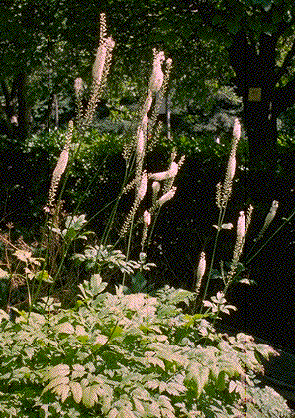
Cimicifuga racemosa
|
Family:
|
Ranunculaceae
|
Medicinal Part:
|
Rhizome and Root
|
Also known as:
|
Squawroot, snakeroot, bugbane, rattleroot, black rattle root.
|
Notes of Interest:
|
The word cohosh is Algonquian for "rough". The roots are black so the naming of this very useful herb is understandable. This root has been used by Native American women for centuries and was even traded for other medicinal herbs all across America by Native American traders and travelers. My Great-Grandmother told me that Black Cohosh was often obtained from travelers and traders in exchange for Echinacea, white sage and chaparral.
|
Actions and Pharmacology:
|
Compounds:
Effects:
|
Triterpenes: triterpene glycoside
Quinolizidine Alkaloids: cytisine, methyl cytisine
Phenylpropane derivatives: including isoferulic acid
The active ingredients in the root are the triterpine glycosides causing an estrogenic effect.
|
Therapeutic Uses:
Therapeutic Uses:
|
My Grandmothers taught me that Black Cohosh was often used for many different conditions, often given as a decoction for fatigue, sore throat, arthritis and even snakebite.
The best use for Black Cohosh is for women. Because of the estrogenic effect. Black Cohosh, in tincture form, is recommended for Premenstrual Stress Syndrome (PMS), postmenopausal symptoms, and to ease childbirth.
When combined with nervines such as Catnip, Chamomile or Red Raspberry Leaf, Black Cohosh is excellent for relieving menstrual cramps.
Black Cohosh as infusions and decoctions are often used for arthritis symptoms and lower back pain.
Experienced herbalists combine Black Cohosh with other herbs, such as St. John's Wort, for short-term depression. REMEMBER: experience is the key! Do not combine herbs without out first researching what effect the herbs you are mixing can do. For example, St. John's Wort can be toxic to those who are on high blood pressure medication.
|
Contraindications:
|
Do not use Black Cohosh during pregnancy due to increased risk of spontaneous abortion.
Do not administer to nursing mothers.
Administer with care to adolescents and the elderly.
Do not administer to children under 10 years of age.
Administer with care to adults with heart disease or estrogen-dependent cancers and those taking sedatives, blood pressure medications, birth control pills or postmenopausal estrogen.
|
Dosages:
|
Tinctures: 10 to 30 drops daily in 2 doses.
Tisanes and Decoctions: Steep 1 Tablespoon (or a good metal tea ball full) of dried root in 1 to 2 cups of boiling water twice a day.
OBSERVE: Do not continue to use if nausea or vomiting occur, or if any other adverse side effects are occur.
|
Notes and Recommendations:
|
REMEMBER: Like any other substance, use in moderation, and for no longer than 6 months for a specific problem. Herbal remedies should be treated with respect for their properties. Most of the medications of today are derivatives of herbal properties. Use with caution.
|