
TuMa's Herbal Health - Medicinal Herbs in the Native American and Folk Medicine Traditions. | home
How Herbs Work | Send TuMa a note | For Sale - Formulated Herbal Teas | For Sale - Tinctures | For Sale - Lip Balm and Salves | For Sale - Beverages | Price Lists | Oils and Salves | Cancer Formula Tea | Herbal Notes by TuMa | Aloe | Arnica | Black Cohosh | Calendula | Dandelion | Echinacea | Feverfew | Garlic | My Photos | TuMa's Favorite Links | Shipping | eBay Store
Herbal Notes by: TuMa
FEVERFEW
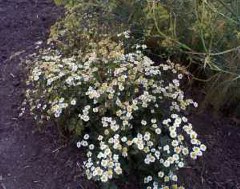
Photo by Paul Laflamme
Tanacetum parthenium
COMMON NAME: Featherfew, featherfoil, midsummer daisy, febrifuge plants, pyrethrum.
FAMILY: Compositae.
MEDICINAL PARTS: The entire plant.
SOLVENTS: Alcohol, and is partially soluble in boiling water.
ACTIONS: Aperient, Carminative, Tonic Emmenagogue, Vermifuge, Stimulant, anti-inflammatory, and vasodilator.
NOTES OF INTEREST: There are two different plants that are often shown as "feverfew". Tanacetum parthenium, as we are discussing here, and Chrysanthemum parthenium. I have seen in many articles that feverfew is shown with both names as if there is no difference in the plant's properties, I'm not so sure. They are obviously not the same plant, but are from the same Compositae family. Their actions may be the same, but my experience is with Tanacetum parthenium only so that's what we'll discuss.
Feverfew is a medicinal herb that has been used since the time of the noted Greek herbalist Dioscorides in first century. The uses of the valuable herb have not changed much. It was used as an anti-inflammatory and pain reliever even then.
PHARMACOLOGY: Volatile oil, Sesquiterpene lactones, flavonoids, and polyymes (in fresh plants). The Sesquiterpene lactones contain parthenolide and this is the active compound in feverfew.
THERAPUTIC USES: Recent studies have shown that feverfew is particularly effective for certain types of migraine headaches, especially those headaches that are most receptive to applications of warmth to the head. Other uses for feverfew include dizziness and tinnitus (ringing in the ears) and nausea. It has a tradition of effective treatment in arthritis, fever, and in some cases, asthma and allergies. As an anti-inflammatory it is effective both internal and externally and is well known for relieving pain due to inflammatory conditions such as osteo-arthritis.
Feverfew has a pungent aroma and a very bitter taste. It is often used fresh as an insect repellent and works well in tincture form for the pain and swelling of insect bites.
PREPARATION: The fresh plant is very effective for poultices and can be added to a simply syrup or honey for immediate consumption. (Remember that honey preparations should not be given to children). Infusions of two or three chopped teaspoons of fresh herb are also very effective.
Since the fresh plant is not readily available to all of us, the dried herb is best prepared in an alcohol-based tincture. Add 1 ounce by weight of dried herb to 4 oz. of vodka or gin and place in a dry, cool, and dark place for approximately two weeks. Strain and store in a clean glass jar in a dark place.
Infusions can be used as a tisane, and as a decoction can be used as a skin wash for insect bites and as a poultice for sore and swollen joints.
I don't recommend taking feverfew in capsule form. It usually takes several weeks for it to be effective and must be monitored so that the levels do not become toxic.
CONTRAINDICATIONS: Do not take feverfew if you are pregnant or nursing or if you are taking blood thinners like coumarin.
DOSAGE: To make an infusion, steep 2 teaspoons of the dried herb in 1 cup of boiling water. Remove from heat and let steep for 15 minutes.
A stronger infusion can be made by steeping 4 teaspoons for 25 minutes; this is for external washes and poultices only.
An alcohol tincture can be taken three times a day, 7 to 10 drops per dose.
If you suffer any adverse affects like gastrointestinal distress, discontinue use.