|
Chapter 1. Environmental Geology And Human Existence.
- Geology: The study of the earth in general.
- Environmental Geology: The sub-discipline that
focuses on the relationship between humans and their geologic, or earth, environment.
Well put – and obviously Civil, Geological, Geotechnical, and Mining Engineering
are central to this relationship in terms of:
- Responsible development
.
- Remedial Engineering.
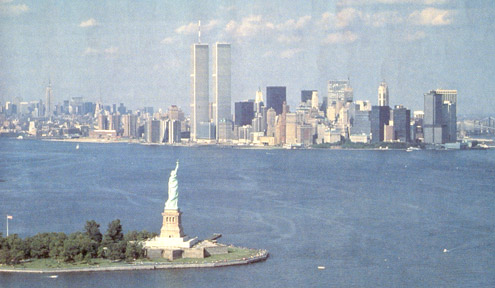
e.g. New York City P.1. Neat bit of Geology.
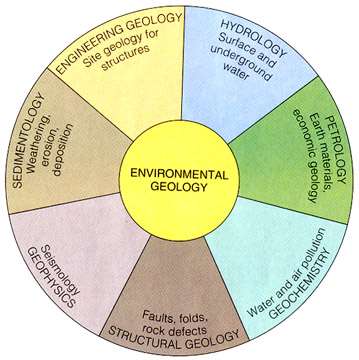
-Environmental geology encompasses all of the traditional branches of geology as shown
very clearly in fig. 1.1.
The relationship between the geological sciences and environmental
geology.

Note: Mineralogy is missing from the chart.
The authors place a lot of emphasis on geologic hazards. In many
ways this reflects their environment in the U.S., and particularly California. We in
Canada have a somewhat different outlook; we have problems; we must solve these problems
in a collective way.
- Key Techniques – Which is where the labs fit in:
e.g.
- Surface data from rock outcrops and soil analysis: (Minerals rocks, and soils labs.)
- Hydro-geological information. i.e. surface/sub-surface water information. (Groundwater
lab.)
- Obtaining sub-surface data. (Drilling; geophysics.)
- Presentation of data in plans (geological maps) and sections. (Maps Lab)
e.g. U.S. National geologic Mapping Act of 1992: estimated U.S. $184 million over the
course of 4 years.
"Geologic mapping is a fundamental part of most Earth-Science studies, with
applications in such fields as applied geology investigations; water resource planning;
and land-use planning for waste dumps, coastal housing and transportation."
- Population Pressure:
The focus of chapter one is mainly on population growth and population pressure. A very
acute problem in most countries of the world, but not so much in Canada, which means that
maybe we should plan for it.
But: Two major Canadian examples:
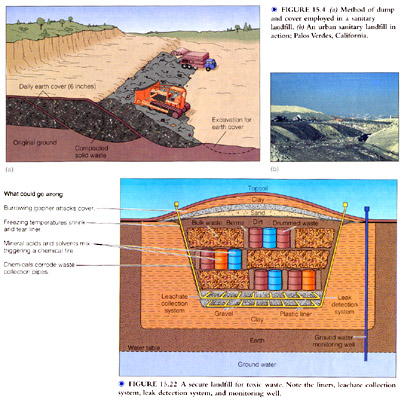
- Disposal of human-generated waste:
e.g. Sanitary and secure landfills in the Toronto area.
- The exceptionally important issue of possible export of Canadian freshwater.
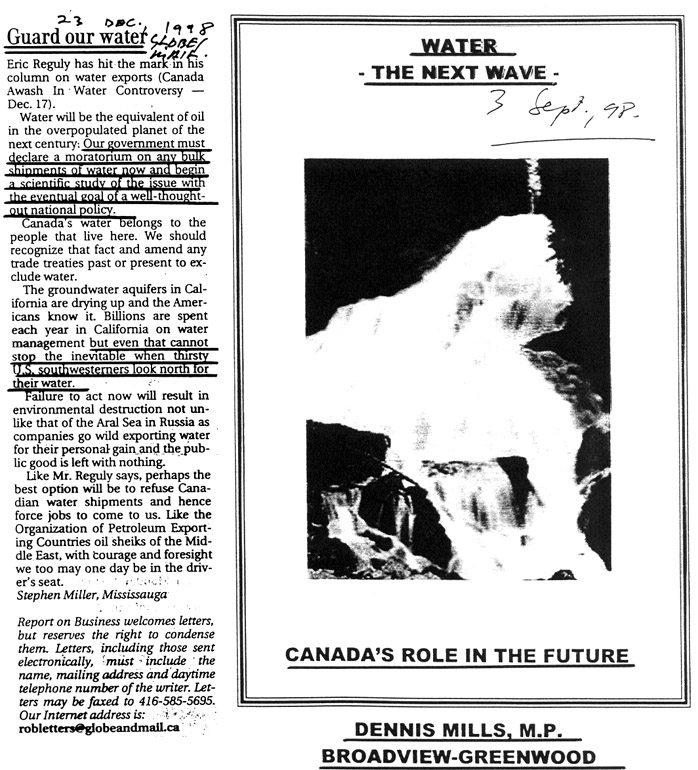
Click here to view an article
on protection of Canada's Fresh Water.
- Global population growth. - Key points:
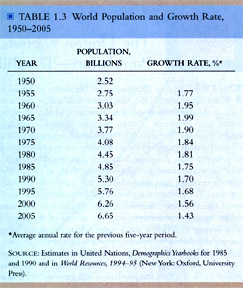
- Global population in 1995 was 5.76 billion. (In 1900, it was approximately 1.6 billion.)
- Approximately 10,000 generations -> first 2 billion.
Now only 1 generation to the next 2 billion.
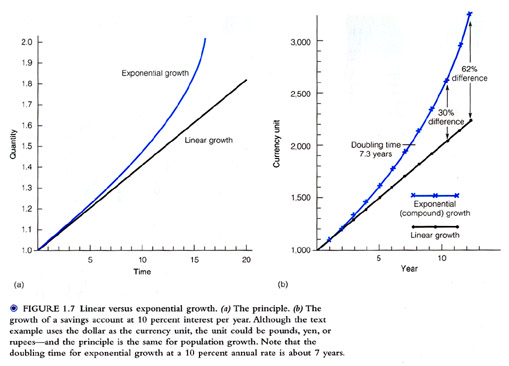
e.g. 2% growth does not sound very much, but results in a doubling time of 35 years.
** Population Doubling time = 70 divided by growth rate in %. (Useful approximation).
- For 1995: growth rate = 1.68%
Therefore, doubling time = 42 years (for 1995).
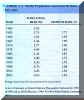
-As table 1.3 shows:
The global growth rate (%) increased to a high of 2.06% in the 1960’s (pg 8);
since when it has been falling slowly e.g. estimated to be 1.43% in 2005.
- This is a world average – some countries have significantly higher population
growth rates than others.
e.g. Europe, Japan, and North American growth rates are pretty low.
1995 U.S. growth rate: 0.69%
1990 – 95 China Growth rate: 1.42% (p. 10)
- What of the future? (U.N. Conference in 1994. P.9)
- Major political and religious issues.
- If family planning succeeds: 7.27 billion by 2015.
- If population stabilizes, the level of population will double at 12 billion.
- If family planning does not succeed: 7.92 billion by 2015; then explodes to 12.5 billion
and more by 2050.
- And there are 700 million undernourished people in the world right now. (p. 9)
- Hence: obviously, this is a major global problem.
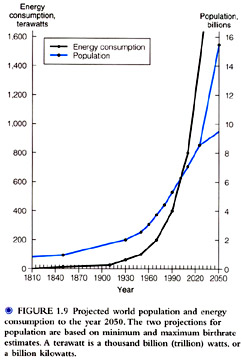
- The Future (Fig 1.9 Page 11): either controlled or uncontrolled:
- Controlled: ~ 10 billion by 2050 and leveling off.
- Uncontrolled: Let us not even think about it.
- Objective: Should be to achieve a sustainable global society (pg 13)

Major Question?
Is there, and should there be, collective Government objectives for stable, zero growth
populations in the various areas of Canada (Provinces; Territories)?
What should they be? How should they be achieved, maintained, and protected?
We are one of the relatively few countries of the world which, by clear management,
could target a certain population and go no higher. We can then protect a sustainable
population, economy, and a beautiful natural environment. We can still do it. |