|
| |
Chapter 2B. Getting around in Geology
(Rocks and the rock cycle - Key Point)
- Rocks
are consolidated natural composites, or aggregates that consist
of various proportions of:
Minerals
- glass, and other Amorphous Materials.
- solidified organic material. e.g. coal.
- The book, like most books, says that there are three classes of rocks, in fact,
there are four:
- Igneous (From Latin "ignis" = Fire):
Formed from natural molten material both by eruption on the Earth’s
surface and by crystallization within the Earth.
Therefore:
i) Extrusive
ii) Intrusive
- Hydrothermal:
(The type not considered in the book, but incredibly
important especially for economic mineral deposits (e.g. copper; gold))
Deposited by natural hot aqueous fluids, for example in mineral veins, or formed by
reaction of natural hot fluids with different rock types.
e.g. Economic kaobinite clay deposits in S.W. England.
Hot:
Depending on the process, temperatures typically between +80 degrees Celsius and +
700 degrees Celsius, at the high T end. Mostly: about 100 degrees Celsius -
350 degrees Celsius.
e.g. Black smokers on the sea floor: about 250 degrees Celsius to 350 degrees Celsius.
- Sedimentary:
Formed by sediment deposition ("sedimentation") primarily on
the sea floor, but also: in lakes, river systems, ice
sheets/glaciers, even on land e.g. sand dunes.
Components:
- Rock fragments
including volcanic rock fragments.
Primary mineral fragments.
Minerals formed by chemical weathering ESP. clay minerals.
Materials synthesized biologically by organisms e.g. coral fragments.
Inorganic chemical crystallization:
e.g. CaCO3 (calcium carbonate).
CaSO4*2H2O (gypsum).
NaCl (Halite)
KCl (Sylvite – exceptionally important; for the
potash fertilizer industry).
Fossils: Sedimentary rocks are renowned for containing fossils
- which can be incredibly detailed. Fossils preserve an amazing record of the
evolution of life on Earth.
- Metamorphic:
All other rocks (see above), incl. pre-existing metamorphic rocks, which have been recrystallized
both mineralogically and texturally by:
- High temperature.
(E.g. marginal to an igneous intrusion; at depth in the earth).
- High pressure
- Especially
: solid state ductile (plastic) deformation. (In
many, but not all cases.)
Example:
Core zones of mountain belts (e.g. Himalayas) exposed at surface: e.g Gravenhurst
– Tweed- Ottawa – Quebec area.
Geologically called: The Grenville province; 1 billion yr. old.
The rock cycle:
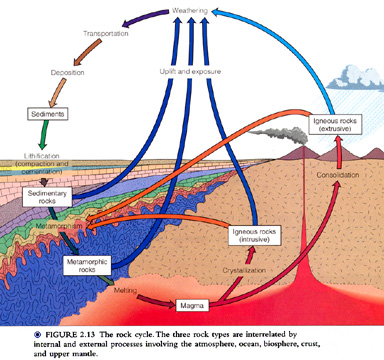
All these rock types are linked by the rock cycle, which reflects an intensely
active outer earth, and the chemical and physical consequences of plate tectonics.
The Rock cycle is illustrated very well in fig. 2.13, P. 35.
However, we need to make three principal modifications:
- We must add a loop to show that metamorphic rocks can be re-metamorphosed
- We must add hydrothermal rocks.
- On P.32, it is stated that the rock cycle is a "closed system".
This is not true of the outer part of the earth, since:
- New magma is added by partial melting of the upper mantle.
- Material is removed back into the mantle by the plate tectonic process of
subduction (see
later).
If you included the whole mantle; the rock cycle would, essentially be closed.
Note: Magma = natural molten rock.
Lava = Surface product only i.e. eruptive flows.
- Igneous (P.32-35 of class
text): key points:
- As mentioned above, there is a primary subdivision for igneous rocks between:
- Intrusive or Plutonic:
Crystallized from molten rock (=magma) within the earth. Hence, cooled moved and
therefore coarse grained. e.g. Granite.
- Extrusive, or volcanic:
Formed at surface by various eruptive mechanisms.
Another important sub-, sub-, division between:
- Non – fragmental e.g. lava flows (e.g. basalt), domes etc.
- Fragmental, also called pyroclastic.
i.e. Fragmented by various eruptive mechanisms.
e.g. Tuff – consolidated volcanic ash.
Therefore, cooled very rapidly in air, or water; therefore, fine grained - even
glassy.
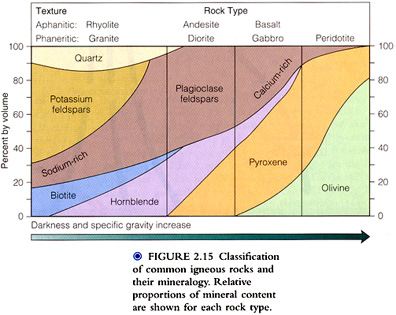
Classification of igneous rocks: (e.g P.32; ESP. fig. 2.15, P. 36.)
- Based on i) Texture i.e. Grain size and grain shapes.
ii) Mineral composition, which reflects chemical composition
- Texture:
- Fine – grained, or aphanitic:
Very fine grained; mainly volcanics, both non – fragmental, and fragmental:
Even: Glasses
e.g. Obsidian- A beautiful natural black glass, with a beautiful glass-type
conchoidal fracture, and glassy, or vitreous lustre; quite SiO2 rich (~ 70%
SiO2)
Pumice- Also SiO2 rich: natural pale glass, but filled with gas
cavities –so light it can float. A cooled down, glass "froth".
Submarine Pillow Lavas - basaltic magma composition (not so SiO2 rich - ~
50% SiO2 ). Outer few cm can be black glass from rapid cooling in water.
N.B. Particular texture:
Porphyritic: Large crystals in a fine grained ground mass
- both extrusive and intrusive.
- Coarse-grained, or phaneritic:
Cooled slowly; time for crystals to grow.
Especially intrusive igneous rocks; interiors of some thick flows or domes.
Intrusions: small-medium size: Plutons.
- Greater than 100 km2: Batholiths.
- Bulk Mineral/ Chemical composition:
(See Fig. 2.15, p.36.)
Felsic (L.H.S.; ~ 70% SiO2 )----> intermediate
----> Mafic (in 50% SiO2 ) ----> ultramafic
Aphanitic (mainly extrusive), and phaneritic (mainly intrusive) name
equivalents in each category.
- Must add "Komatiite" as the aphanitic equivalent of "peridotite".
- Felsic: Rich in potassium feldspars and quartz.
- Mafic: Rich in calcium feldspars, pyroxenes and olivine.
|
Felsic
Intermediate
Mafic Ultramafic |
|
| Fine:
Course:
|
|
<-- Komatiite
|
<----- SiO2 content increases.
- Hydrothermal rocks:
As mentioned above, natural hot water related; mainly at 100 degrees Celsius – 350
degree Celsius:
E.g. (i) Mineral vein systems:
E.g. certain Au and Ag deposits in ~ 1 m wide veins.
Criss- crossing ~ 0.1-5cm vein "networks" (=stockworks) in porphyry
Cu, Mo and Au systems.
-Mineral deposition in "open space", originally fluid filled veins.
(ii) Formed by hot water/rock interaction i.e.
replacive .
E.g. sulphide replacement of carbonates -> mantos.
Hydrothermal alteration of granitic feldspars to kaolinite clay (e.g. S.W.
England); used for ceramics; very high quality paper coating and filling.
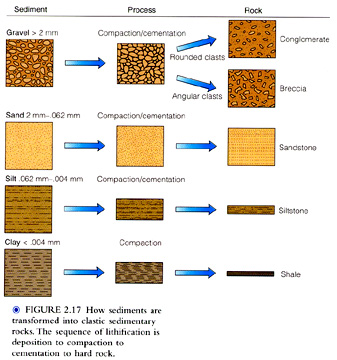
- Sedimentary Rocks:
Hardened (lithified) sediment:
Deposition by marine water, river systems, glaciers, wind etc.
- Key Feature:
All sedimentary rocks show layering referred to as bedding or stratification,
at a very large range of scales: sub-mm in shales, to kilometers in sed. sequences.
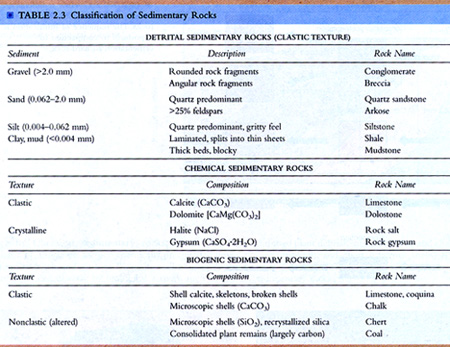
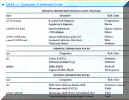
- Table 2.3, P.38 shows the prime classification into:
- Detrital or Clastic
- Chemical
- Biogenic
N.B. Important to remember fragmental volcanic rocks
e.g. Lithified volc. ash = Tuff

Classification of Sedimentary Rocks
- Metamorphic Rocks:
Mineralogically and texturally recrystallized by high T at high P +-
(ductile) plastic
deformation.
N.B. Foliation: planar alignment of minerals.
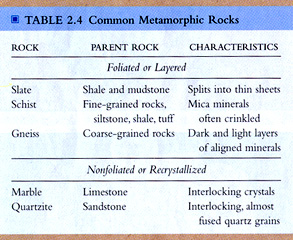
Table 2.4 describes some common metamorphic rock types, (p.40).
E.g. Foliated:
Sedimentary shale or mudstone -------> slate
coarser (can see individual mineral grains ESP. MICAS.) -----> Schist
Coarse and compositionally banded -----------------> Gneiss
Non-Foliated:
e.g. Limestone ----------� Marble
(e.g. First Canadian Place).
Sandstone ----------� Quartzite

- Finally Structural Geology:
Extremely important for civil and the different types of geological engineering (pp.
39-40, 367-368).
1. Weak Planar structures:
i) Bedding planes in sedimentary rocks.
ii) Foliation planes in metamorphic rocks.
2. Brittle Structures:
i) Without Displacement: Joints = Brittle Fractures (no displacement).
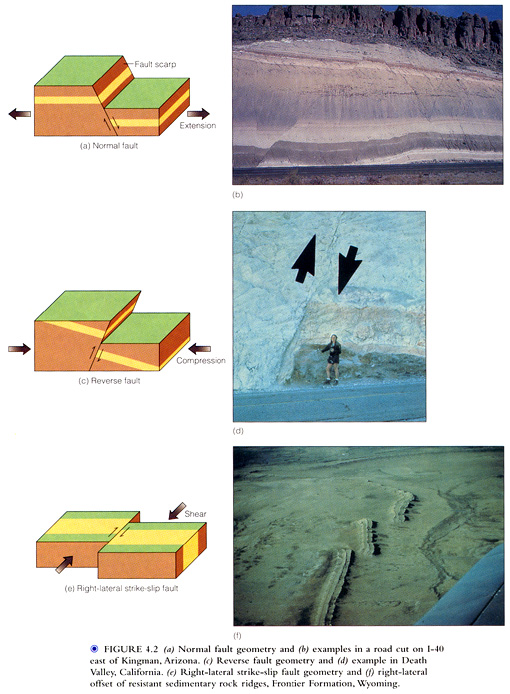
ii) With Displacement: Faults see Fig. 4.2 P.72 for the 3 principal types:
- Normal
- Reverse
- Strike slip – right and left lateral.
Click here to see the
different type of faults.
Relevance to civil and geological engineering:
Simple:
The 3D i) distributions and ii) orientations of these i) weakness planes, and ii)
brittle structures (joints; faults) have enormous effects on bulk rock strengths in any
surface or sub-surface excavations, and in foundation engineering.
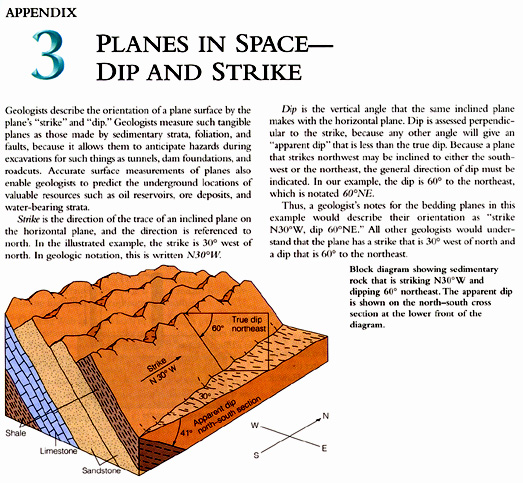
The orientations of planar features in rocks are defined by dip and strike- very
well explained in Appendix 3, P. 489.
Click
here to view appendix 3
- Ductile Structures:
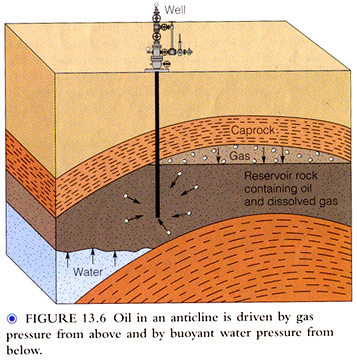
E.g. Particularly FOLDS in sedimentary rocks (and metamorphic):
E.g. Convex up in normal sediments:
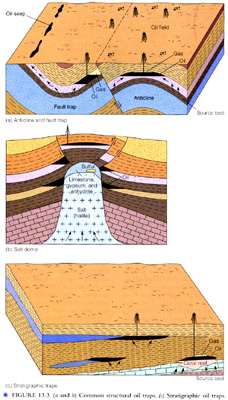
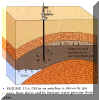
The anticline; one of the most important types of oil trap.
Convex Down in normal sediments:
Intervening synclines; to remember: syncline = "saucer".
See: Fig. 13.3, P. 368
Metamorphic Rocks:
"Younging" direction not known, usually:
Convex up = Anti-form
Convex down = Syn-form
Click here
to view the common structural oil traps.
|