|
Chapter 2C. Getting around in Geology
(Geologic - Key Point) p40-41
"Interest in extremely long periods of time sets geology and
astronomy apart from other sciences"(page 40) -very true
- There are two different types of age dating:
(i) RELATIVE
(ii)ABSOLUTE; in yrs.
(i)RELATIVE AGE DATING:
Utilizes 3 Laws:
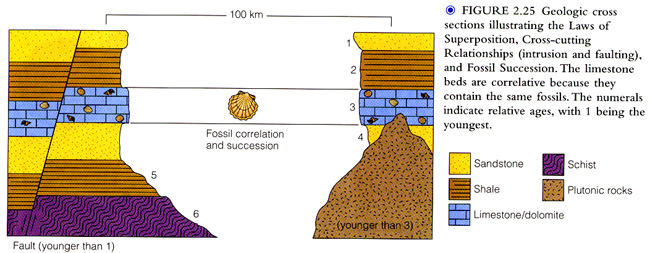
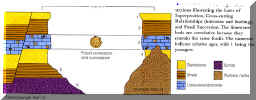
- The law of superposition:
In a sequence of undeformed sedimentary rocks (+- volcanics) the layers at the top are
youngest and at the bottom-oldest.
(N.B. In mountain belts you have to be careful since sequences can be inverted.)
- The law of cross-cutting relationships
Igneous and hydrothermal rocks, or structures, which cross-cut must, logically,
be younger than the rocks which are cross-cut.
- The law of fossil succession
Evolution has generated a particular sequence of organisms which has not repeated,
and which is preserved in sedimentary rocks in the form of fossils.
Hence, detailed relative age dating and sediment correlation can be carried out using
"The observed chronologic sequence of life forms through geologic time."
This works very well, and in extreme detail for the past ~600 Myr Older than ~600
Myr
it does not work because few fossils are preserved.
Possible in some parts of the geological record to correlate within + 1
Myr.
- ABSOLUTE AGE DATING:
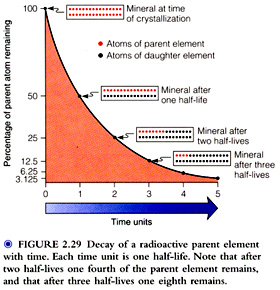
Uses the decay of unstable isotopes of elements which decay at known rates expressed by
the half life:
Opposite of doubling time - and also exponential: time given for 1/2 a number of unstable
isotopes to decay. (see fig. 2.29, p.46)
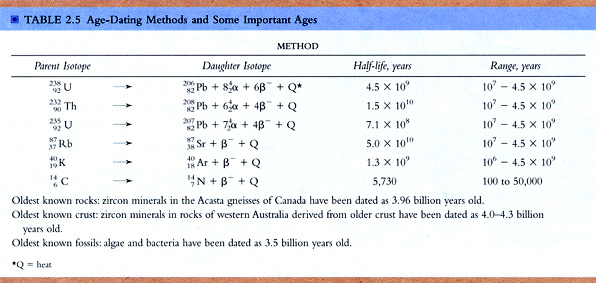
See table 2.5, p. 46 for the most important decay schemes with 1/2 lives ranging from:
4.5x10⁹ yrs for 238U -> 206Pb to 5,730
yrs for 14C -> 14N.
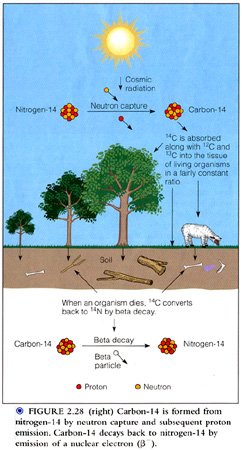
Notes: (i) Alpha decay (4He atoms); Beta decay
(electrons); (ii) 14C is generated by cosmic ray interaction (p.43)
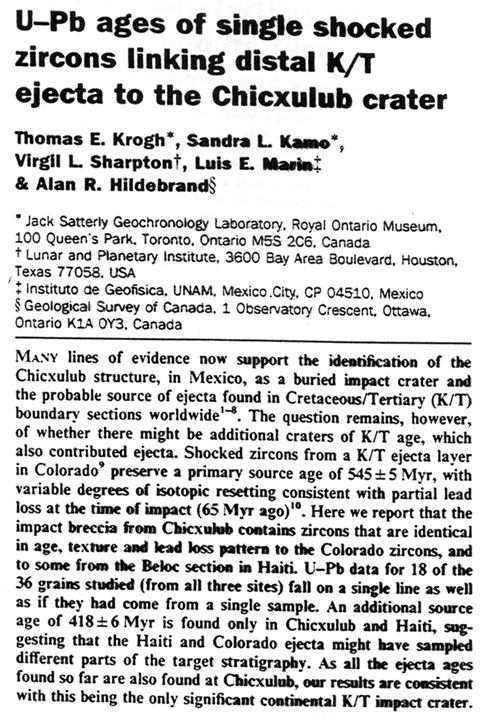
Example: U-Pb dating of the K/T (Cretaceous/ Tertiary) boundary meteorite impact
from shocked zircons:
(i) IMPACT DATE: 65.5 + 3 Myr.
(ii) IMPACTED ROCKS
beneath~ 2 km of sediments (limestone; anhydrite => CO2 ; SO2
on impact): 545 + 5 Myr, and 418 + 6 Myr (less important). And
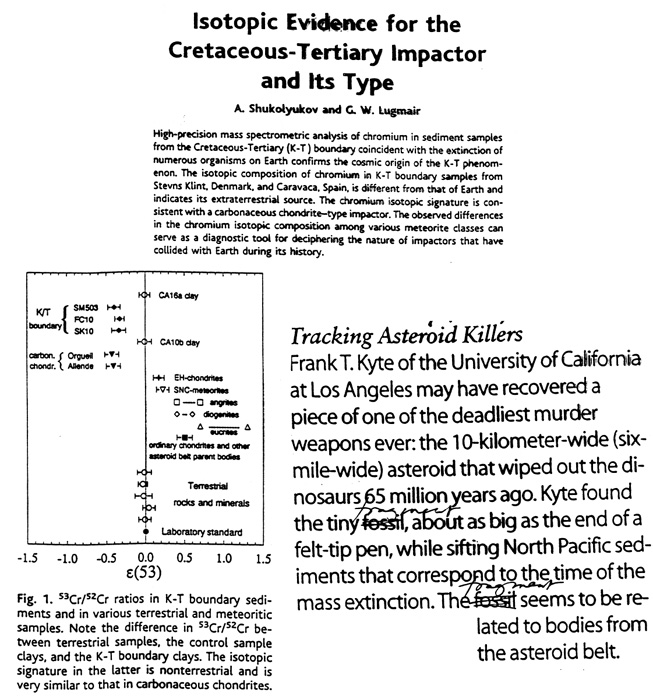
now (i) (Feb. 1999), a small fragment of the ~10 km K/T meteorite may have been
discovered.
But (ii) 23Cr/52Cr ratios indicate a carbonaceous
chandrite impactor.
Click
here to view an article on the crater of K/T age.
Click
here to view an article on the Isotopic evidence for the Cretaceous-Tertiary Impactor
THE AGE OF THE EARTH:
(or rather, the earth-moon system.)
- Formation of first condensates of the solar Nebula:
Now accurately dated to: 4.56-4.57 billion. i.e 4.6 billion.
- Fe-Ni core differentiation:
small asteroids: only ~0.5 - 6.5 Myr after.
Mars: ~10 - 30 Myr after.
Earth/moon: >50 Myr (? ~ 70 Myr after.)
- Age of Earth's oldest mineral frags.:
~4.0 - 4.3 billion yr zircons.
- Age of oldest preserved Earth rocks:
~3.96 billion (Acasta Gneisses; N.W.T.).
- Oldest definite life forms (fossils):
W. Australia: ~3.4-3.5 billion
? Evidence for life back to ~ 3.8 billion.
Click
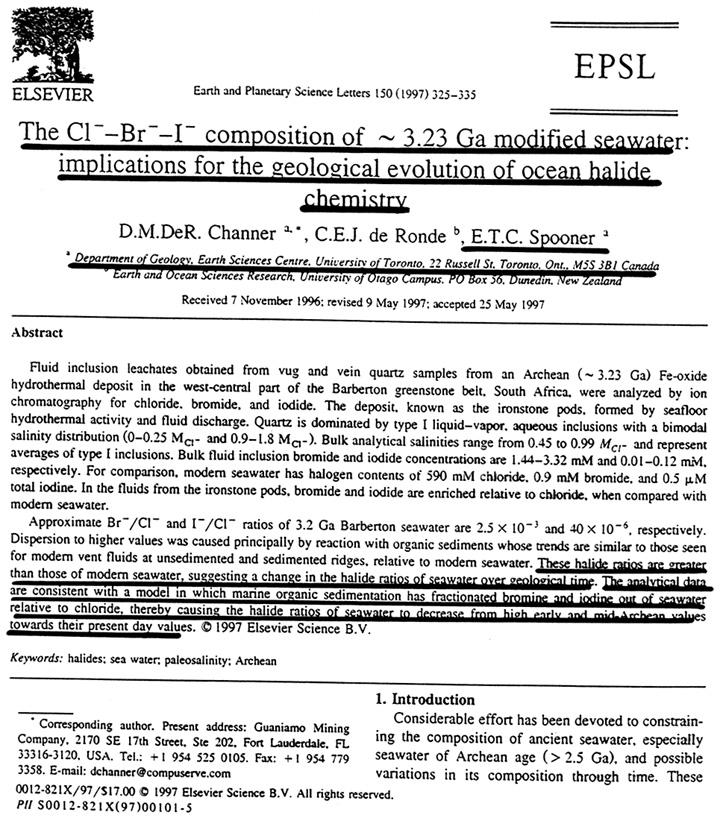
here to view an article on the evolution of ocean halide
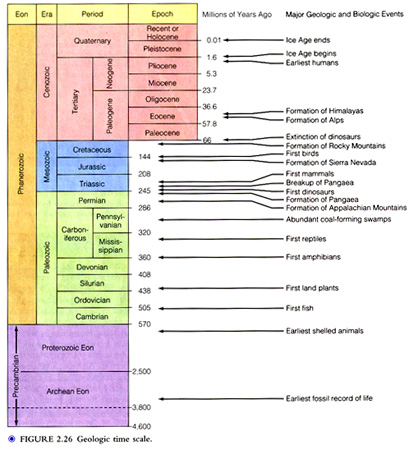
THE GEOLOGIC TIME SCALE: (Fig.2.26, p. 42.)
Based on relative and absolute age dating, a very detailed geologic time scale has been
assembled full of absurd names:
e.g 3 EONS:
(i) The Phanerozoic back to 540 Myr. (base of Cambrian=>only ~ 12% of Earth’s
time.
(ii) The Proterozoic from 540 Myr to 2.5 billion => ~42 %
(iii) The Archean from 2.5 billion back => ~ 46 % (but only ~ 33% (back to ~ 4 billion) is observable.)
N.B. The Proterozoic + Archean = the Precambrian.
Click
here to see the geologic time scale.
3 ERAS IN THE PHANEROZOIC:
Cenozoic
Mesozoic
Palaeozoic
Innumerable periods and epochs.
FINALLY:
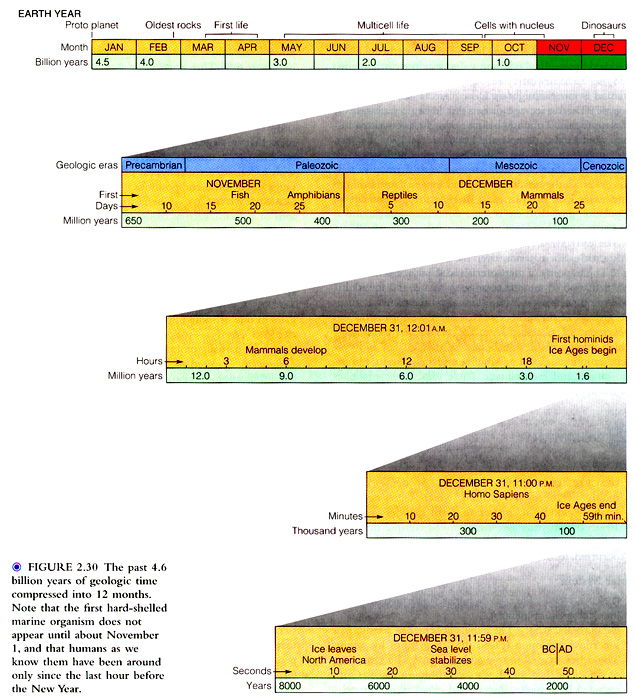
If the earth’s 4.6 billion yrs are represented by 1 calendar year - see fig. 2.30,
p. 47:
- Homo sapiens: appears 30 mins. before midnight on the last night.
- All written recorded history: last 30 seconds.
Hmmm.........salutary to think about.
It has taken ~4.6 billion yrs of steady evolutionary development of increased
complexity of organisms to generate the last "30 seconds."
Amazing!
Click
here to view the geologic time compressed into 12 months.
|