OTHER ANIMALS:
BEES
Bees are one of the few domesticated species of insect. Silk worms, the grub of a moth, being the other well known example. They have been kept in this country for hundreds of years, providing honey as an excellent source of winter sugar, for mead production, and beeswax for candles. Our bees can be seen working behind glass in an exhibition hive which was built, and is maintained by Michael Hunt. The bees have an exit from the hive behind a wooden wall. Today bee kepping in Britain is under threat from the use of insecticides on farm land and in people's gardens, and from a devastating new infection which is steadily moving through the country destroying our hives.
Oue bee garden has been planted, with a selection of native limestone plants which are particularly good for bees. Bees forage for a distance of up to one mile from the hive and they are important for the pollination of the yellow fields of oilseed rape and blue flax or linseed flowers. Locally produced honey is available in the Farm shop.
RABBITS
| Rabbits were first
introduced into this country nearly 2000 years ago, by
the Roman settlers, and soon escaped into the wild.
During the Middle Ages they were kept in open enclosures
called 'warrens' and harvested for their skins and tender
meat, by the 'warreners'. By the turn of the century
'wild' rabbits had become a major agricultural problem.
They eat thiusands of pounds worth of crops each year and
'breed like rabbits' ! There are many different domestic breeds of rabbit, kept for their meat, their skins and as ornamental breeds or pets. At the Cotswold Farm Park we breed; English Lop, Dwarf Lop, Old English, Chinchilla Rex, Harlequin, Flemish Giant, and Dutch although they are not all on display at the same time. |
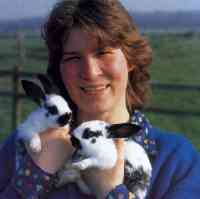
![]() Above: Elizabeth Henson and the Baby Rabbits |
Back to Top of Page
To Sheep / To Pigs / To Goats / To Cattle / To Poultry and Waterfowl / To Other Animals