POULTRY AND
WATERFOWL
(Click on any of the
pictures to see a larger image)
STANDARD FOWL
All domestic poultry are
descended from Asian Red Jungle Fowl. The modern poultry industry
is based on a very few intensively managed hybrid strains while
the barn yard method of production and the barnyard breeds, which
had been developed over many years from stock imported from
around the world, are slowly disappearing.
Red Pile OLD ENGLISH GAME are
of ancient English origin and were developed as a fighting bird.
Julius Caesar noted that the Britons kept fowls 'for pleasure,
but not for the table' and cock fighting was not made illegal in
Britain until 1849. Today they are kept by enthusiasts for show
and Red Pile is just one of some thirty colour varieties found in
the breed.
Silver Grey DORKINGS are also
very ancient and were described by the Romans in AD. 47. They
have a large, long, deep body and five toes on each foot. Most
chicken breeds have only four toes, three pointing forwards and
one at the back.
| The LIGHT SUSSEX are a
very old breed and were the most popular of all the
Sussex varieties, particularly well known for producing
good quality table birds. The Yorkshire or Golden Pheasant Fowl were given
their modern name, OLD ENGLISH PHEASANT FOWL, in 1914.
They were particularly popular with farmers because they
have a meaty breast for a light breed and produce white
eggs.
The RHODE ISLAND RED
was developed in the Rhode Island region of the USA from
Asiatic black-red fowls of Shanghai, Malay and Java in
the 1860's and were first introduced into this country in
1909. They became very popular for both meat and egg
production since they lay attractive light brown eggs.
|
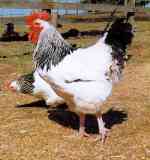 Above: Light Sussex pair
|
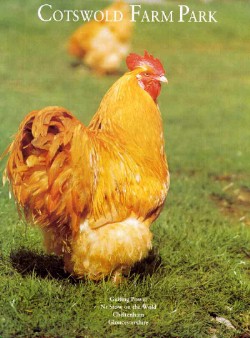
Above: Buff Cochin {NB: larger image is very big)
|
The Dutch village of
Welsum gave its name to the WELSUMMER imported in 1928.
They are famous for their richly coloured dark brown eggs
and unlike many 'fancy fowl' they are still judged on
their egg production, as well as their good looks. Dark BRAHMA were imported into
New York in 1846 from the area around the Brahma-Pootra
river in India and first appeared in Britain in 1853.
They have nicely tinted eggs and are classified as a
heavy breed with a pea comb.
In the 1950's Buff
COCHINS were first imported from China and were first
imported frm China and were known as the Cochin-China.
They were very popular because of their great size and
good laying ability although sadly they have been
selected recently more for their fluffy leg feathers,
which are popular in the show ring, than their utility
characteristics.
The SCOTS DUMPY is related to the Scots Grey, which is
another traditional barnyard breed. The Dumpys have a
standard size body and a very short leg. Birds of this
type have been known in Scotland since 1678, but by 1975
they were almost extinct. Fertile eggs were reimported
from a flock located in Zimbabwe, after the owners saw a
TV programme about the Cotswold Farm Park.
|
| The White SILKIE, which are thought to be of Asiatic
and probably Japanese origin have been known for several
hundred years. They are small standard fowl, and are well
known for their persistent broodiness. They will happily
sit on and hatch the eggs of anything, and make excellent
mothers although they do get most upset when their
offspring take to the water, which happens when they have
hatched a brood of duck or goslings ! |
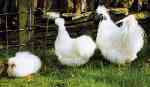 Above:
Silky poultry
|
BANTAMS
Bantams are miniature poultry breeds, sometimes
strains of standard size fowl but many occur only in the bantam
form. OLD ENGLISH GAME Bantams mimic the standard Old English
breed but have very little common ancestry. They were evolved
from common barnyard bantam stock and are selected entirely for
the show ring where the detailed colour patterns are of great
importance to the breeders.
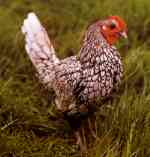
Above: Silver Seabright Bantam
cockerel
|
The Silver SEABRIGHT is one of the
oldest British varieties and is a genuine bantam breed
with no standard size counterpart. Their delicately laced
wings, rose comb and clean shape make them one of the
most attractive of our breeds. SILVER SPANGLED
HAMBURGS originated in Northern Europe but the spangled
variety was developed in Yorkshire and Lancashire 300
years ago. They were excellent egg producers but like
many bantam breeds were sadly selected for the show ring,
losing much of their laying ability along the way.
Originating in Japan the Black Tailed White JAPANESE
are another true bantam breed of great antiquity. They
are the shortest legged of all the bantams and the Black
Tailed Whites are most striking with thrie snow white
bodies, black tails and necks and yellow legs.
White-Crested Black POLANDs were first shown in London in
1845 but are believed to have originated from Poland and
are probably descended from the ancient Paduan or
Patavinian Fowl.
|
The Bearded Belgian or BARBU D'UCCLE originated as its name
suggests, in Belgium and they are a true bantam breed with no
counterpart among the Standard Fowl. It is said that their
feathered legs stop them from scratching the ground, making them
ideal ornamental garden fowl. They are certainly very attractive
birds.
GUINEA FOWL
Guinea Fowl were originally brought to Europe
on sailing ships from the Guinea Coast of Africa, but when they
arrived in Britain, from Turkey, they were called 'Turkeys'.
When the Pilgrim Fathers first colonised
America, they named the large birds they found 'Turkey', after
the Guinea Fowl which they resembled, and this is how the
American Turkey got its name.
TURKEYS
| Turkeys originated in North America
but were brought to Britain via Spain in 1524. They were
domesticated and improved and then later re-exported to
the United States. NORFOLK BLACK
TURKEYS were the first of the domesticated breeds of
Turkey.
PIED TURKEYS also known in Germany as
the 'Crolwitzer', or in america as the 'Royal Palm', are
one of the colour varieties of old fashioned farmyard
turkeys.
Unlike modern 'broad breasted' turkeys,
which have been selected for such extreme meat production
that they are no longer able to reproduce naturally but
must be assisted with the use of artificial insemination,
both these old breeds are active thrifty outdoor birds.
|
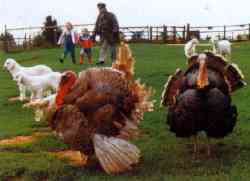
Above: Turkey stags meeting the
goats (NB: No larger image available. Sorry!)
|
GEESE
All British Domestic Geese are thought to be
descended originally from wild Greylag geese but the BRECON BUFF
was the first buff-coloured breed, created in Wales in 1934, from
geese on the local Breconshire farms in Wales.
DUCKS
It is thought CAYUGA DUCKS were originally descended from
Black east Indian ducks. They are beautiful birds with a green
flourescence shining off their jet balck feathers. They take
their name from Lake Cayuga, in New York State in the USA from
where they were introduced to Britain in 1851.
Fawn and White INDIAN RUNNER DUCKS were first introduced fron
Malaya in the 1870's, they were renowned for prolific egg laying.
They have a very upright posture and are now available in many
different colours although the fawn and white was the original
colour variety.
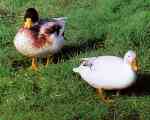
Above: Silver Appleyard Bantam Ducks
|
SILVER APPLEYARD BANTAM DUCKS are an ornamental breed
found in both Standard and bantam varieties. They were
created by Reginald Appleyard in the late 1930's in
Ixworth in Suffolk where he also created the Ixworth
breed of hens. Our director Joe Henson was taken to visit
his farm and meet him, while he was still at school,
adding to his lifelong fascination for livestock
breeding. CRESTED DUCKS have always been a rare breed
and are somewhat of a curiosity. Any colour is permitted
and they have a large, globular crest of feathers set on
the very top of their heads.
|
Back to Top of Page
To
Sheep / To Pigs
/ To
Goats / To Cattle / To Equines/ To Other Animals
Back
to Cotswold Farm Park