CATTLE
:(Click
on any of the pictures to see a larger image)
A sample of each of our cattle breeds is
normally on display at the Farm Park on any one day. All the
cattle leave the farm park site each night to go onto large
grazing fields and are waiting to come back into work each
morning !
We put the bulls out with the cows on
1st June, so that our calves will be born nine months later in
March. The cows are housed for the winter, but can be turned out
onto the spring grass soon after calving. The new calves, with
their mothers are all on display by the beginning of May.
Many Rare Breeds of Cattle are kept by
enthusiasts in very small herds where it is not possible for them
to keep a bull. The Rare Breeds Survival Trust ensures that
artificial insemination is available for all the rare breeds to
enable these smaller herds to produce pure bred calves. The
Cotswold Farm Park has supplied five Gloucesters, three White
Parks , three Longhorns and a Kerry bull for this purpose.
LONGHORN
CATTLE :
1975 - ENDANGERED (less than 250 cows)
1995 - MINOR BREED (2500 breeding cows)
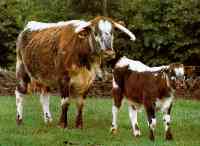 Longhorn
cow 'Acorn' with her calf
|
The wild ancestors of our
domestic cattle, the Aurochs, is now extinct, but
detailed contemporary paintings of them can be seen
decorating the walls of Stone Age caves. Our Longhorn
cattle of today bear a striking resemblance to them with
their wide horns and attractive line back markings and
brindle colour. They were
once a very popular multi-purpose breed being used as
powerful draught oxen, as dairy cows for milking and to
produce beef cattle which could walk many miles to
market.
In the 1790's the farming
pioneer, Robert Bakewell used Longhorns in his first
experiments in scientific animal breeding and
improvement. His work, involving the purposeful changing
of a breeds characteristics by selective breeding was
greatly admired by Charles Darwin, who used it to help
develop his ideas about evolution.
|
Sadly the breeds' long horns made them
difficult to manage in the 1950's and 60's when farmers housed
cattle and fed cereals. Their numbers declined until by 1970 they
were close to extinction. A recent revival in the production of
quality beef, grown out of doors on grass, has enabled the
Longhorn to make a dramatic come back, assisted by an active
Breed Society which has been run from the Cotswold Farm Park
Office since 1984. The Bemborough herd was established in 1969
and has produced a number of bulls of national renown.
OXEN
| Oxen are castrated male cattle
trained to pull. They may be of any breed, although many
of our old traditional breeds were selected for the
purpose. For thousands of years oxen were the main source
of power on farms throughout the world and are still
vital in many developing countries. We have trained oxen at the Cotswold Farm
Park for nearly twenty years and have used Welsh Blacks,
Longhorns, Gloucesters, White Parks and even Highlands.
We currently have a pair of Longhorn oxen, "Philip
and Edward" weighing just under 1 tonne each and a
young pair who are not yet fully grown.
The 'boys' are used regularly
for set dressings in period films which have included;
Precious Bane, Robin Hood, Merlin, Monty Python and the
Time Bandits, Princess Caraboo, and Mel Gibson's Brave
Heart. They have even pulled a wedding coach.
|
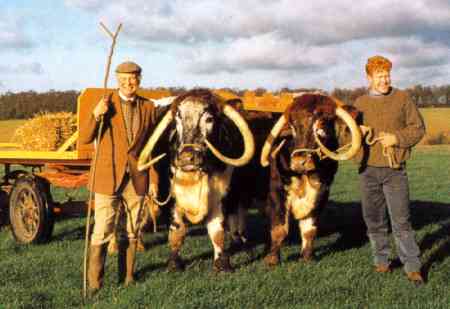
Joe and Adan
Henson with a pair of Longhorn oxen, 'Philip' and
'Edward' (NB: No larger image available. Sorry!)
|
HIGHLAND
CATTLE
Locally adapted - not classified
as rare by the Rare Breeds Survival Trust
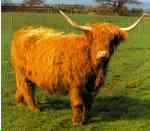 Highland
Heifer, 'Una'
|
Another ancient breed the
Highland is one of the hardiest breeds of cattle in the
world, able to survive the cold and wet winters of the
Scottish Highlands and Islands where they are not rare.
They have a thick woolly under-coat which helps to keep
them warm and a long hairy over-coat that runs off the
snow and rain. The Highland represents an extreme of the
great range of genetic variation found within domestic
cattle breeds and it is for this reason that we have kept
a herd at the Cotwswold Farm Park since 1970. Highlands were traditionally found in a
range of colours from blonde to balck but the red colour
became popular and then predominant during this century.
In 1993 we purchased a rare black bull, 'Albert' and are
hoping to have some black calves born in the herd, in the
future.
|
WHITE
PARK CATTLE
1973 - CRITICALLY RARE (less than 150 cows)
1995 - ENDANGERED (less than 450 cows)
| Sacrificed by the Druids and
used in religious ceremonies by the Romans, they were
enclosed into the Norman deer parks in the 11th century
by William the Conqueror's barons. They were hunted for
sport by the Plantagenet kings, and have been handed down
to us through the centuries as ornamental park cattle in
five ancestral herds. The
Chillingham herd of Northumberland and Vaynol herd of
North Wales have been isolated for so long that they are
now considered to be separate breeds, while the Chartley,
Cadzow and Dynevor herds have been combined to form the
White Park breed.
The Cotswold Farm Park's
'Bemborough' herd was established in 1969 when half the
'Gene Bank' of endangered breeds, established at
Whipsnade Zoo by Lord Zuckermann in the 1960's was moved
here. It is descended from the Earl Ferrers' Chartley
stock and animals born here have taken the Championship
at the Rare Breeds National Show every year from 1988 to
1992.
|
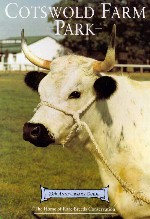
Bemborough
'Nanette' Interbreed Champion 1992 (NB: larger image is
very big)
|
GLOUCESTER
CATTLE
1975 - CRITICALLY RARE (12 bulls and 60 females
including calves)
1995 - ENDANGERED (39 bulls and 500 females)
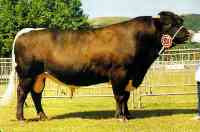
Gloucester
Bull, 'Boy', Interbreed Champion at the Three Counties
Show 1994
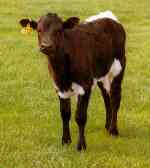
Gloucester
calf
|
The Old Gloucester was a triple
purpose breed used for milk production, draught work and
meat. They are a beautiful dark mahogany colour with a
striking white line down the back and along the belly.
The cows produce milk which was ideal for cheese-making,
an important characteristic when fresh milk could not
reach London market from Gloucestershire, and by the
thirteenth century traditional Double Gloucester cheese
had become famous. Sadly
they could not compete with the specialist dairy breeds
for gross milk production, and they were gradually
replaced by Longhorns, Shorthorns and finally the black
and white Holstien Friesians. By 1975 only one herd
remained belonging to the Dowdeswell sisters at Wick
Court near Gloucester.
The Bemborough herd was
established in 1969 direct from Wick Court and has
produced a number of key bulls for use in the artificial
insemination programme, and many champions. Nationally,
numbers are increasing with the support of an active
breed society which has been run from the Cotswold Farm
Park Office since 1981.
|
BRITISH
WHITE CATTLE
1973 - ENDANGERED (less than 250 cows)
1994 - AT RISK (less than 750 cows)
| Another dual-purpose breed
which could not compete in a more specialised
agricultural market was the British White. It is a
naturally 'polled' or hornless breed which makes them
easily distinguishable from the similarly coloured White
Park. The breed was
developed in the Eastern Counties of England from cattle
brought into this country by Viking settlers, and they
were originally used as drauht oxen and to produce milk,
meat and laether. Today they are being developed
principally for beef production which means that the old
dairy strains are disapppearing. Our herd was established
in 1972 and our cows are of the old dairy type which
produce more than enough milk for one calf. After each
cow has calved we often buy an extra calf from a
neighbouring dairy farm, which we foster onto the cow,
who has plenty of milk to rear twins.
|
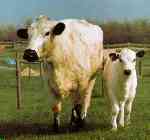
British White cow 'January'
with her calf
|
DEXTER
CATTLE
1975 - ENDANGERED (less than 250 cows)
1993 - MINOR BREED (1500 breeding cows)
This diminutive breed was develpoed in
Ireland during the last century by Mr. Dexter. He selected
miniature and dwarf examples of the Irish Kerry breed to produce
the ideal small-holdes cow. Two Dexters will eat no more than one
standard size cow, but by staggering their calving dates, it is
possible to produce a constant supply of milk for the house, and
provide two calves a year.
Twenty years ago they were a rare breed,
but they have benefited from an upsurge in interest in
small-scale and self sufficient farming 'the good life' for which
they are undoubtedly the ideal breed and they are no longer
classified as a rare breed.
BEEF
SHORTHORN CATTLE
1973 - COMMON (more
than 3000)
1994 - VULNERABLE (less than 750 cows)
Until the 1950's the Shorthorn
was the most numerous British cattle breed, and the most widely
distributed worldwide. In 1822 it became the first breed to have
a published 'Herd Book', a detailed record of the pedigrees and
births of all the animals in the breed. This was and still is
known as the 'Coates Herd Book' and the ancestry of all living
Shorthorn cattle can be traced back to that first edition.
They are naturally horned
cattle, although they are often disbudded painlessly at birth,
preventing the horns from growing. They may be red, white, red
and white or a mixture of the two colours making an attractive
roan colour. The breed was originally dual purpose but was soon
developed into different strains used to perform different tasks.
The Dairy Shorthorn was developed for its milking characteristics
and is still quite numerous, although holds a relatively tiny
proportion of the dairy market as compared to the predominant
black and white Holstein Friesian. The Beef Shorthorn was
developed as a quality beef breed for crossing. Beef Shorthorn
bulls were used on hardy hill cows, often with rather poor beef
conformation, to produce quality beef calves. They became very
popular and were exported all over the world where the quality of
British breeding stock is still held in very high regard.
Sadly the fashions in beef
production have changed and this magnificent breed has found
itself rather unexpectedly on the lists of the Rare Breeds
Survival Trust.
BELTED
GALLOWAY
1973 - Not Classified
as Rare
1993 - MINOR BREED (less than 1500 cows)
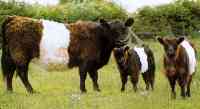
Belted Galloway cow
'Petronella' with her twins, 'Sash and Splash'
|
A 'polled' or hornless
breed, the Belted Galloway originated from the South West
of Scotland and is very well adapted to it's own
particular environment, and to extensive beef production
out of doors. They are very hardy and grow a thick winter
coat which is made even more attractive by their white
belt or belly band. The back-ground colour is normally
black, although dun and red animals do occur. We have
kept Belted Galloways since 1970 and have had one dun
heifer. We have also been lucky enough to have several
sets of twins in the past few years. |
Back
to Top of Page
To
Sheep / To Pigs / To Goats / To Equines / To Poultry
and Waterfowl / To Other
Animals
Back
to Cotswold Farm Park